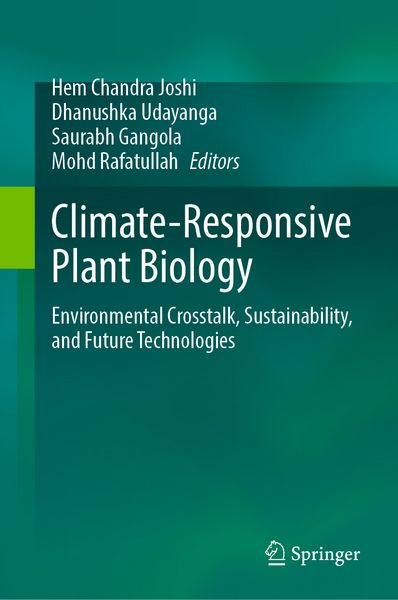
Produktbild: Climate-Responsive Plant Biology
- 11%

Climate-Responsive Plant Biology Environmental Crosstalk, Sustainability, and Future Technologies

11% sparen

189,99 € UVP 213,99 €

inkl. gesetzl. MwSt., Versandkostenfrei


Beschreibung

Produktdetails

Einband

Gebundene Ausgabe

Erscheinungsdatum

10.04.2026

Abbildungen

XXI, 305 p. 29 illus., 26 illus. in color.

Herausgeber

Hem Chandra Joshi + weitere

Verlag

Springer Singapore

Seitenzahl

305

Maße (L/B/H)

24,1/16/2,4 cm

Gewicht

656 g

Auflage

1. Auflage

Sprache

Englisch

ISBN

978-981-9573-53-0

Beschreibung

Portrait


Dr. Hem Chandra Joshi
, Assistant Professor of Botany at D.S.B. Campus, Kumaun University, Nainital, specializes in plant physiology and nutrient-environment interactions. He earned his Ph.D. in Plant Physiology from G.B. Pant University of Agriculture and Technology, Pantnagar, and completed his M.Sc. in Botany as a University Gold Medallist. With more than nine years of research and teaching experience, his work integrates mineral nutrition, environmental biotechnology, bio-nanotechnology, and biosensor applications to support sustainable agriculture and precise plant health monitoring. Dr. Joshi has published over 35 peer-reviewed research papers, presented at national and international scientific forums, and supervised postgraduate dissertations. He actively engages in academic development through workshops, FDPs, scientific webinars, and membership in professional scientific societies. In recognition of his research contributions, he received the Young Scientist Award from the State Science and Technology Department. He also serves as a reviewer for several reputed international journals, including review contributions for 3 Biotech (4 manuscripts), Agricultural Water Management (2), Environmental Research Communications (15), Materials Research Express (2), Nano Express (1), and Plant Nano Biology (8). His scientific and academic leadership aims to promote interdisciplinary research and technological innovation for environmentally resilient and resource-efficient agricultural systems.


Prof. Dhanushka Udayanga
is affiliated with the Department of Applied Sciences, Faculty of Humanities and Sciences, Sri Lanka Institute of Information Technology (SLIIT), where he teaches and conducts research in biotechnology and mycology. He has extensive research experience, with a focus on molecular systematics of fungi and their applications in agriculture and environmental sciences. He obtained his Ph.D. from Mae Fah Luang University, Thailand, and has served as a visiting scientist at the United States Department of Agriculture, Agricultural Research Services (USDA-ARS) in Beltsville, Maryland, USA. Prof. Udayanga has authored over 50 research articles in reputed international journals and is actively involved in peer review and editorial duties for several academic journals.


Dr. Saurabh Gangola
is an Assistant Professor in the Department of Microbiology at Graphic Era University, Dehradun, India. He brings more than six years of teaching and research experience, particularly in environmental microbiology. He holds a doctorate in Microbiology and his core research interests include the biodegradation and bioremediation of xenobiotic compounds such as pesticides, dyes, heavy metals, and polyaromatic hydrocarbons. Dr. Gangola has been recognized with the Governor Research Award in 2019 by the state of Uttarakhand. He has published 60 research and review papers, contributed 37 book chapters, edited 3 academic books, and holds 5 patents in related fields.


Dr. Mohd Rafatullah
is currently an academic staff member in Environmental Technology at the School of Industrial Technology, Universiti Sains Malaysia (USM), Malaysia. He began his journey at USM as a Postdoctoral Fellow in 2008. He earned his Ph.D. in Environmental Chemistry from Aligarh Muslim University (AMU), India, in 2007. His areas of specialization include environmental pollutants, nanomaterials for environmental applications, water and wastewater treatment, adsorption and ion exchange mechanisms, and instrumental analytical techniques. Dr. Rafatullah has published numerous research and review articles in international journals and has presented his findings at both national and international conferences. He actively participates in professional development through various workshops and seminars worldwide.

Produktdetails

Einband

Gebundene Ausgabe

Erscheinungsdatum

10.04.2026

Abbildungen

XXI, 305 p. 29 illus., 26 illus. in color.

Herausgeber

Verlag

Springer Singapore

Seitenzahl

305

Maße (L/B/H)

24,1/16/2,4 cm

Gewicht

656 g

Auflage

1. Auflage

Sprache

Englisch

ISBN

978-981-9573-53-0

Herstelleradresse

Springer-Verlag KG
Sachsenplatz 4-6
1201 Wien
AT

Email: ProductSafety@springernature.com

Noch keine Bewertungen vorhanden

Verfassen Sie die erste Bewertung zu diesem Artikel

Helfen Sie anderen Kundinnen und Kunden durch Ihre Meinung.

Kundinnen und Kunden meinen

Bewertungen (0)

Weitere Artikel findest du in

  • Produktbild: Climate-Responsive Plant Biology

  • 1. Current trends in Plant-environment interactions: Bridging abiotic and biotic frontiers.- 2. Climate Change and Plant Physiology.- 3. Adaptation Strategies in Plants.- 4. Plant Growth and Development in the Changing Environment.- 5. Phytoremediation mechanisms of submerged macrophytes (Vallisneria spiralis and Ceratophyllum demersum) in remediating inorganic pollutant-contaminated surface water environments and their further enhancements.- 6. Conservation Strategies for Plant Diversity.- 7. Agriculture, Sustainability, and Climate Change: Interconnected Futures.- 8. Technological advances in studying plant environment interactions.- 9. Comparative evaluation on current progress of global crop production service in the 21st century and its future prospects.- 10. Role of Epigenetics in Plant Adaptation to Environmental Stress.- 11. Plant Microbe Interaction In the context of climate change.- 12. CRISPR and Gene Editing for Climate-Resilient Crops.- 13. Socioeconomic Impacts of Climate Change on Agriculture and Plant Systems.- 14. Green Nanotechnology for Enhancing Plant Resilience.