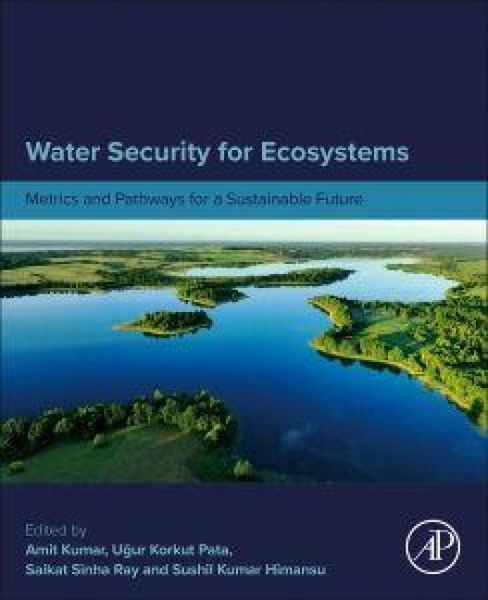
Produktbild: Water Security for Ecosystems

Water Security for Ecosystems Metrics and Pathways for a Sustainable Future

184,99 €

inkl. gesetzl. MwSt., Versandkostenfrei


Beschreibung

Produktdetails

Einband

Taschenbuch

Erscheinungsdatum

22.06.2026

Herausgeber

Amit Kumar + weitere

Verlag

Elsevier

Seitenzahl

522

Maße (L/B/H)

23,6/19,3/2,5 cm

Gewicht

1066 g

Sprache

Englisch

ISBN

978-0-443-45116-4

Beschreibung

Portrait

Dr. Amit Kumar is a Professor of Hydrology and Water Resources at Nanjing University of Information Science and Technology. He obtained his M.Tech and PhD from the Indian Institute of Technology (IIT) Roorkee and conducted his postdoctoral research at Hohai University, China. Dr. Kumar’s research spans the ecological health of aquatic habitats, water quality modeling, and water security practices to meet the Sustainable Development Goals. He has published five books, including Elsevier’s Climate Change in the Himalayas, and is an advisory board member for the Elsevier journal Ecological Indicators.

Dr. Uğur Korkut Pata is an Associate Professor of Economics at Hatay Mustafa Kemal University. He obtained his PhD from Karadeniz Technical University, Turkey, and his research focuses on the economics of sustainable development, carbon neutrality, and ecological footprint mitigation. Recent work investigated the determinants of load capacity to propose a fishing load capacity curve hypothesis for broad utility in environmental economics literature. He is an Associate Editor of the Elsevier journal Gondwana Research.

Dr Saikat Sinha Ray is an accomplished environmental engineer and academic, currently serving as an Assistant Professor (Sr.) in the Department of Environmental Science and Engineering at SRM University, Andhra Pradesh, India. His expertise encompasses membrane technology, seawater desalination, and the development of self-cleaning and functional surfaces for advanced environmental applications. Dr. Ray earned his Ph.D. in Environmental Engineering from the National Taipei University of Technology, Taiwan. He further strengthened his academic and research profile through postdoctoral research and a subsequent appointment as a Research Assistant Professor at the Ulsan National Institute of Science and Technology (UNIST), South Korea, where he contributed significantly to advancements in membrane fabrication, nanocomposite materials, and next-generation water treatment technologies. His research has been published in leading international journals such as Desalination, Journal of Membrane Science, and Chemical Engineering Journal. His work on integrating artificial intelligence with water treatment systems and designing superhydrophobic membranes for enhanced desalination and separation processes has gained considerable recognition in the global scientific community. In addition to his research articles, Dr. Ray has made notable contributions to academic publishing through books and edited volumes, including conference proceedings. He has already published several books, including Sustainable Water Solutions: Proceedings of the Water Elixir Meet 2025, Water Security for Ecosystems: Metrics and Pathways for a Sustainable Future (July 1, 2026), and Sustainable Water Management (August 1, 2026), reflecting his commitment to disseminating knowledge and fostering interdisciplinary dialogue in water research. Beyond his scholarly output, Dr. Ray actively engages in editorial responsibilities, international collaborations, and academic event organization, further demonstrating his dedication to advancing innovative and sustainable solutions in environmental engineering and water resource management.

Dr. Sushil Kumar Himanshu is an Associate Professor and Deputy Dean at the Faculty of Food, Agriculture, and Natural Resources, Asian Institute of Technology (AIT), Thailand. He obtained his M.Tech in Hydrology and PhD in Water Resources Development and Management from the Indian Institute of Technology (IIT) Roorkee and conducted postdoctoral research at Texas A&M University. Dr. Himanshu’s research focuses on the applications of generative AI, remote sensing, and modeling applications for climate-smart water management. His research has been funded by ADB, World Bank, UN-FAO, USDA, and other agencies to support agricultural and aquacultural sustainability, food security, and water security. He is a co-editor of the Elsevier book Advances in Remediation Techniques for Polluted Soils and Groundwater.

Produktdetails

Einband

Taschenbuch

Erscheinungsdatum

22.06.2026

Herausgeber

Verlag

Elsevier

Seitenzahl

522

Maße (L/B/H)

23,6/19,3/2,5 cm

Gewicht

1066 g

Sprache

Englisch

ISBN

978-0-443-45116-4

Herstelleradresse

Libri GmbH
Europaallee 1
36244 Bad Hersfeld
DE

Email: gpsr@libri.de

Noch keine Bewertungen vorhanden

Verfassen Sie die erste Bewertung zu diesem Artikel

Helfen Sie anderen Kundinnen und Kunden durch Ihre Meinung.

Kundinnen und Kunden meinen

Bewertungen (0)

Weitere Artikel findest du in

Die Leseprobe wird geladen.
  • Produktbild: Water Security for Ecosystems
  • 1. Understanding water security: Concept and challenges
    2. Ecological footprints and sustainable fishing load capacity: Balancing aquatic ecosystem health and resource management
    3. Water scarcity in a changing climate: A global perspective
    4. The nexus of water, energy, and food security: A practical application
    5. Measuring water footprints: Methods and applications
    6. Human activities and their impact on fishing load capacity
    7. Urbanization, industrialization, and water security: Theoretical perspectives and empirical evidence
    8. Agriculture and virtual water trade: Hidden impacts
    9. Innovative water conservation techniques: Advancing sustainable solutions for water security and management
    10. Integrated water resource management: Policy, practices, and progress towards the SDGs
    11. Desalination for agriculture and industrial applications
    12. Transboundary governance for ecosystems: Addressing water security challenges across shared watersheds
    13. Climate change and water security: Risks and adaptation strategies
    14. Community-based water management for resilience
    15. Technology for hydro-ecology and big data for smart water management
    16. Microbial remediation of heavy metal pollution in aquatic ecosystems: A key to water security
    17. Global water policies and the role of international cooperation
    18. A roadmap for future water security and sustainable ecological footprints