KI-Beratung Beta

Produktbild: Children in Migration and International Family Law

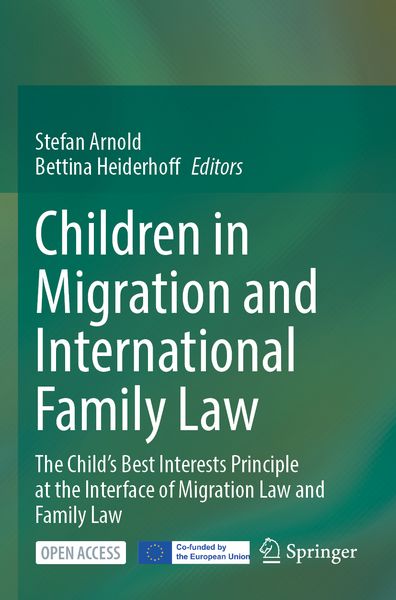
Children in Migration and International Family Law The Child’s Best Interests Principle at the Interface of Migration Law and Family Law

39,99 €

inkl. gesetzl. MwSt., Versandkostenfrei


Beschreibung

This open access book offers readers a better understanding of the legal situation of children and families migrating to the EU. Shedding light on the legal, practical, and political difficulties at the intersection of international family law and migration law, it demonstrates that enhanced coordination...

Beschreibung

This open access book offers readers a better understanding of the legal situation of children and families migrating to the EU. Shedding light on the legal, practical, and political difficulties at the intersection of international family law and migration law, it demonstrates that enhanced coordination between these policy areas is crucial to improving the legal situation of families on the move. It not only raises awareness of these “interface” issues and the need for stakeholders in migration law and international family law to collaborate closely, but also identifies deficits in the statutory framework and suggests possible remedies in the form of interpretation and regulatory measures.
The book is part of the EU co-financed FAMIMOVE project and includes contributions from international experts, who cover topics such as guardianship, early marriage, age assessment, and kafala from a truly European perspective. The authors’ approach involves a rigorous analysis of the relevant statutory framework, case law, and academic literature, with particular attention given to the best interest of the child in all its facets. The book examines how this principle can be more effectively applied and suggests ways to foster a more fruitful understanding of its regulatory potential.
Given its scope and focus, the book will be of interest to researchers, scholars, and practitioners of Private International Law, Family Law, and Migration Law. It makes a valuable contribution to these fields, particularly at their often-overlooked intersections.

Rezension


"The chapters in this book are particularly useful to Anglophone practitioners, policymakers, and academics, as valuable insights from non-common law, non-English language jurisdictions are still largely overlooked in policy making, teaching, and research. Moreover, this book makes valuable contributions to private international law and the interactions between foreign and domestic laws. Given the central importance of the stable continuance of family life for adults and children who migrate, this volume provides a person-centred reflection on an important area of law." (Jonathan Collinson, International Journal of Refugee Law, January 20, 2026)


“The principle of the best interests of the child and its more effective implementation is a focal point in all chapters. … This book has many different strengths that stand out. … the book is a valuable resource for practising professionals (lawyers, social workers, etc.), academics, policy makers and other stakeholders.” (Bekir Güzel, European Journal of Migration and Law, Vol. 27 (2-3), 2025)

Portrait


Bettina Heiderhoff
is Director of the Institute for German and International Family Law and Professor for Private International Law, International Civil Procedure and German Private Law at the University of Münster. From 2006 to 2013, she held a Chair for Private Law at Hamburg University. Her research interests include international family law and the interface of migration law and family law. She is also specialised in EU private law and consumer protection.  


Stefan Arnold
is Director of the Institute of International Business Law and holds the Chair for Private Law, Philosophy of Law, and Private International Law at the University of Münster. From 2014 to 2017, he held the Chair for Private Law, Comparative Law and Private International Law at the Karl Franzens University of Graz. He habilitated in 2013 at the Ludwig-Maximilians-University of Munich and was a member of the Young Academy of the Bavarian Academy of Sciences and Humanities from 2011-2014. His research interests include international family law and philosophy of law.

Produktdetails

Einband

Taschenbuch

Erscheinungsdatum

01.12.2025

Abbildungen

X, 323 p.

Herausgeber Stefan Arnold + weitere

Produktdetails

Einband

Taschenbuch

Erscheinungsdatum

01.12.2025

Abbildungen

X, 323 p.

Herausgeber
Verlag Springer
Seitenzahl

323

Maße (L/B/H)

23,5/15,5/1,9 cm

Gewicht

511 g

Sprache

Englisch

ISBN

978-3-031-71600-3

Herstelleradresse

Springer-Verlag KG
Sachsenplatz 4-6
1201 Wien
AT

Email: ProductSafety@springernature.com

Noch keine Bewertungen vorhanden

Verfassen Sie die erste Bewertung zu diesem Artikel

Helfen Sie anderen Kundinnen und Kunden durch Ihre Meinung.

Kundinnen und Kunden meinen

Bewertungen (0)

  • Produktbild: Children in Migration and International Family Law

  • Children in Migration and International Family law – an introduction Children in Migration and International Family law – an introduction.- An Introduction to FAMIMOVE, its accomplishments and its challenges.- The child’s best interests in international jurisdiction under the Brussels IIter Regulation.- The Child’s Best Interests Principle in EU Law on Third-Country Nationals.- Binding effect of an age assessment.- Guardianship of children in the context of migration in Hungary.- Guardianship and other protective measures for minor refugees in Germany.- A European Approach to Cross-Border Guardianship.- Early Marriages in Sweden.- Early Marriage in Germany – Law and Politics of Cultural Demarcation.- Early Marriages in Austria – private international law and ordre public assessment.- Early Marriage – a European Perspective.- Beyond kafāla: How parentless children are placed in new homes in Muslim jurisdictions.- Kafāla in France.- Kafāla in the Netherlands.- Kafāla in Belgium: private international law as an essential tool to establish migration law consequences?.- Principles to ensure a cross-border kafāla placement is in the best interests of the child.- Recognition of kafāla in European member states – need for a uniform approach?.- The Role of the Court of Justice in Shaping the Right to Maintain Family Unity for Beneficiaries of International Protection.- Polygamous marriages and reunification of families on the move under EU law: an overview.