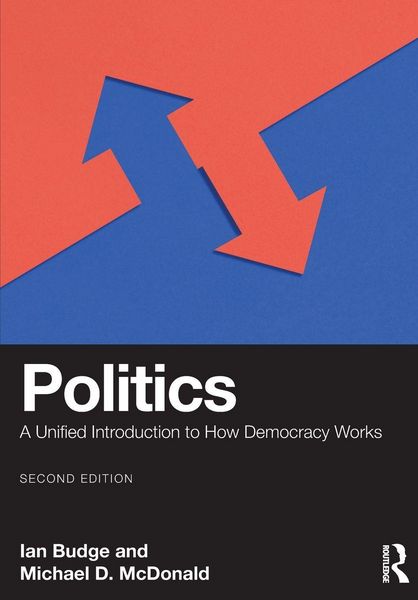
Politics A Unified Introduction to How Democracy Works
-
- Hardcover
- Taschenbuch ausgewählt
- eBook
-
Sprache:Englisch
55,99 €
inkl. gesetzl. MwSt.,
Beschreibung
Produktdetails
Einband
Taschenbuch
Erscheinungsdatum
22.06.2026
Abbildungen
schwarz-weiss Illustrationen, Zeichnungen, schwarz-weiss, Tabellen, schwarz-weiss
Verlag
Taylor and FrancisSeitenzahl
480
Maße (L/B/H)
24,2/17/3 cm
Gewicht
876 g
Auflage
2. Auflage
Sprache
Englisch
ISBN
978-1-03-277518-0
The second edition of this comprehensive introduction to politics remains an essential framework for assessing the health and workings of present-day democracy. The book explores how democratic processes bring public policy into line with popular, basically centrist, preferences. In helping explain its workings, it equips us to better defend democracy.
Applying newly integrated theories of democratic processes to contemporary developments such as the use of right-wing populism across the world, it is the first textbook to help readers develop and apply predictive explanations for themselves. In doing so, it provides straightforward practical tools for evaluating how current events impact on democratic procedures and processes.
Key features:
- Provides answers to key questions such as how much contemporary democracies have lost direction under the impact of populist parties, big business and international threats
- Validated against statistical evidence and examples from across the world, it details more exactly when and how democracy goes wrong and how to put it right
- Shows how to develop predictive explanations as a basis for action, thus strengthening democracy by understanding it better
- Outlines-in easy-to-understand terms-the basic statistical approaches that drive empirically informed analysis
- In-text features include chapter summaries, reviews, key points, illustrative briefings, key concepts and project and essay suggestions, plus further reading
Politics is an essential resource for students of political science hoping for a rules-based global order, and of key interest to economics, public policy analysis, and more broadly, the social sciences.
Noch keine Bewertungen vorhanden
Verfassen Sie die erste Bewertung zu diesem Artikel
Helfen Sie anderen Kundinnen und Kunden durch Ihre Meinung.
Kurze Frage zu unserer Seite
Vielen Dank für dein Feedback
Wir nutzen dein Feedback, um unsere Produktseiten zu verbessern. Bitte habe Verständnis, dass wir dir keine Rückmeldung geben können. Falls du Kontakt mit uns aufnehmen möchtest, kannst du dich aber gerne an unseren Kund*innenservice wenden.
zum Kundenservice