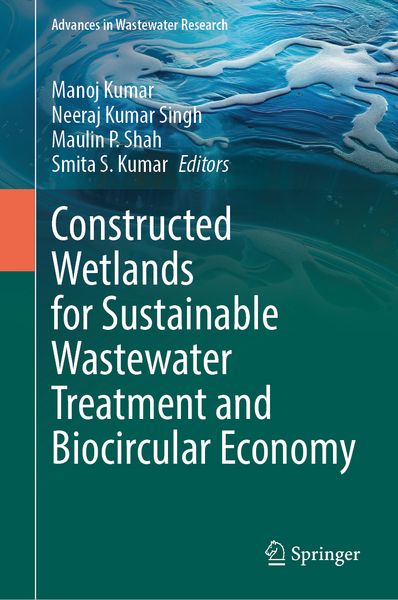
Produktbild: Constructed Wetlands for Sustainable Wastewater Treatment and Biocircular Economy
- 10%

Constructed Wetlands for Sustainable Wastewater Treatment and Biocircular Economy

10% sparen

152,99 € UVP 171,19 €

inkl. gesetzl. MwSt., Versandkostenfrei

Lieferung nach Hause

Beschreibung

Produktdetails

Einband

Gebundene Ausgabe

Erscheinungsdatum

08.05.2026

Abbildungen

VII, 56 illus., 52 illus. in color., schwarz-weiss Illustrationen, farbige Illustrationen

Herausgeber

Manoj Kumar + weitere

Verlag

Springer Singapore

Seitenzahl

472

Maße (L/B/H)

24,1/16/3,2 cm

Gewicht

879 g

Auflage

1. Auflage

Sprache

Englisch

ISBN

978-981-9569-65-6

Beschreibung

Portrait

Dr. Manoj Kumar is a research associate in the Environment and Biofuel Research Laboratory, Department of Hydro and Renewable Energy, the Indian Institute of Technology Roorkee, India. Prior to that, he worked as a senior research fellow and junior research fellow at the School of Environment and Sustainable Development, Central University of Gujarat. He received his Ph.D. from the School of Environment and Sustainable Development, Central University of Gujarat, India. He is a reviewer of various international journals and a member of many technical Societies. He has been awarded the Rajiv Gandhi National Fellowship (RGNF)-(2017-218), University Grants Commission (UGC), New Delhi, Government of India. He received many awards including the NESA-Young Scientist of the Year Award 2021 from the National Environmental Science Academy, New Delhi, India. His research interests include biological wastewater treatment, phytoremediation, constructed wetlands, bioelectrochemical systems, energy recovery from wastewater, environmental microbiology, and environmental engineering.


Dr. Neeraj Kumar Singh is a research associate in the Department of Bioscience and Bioengineering, Indian Institute of Technology Roorkee, India. He received his M.Phil. and Ph.D. in environment and sustainable development from the Central University of Gujarat, India. He has worked under various projects funded by the Government of India and many other organisations for the development of microbial fuel cells, bioelectrochemical systems, bio-hydrogen, and bioethanol production. He has published research papers and book chapters in reputed journals. He has developed various pretreatment strategies of lignocellulosic biomass for value-added product recovery and methane suppression for enhanced hydrogen production in bioelectrochemical systems. His research interests include wastewater treatment, biohydrogen, and bioethanol production from agriculture biomass.


Dr. Maulin P. Shah is interested in genetic adaptation processes in bacteria, the mechanisms by which they deal with toxic substances, how they react to pollution in general and how we can apply microbial processes in a useful way (for example, bacterial bioreporters). One of his major interests is to study how bacteria evolve and adapt to use organic pollutants as novel growth substrates. His research work focuses on the impact of industrial pollution on microbial diversity in wastewater though cultivation dependant and cultivation independent analyses. His major work involves isolation, screening, identification and genetic engineering of microbes for the degradation of hazardous materials. He has more than 450 research publications in highly reputed national and international journals. He manages the research programs at Enviro Technology Ltd., Ankleshwar, India. He also serves as a reviewer in various academic journals.

Dr. Smita S. Kumar is faculty in the Department of Environmental Studies, Central University of Haryana in India. She has a Ph.D. in environmental science and engineering and has teaching and research experience of more than 10 years. Prior to the current position, she was faculty at the J.C. Bose University of Science & Technology, YMCA, in Faridabad, India. She pursued her postdoctoral research at the Centre for Rural Development and Technology, Indian Institute of Technology, Delhi, where she worked on the conversion of emerging water pollutants from agrochemical and pesticide industries into green energy by microbial fuel cell technology. Her research interests include environmental pollution assessment and abatement, waste and wastewater treatment, sustainable bio-energy production, landfill leachate treatment, and bioremediation. She has published more than 100+ peer-reviewed journal articles, conference proceedings, book chapters, and edited books.


Produktdetails

Einband

Gebundene Ausgabe

Erscheinungsdatum

08.05.2026

Abbildungen

VII, 56 illus., 52 illus. in color., schwarz-weiss Illustrationen, farbige Illustrationen

Herausgeber

Verlag

Springer Singapore

Seitenzahl

472

Maße (L/B/H)

24,1/16/3,2 cm

Gewicht

879 g

Auflage

1. Auflage

Sprache

Englisch

ISBN

978-981-9569-65-6

Herstelleradresse

Springer-Verlag GmbH
Tiergartenstr. 17
69121 Heidelberg
DE

Email: ProductSafety@springernature.com

Kundinnen und Kunden meinen

0 Bewertungen

Informationen zu Bewertungen

Zur Abgabe einer Bewertung ist eine Anmeldung im Konto notwendig. Die Authentizität der Bewertungen wird von uns nicht überprüft. Wir behalten uns vor, Bewertungstexte, die unseren Richtlinien widersprechen, entsprechend zu kürzen oder zu löschen.

Die Bewertungen sind nach Format, Anzahl Sterne und Datum sortiert.

Verfassen Sie die erste Bewertung zu diesem Artikel

Helfen Sie anderen Kund*innen durch Ihre Meinung

Kundinnen und Kunden meinen

0 Bewertungen filtern

  • Produktbild: Constructed Wetlands for Sustainable Wastewater Treatment and Biocircular Economy
  • Introduction, Classification, Design and Sustainability of Constructed wetlands for Wastewater Treatment.- Wastewater Treatment Using Constructed Wetlands as A Natural Based Solution.- Designs, Operational and Maintenance of Constructed Wetlands for the Treatment of Wastewater.- Performance Assessment of Field-Scale Constructed Wetland: A Case Study.- Challenges and Innovation for Waste Water Treatment: Future Directions for Constructed Wetlands.- Application of Artificial Intelligence for Bioelectrochemical Systems with Constructed Wetlands for Wastewater Treatment and Resource Recovery.- Integration of Emerging Technologies with Constructed Wetland for Wastewater Treatment: A Perspective.- Sustainability of Constructed Wetlands for Wastewater Treatment.- Constructed Wetland Microbial Fuel Cell Technology: A Sustainable Solution for Hazardous Wastewater Treatment.-Recent advances in Nutrient removal from wastewater using constructed wetlands with biochar.- Enhancing the Performance of Floating Treatment Wetlands: Technological Approaches.- Constructed Wetland Application and Analytical Challenges for Metal Removal from Industrial Wastewater.- Bibliometric Overview of Research Progress, Challenges, and Prospects of Water Treatment using Constructed Wetlands.- Global Scenario of Design, Development of (CWs): Current Perspectives and Future Possibilities.- Policy Landscape: A Global Perspective on Constructed Wetland.- Constructed Wetlands for Wastewater Treatment and Life Cycle Assessment.- Techno-Economical Analysis of Various Engineered Constructed Wetlands for Wastewater Treatment.- Harnessing Constructed Wetland Systems for Wastewater Treatment: A Pathway to a Sustainable Green Circular Economy.- Future Prospects and Challenges of Constructed Wetlands in Achieving the Biocircular Economy.- Policy Insights on Next-Gen-Constructed Wetlands for Integrated Water Management.