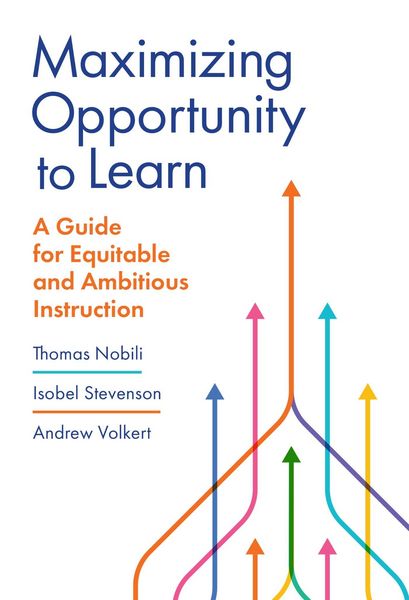
Maximizing Opportunity to Learn A Guide for Equitable and Ambitious Instruction
-
- Englisch ausgewählt
103,99 €
UVP
119,50 €
inkl. gesetzl. MwSt.,
Beschreibung
Produktdetails
Einband
Gebundene Ausgabe
Erscheinungsdatum
24.04.2026
Verlag
Teachers College PressSeitenzahl
208
Maße (L/B/H)
23,5/16,2/1,7 cm
Gewicht
395 g
Sprache
Englisch
ISBN
978-0-8077-8358-0
Ensure all students have the best opportunity to achieve academic success by using instructional approaches proven to have the most impact, while also avoiding common practices that ultimately hinder student learning (K-12).
Maximizing Opportunity to Learn advocates for teaching that combines high expectations with high leverage practices so that all students, especially those who historically have been marginalized, consistently experience maximized opportunities to learn. The authors introduce classroom teachers and instructional leaders to the Heuristic for Equitable and Adaptive Teaching (HEAT), a model for equitable and ambitious instruction that is both grounded in research and concrete enough to be put into practice.
Ambitious instruction demands that every student engage with tasks of high cognitive demand. "Equity" in this sense means more than inclusion; it requires creating the conditions so that every learner is positioned as capable, agentic, and able to achieve at high levels. In addition to providing proven-effective practices, the authors also challenge the efficacy of some common instructional practices, such as questioning and differentiation, illustrating how they often undermine equity rather than promote it.
Book Features:
- Explains how reducing variation in instructional quality and variation in student experience are the keys to achieving effective, equity-centered instructional improvement.
- Explains what instruction that supports every student looks like, as opposed to an ineffectual equity-neutral instructional approach or culturally relevant pedagogy that can be framed as only relevant to students of Color.
- Demonstrates why several common instructional practices that are still heavily promoted in the field are counter to the goal of equity and do not lead to improved outcomes for all students.
- Provides specific guidance for leaders on how to develop a district-wide strategy for developing, supporting, and sustaining equitable and ambitious instruction.
Noch keine Bewertungen vorhanden
Verfassen Sie die erste Bewertung zu diesem Artikel
Helfen Sie anderen Kundinnen und Kunden durch Ihre Meinung.
Kurze Frage zu unserer Seite
Vielen Dank für dein Feedback
Wir nutzen dein Feedback, um unsere Produktseiten zu verbessern. Bitte habe Verständnis, dass wir dir keine Rückmeldung geben können. Falls du Kontakt mit uns aufnehmen möchtest, kannst du dich aber gerne an unseren Kund*innenservice wenden.
zum Kundenservice