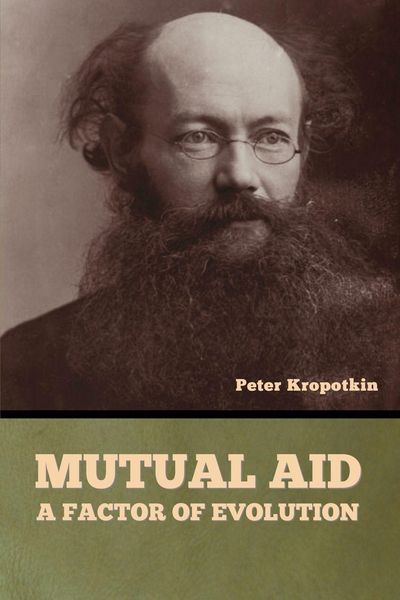
Mutual Aid A Factor of Evolution
-
- Hardcover
- Taschenbuch ausgewählt
- eBook
-
Sprache:Englisch
-
Verlag:Bibliotech Pr
- Read & Co. Great Essays 29,99 €
- Tredition 14,90 €
- Dover Publications Inc. 21,99 €
- Bibliotech Pr 11,99 € ausgewählt
- Les prairies numériques 29,99 €
- Culturea 23,90 €
- Martino Fine Books 17,99 €
- Sanage Publishing House 19,99 €
- Creative Media Partners, LLC 19,99 €
- Cosimo Classics 25,99 €
- Black Rose Books 28,99 €
- Aziloth Books 17,99 €
- Freedom Press 25,99 €
- Kessinger Publishing, LLC 28,99 €
- Critical Editions 19,99 €
- Repro India Limited 19,99 €
- Turnaround 28,99 €
- Indoeuropeanpublishing.Com 15,99 €
- Penguin Books Ltd 12,29 €
11,99 €
inkl. gesetzl. MwSt.,
Beschreibung
Produktdetails
Einband
Taschenbuch
Erscheinungsdatum
21.11.2025
Verlag
Bibliotech PrSeitenzahl
214
Maße (L/B/H)
22,8/14,9/1,7 cm
Gewicht
236 g
Sprache
Englisch
EAN
9798897733163
Mutual Aid: A Factor of Evolution is a 1902 collection of anthropological essays by Russian naturalist and anarchist philosopher Peter Kropotkin. The essays, initially published in the English periodical The Nineteenth Century between 1890 and 1896, explore the role of mutually-beneficial cooperation and reciprocity (or "mutual aid") in the animal kingdom and human societies both past and present. It is an argument against theories of social Darwinism that emphasize competition and survival of the fittest, and against the romantic depictions by writers such as Jean-Jacques Rousseau, who thought that cooperation was motivated by universal love. Instead Kropotkin argues that mutual aid has pragmatic advantages for the survival of human and animal communities and, along with the conscience, has been promoted through natural selection.
Mutual Aid is considered a fundamental text in anarchist communism. It presents a scientific basis for communism as an alternative to the historical materialism of the Marxists. Kropotkin considers the importance of mutual aid for prosperity and survival in the animal kingdom, in indigenous and early European societies, in the medieval free cities (especially through the guilds), and in the late 19th century village, labor movement, and poor folk. He criticizes the State for destroying historically important mutual aid institutions, particularly through the imposition of private property.
Noch keine Bewertungen vorhanden
Verfassen Sie die erste Bewertung zu diesem Artikel
Helfen Sie anderen Kundinnen und Kunden durch Ihre Meinung.
Kurze Frage zu unserer Seite
Vielen Dank für dein Feedback
Wir nutzen dein Feedback, um unsere Produktseiten zu verbessern. Bitte habe Verständnis, dass wir dir keine Rückmeldung geben können. Falls du Kontakt mit uns aufnehmen möchtest, kannst du dich aber gerne an unseren Kund*innenservice wenden.
zum Kundenservice