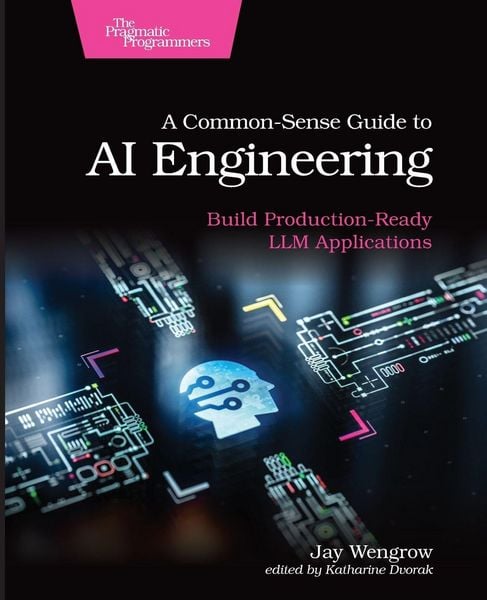
Produktbild: A Common-Sense Guide to AI Engineering

A Common-Sense Guide to AI Engineering Build Production-Ready LLM Applications

56,99 €

inkl. gesetzl. MwSt., Versandkostenfrei


Beschreibung

Produktdetails

Einband

Taschenbuch

Erscheinungsdatum

26.05.2026

Herausgeber

Katherine Dvorak

Verlag

Pragmatic Programmers

Seitenzahl

340

Maße (L/B/H)

23/18,8/2 cm

Gewicht

648 g

Sprache

Englisch

EAN

9798888651933

Beschreibung

Produktdetails

Einband

Taschenbuch

Erscheinungsdatum

26.05.2026

Herausgeber

Katherine Dvorak

Verlag

Pragmatic Programmers

Seitenzahl

340

Maße (L/B/H)

23/18,8/2 cm

Gewicht

648 g

Sprache

Englisch

EAN

9798888651933

Herstelleradresse

Libri GmbH
Europaallee 1
36244 Bad Hersfeld
DE

Email: gpsr@libri.de

Noch keine Bewertungen vorhanden

Verfassen Sie die erste Bewertung zu diesem Artikel

Helfen Sie anderen Kundinnen und Kunden durch Ihre Meinung.

Kundinnen und Kunden meinen

Bewertungen (0)

  • Produktbild: A Common-Sense Guide to AI Engineering
    • Foundations
      • HeLLMo,World!
        • Signing Up for an LLM-as-a-Service
        • Creating Our First App
        • Tweaking the Model and Temperature
        • Checking API Usage
        • Wrapping Up
      • Understanding How LLMs Work
        • What Is a Large Language Model (LLM)
        • Realizing LLMs Are Nondeterministic Creatures
        • Gauging the Temperature
        • Understanding the Challenges of Nondeterminism
        • Wrapping Up
      • Diving Deeper into LLMs
        • Diving into Tokens
        • Diving into Embeddings
        • Diving into Fine-Tuning
        • Wrapping Up
      • Selecting an LLM
        • Getting Your Hands on an LLM
        • Comparing Different LLMs
        • Deciding on an LLM
        • Wrapping Up
      • Chatbots
        • Building a Chatbot
          • Getting User Input
          • Augmenting the Prompt
          • Adding Multi-Turn Dialogue
          • Managing State with Memory Systems
          • Adding a System Prompt
          • Building the Messages Array
          • Wrapping Up
        • Augmenting a Prompt with Knowledge
          • Building a Chatbot
          • Augmenting with Knowledge
          • Avoiding Context Window Limitations
          • Preparing the Data
          • Implementing the Knowledge Chatbot
          • Running into PACKing Problems
          • Wrapping Up
        • Efficiently Adding Knowledge with RAG
          • Augmenting with Documentation Chunks
          • Getting into Search Engines, Retrieval, and RAG
          • Searching with Meaning: Keywords Versus Semantics
          • Using Embedding-Similarity Search
          • Building a Starter Search Engine
          • Implementing a RAG Chatbot
          • Wrapping Up
        • Measuring Quality with Evals
          • Introducing Evals
          • Setting Up Our App
          • Conducting Error Analysis
          • Open Coding
          • Axial Coding
          • Creating an Eval Test Framework
          • Running Human Evals
          • Wrapping Up
        • Prompt Engineering
          • Eliminating Ambiguity
          • Utilizing the System Prompt
          • Rewriting History
          • Using Delimiters and Bullet Points
          • Reordering Prompt Components
          • Wrapping Up
        • Reducing Hallucinations
          • Understanding Why Our App Hallucinates
          • Instructing the LLM to Be Faithful
          • Pleading and Threatening
          • Upgrading the Model
          • Citing Sources and Few-Shot Prompting
          • Iterate, Iterate, Iterate
          • Chain-of-Thought Prompting
          • Final Prompt Engineering Thoughts
          • Checking On Our Evals
          • Wrapping Up
        • Evaluating and Optimizing RAG
          • Discovering a RAG Failure
          • Evaluating RAG
          • Expanding the Query
          • Metadata-Based Filtering
          • Evaluating RAG Subcomponents
          • Dreaming Up an Agentic RAG Wish List
          • Wrapping Up
        • Agents
          • Equipping an LLM with Tools
            • Understanding an LLM’s Limitations
            • Triggering a Function
            • Defining “Agents”
            • Feeding Tool Results Back to the LLM
            • Building a Website Reader Tool
            • Deciding to Use a Tool
            • Using the Tools API
            • Wrapping Up
          • Running the Agent Loop
            • Solving a Complex Problem
            • Constructing an Agent Loop
            • Building a News Podcast Agent
            • Exploring Agent Failure Modes and Evals
            • Giving the Agent a Plan
            • Asking the Agent to Create a Plan
            • Wrapping Up
          • Architecting Agentic Workflows
            • Designing an LLM Assembly Line
            • Implementing an LLM Assembly Line
            • Weighing Agentic Workflows Against Classic Agent Loops
            • Workflow Routing
            • Performing Tasks in Parallel
            • Wrapping Up
          • Enhancing Retrieval with Agentic RAG
            • Architecting an Agentic RAG Plan
            • Implementing a RAG Agent
            • Avoiding Unnecessary RAG
            • Generating Structured Outputs
            • Researching as an Agent
            • Conducting Multi-Hop Research
            • Wrapping Up
          • Building System-Integrated Agents
            • Integrating with Databases
            • Reading and Writing
            • Writing Safely
            • Including a Human in the Loop
            • Integrating with Web APIs
            • Integrating MCP and Other Third-Party Tools
            • Hosting Your Own Tools
            • Wrapping Up
          • Production
            • Setting Guardrails
              • Introducing Guardrail Types
              • Guarding LLMs with Other Models
              • Balancing Guardrail Trade-Offs
              • Mitigating Cybersecurity Risks
              • Protecting Personally Identifiable Information
              • Using Guardrail Frameworks
              • Red-Teaming, Evals, and Monitoring
              • Wrapping Up
            • Observing AI Systems
              • Logging All the Things
              • Using Observability Tools
              • Running Evals in Production
              • Monitoring and Alerts
              • Gathering User Feedback
              • Wrapping Up
            • Handling Exceptions
              • Understanding Your Errors
              • Retrying Requests
              • Switching Models
              • Falling Back to Semantic Search and Caching
              • Fitting in the Context Window
              • Aborting Hanging Requests
              • Recovering from Tool Failures
              • Creating a Fallback Plan
              • Wrapping Up
            • Automating Evals
              • Unit Testing
              • Running Reference-Based Evals
              • Checking Outputs Deterministically
              • Using an LLM-as-Judge
              • Running Evals
              • Aligning the LLM Judge
              • Working with Imperfect Judges
              • Wrapping Up
              • Final Thoughts