KI-Beratung Beta

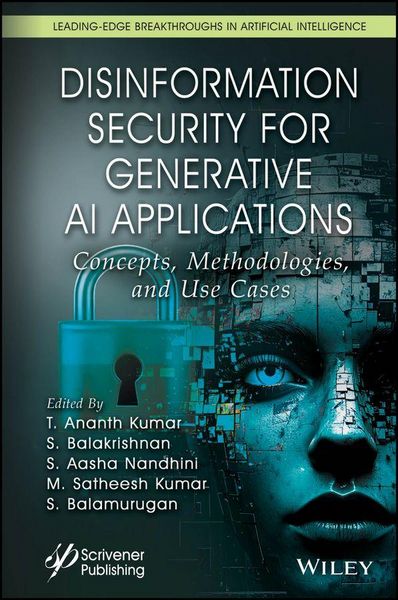
Produktbild: Disinformation Security for Generative AI Applications
Vorbesteller Neu

Disinformation Security for Generative AI Applications Concepts, Methodologies, and Use Cases

209,99 €

inkl. gesetzl. MwSt., Versandkostenfrei


Beschreibung

Produktdetails

Einband

Gebundene Ausgabe

Erscheinungsdatum

03.01.2027

Herausgeber

T. Ananth Kumar + weitere

Verlag

Wiley

Seitenzahl

512

Sprache

Englisch

ISBN

978-1-394-42236-4

Beschreibung

Produktdetails

Einband

Gebundene Ausgabe

Erscheinungsdatum

03.01.2027

Herausgeber

Verlag

Wiley

Seitenzahl

512

Sprache

Englisch

ISBN

978-1-394-42236-4

Herstelleradresse

Libri GmbH
Europaallee 1
36244 Bad Hersfeld
DE

Email: gpsr@libri.de

Noch keine Bewertungen vorhanden

Verfassen Sie die erste Bewertung zu diesem Artikel

Helfen Sie anderen Kundinnen und Kunden durch Ihre Meinung.

Kundinnen und Kunden meinen

Bewertungen (0)

Die Leseprobe wird geladen.
  • Produktbild: Disinformation Security for Generative AI Applications
  • Series Preface xix
    Preface xxi

    Part 1: Foundations and Advances in Generative AI and Machine Learning 1

    1 Recent Advances in Generative Modeling: A Unified Review of GANs, Transformers, Autoencoders, Diffusion Models, and Large Language Architectures 3
    S. Tamil Selvi and P. Visalakshi

    1.1 Introduction 4
    1.2 Generative Models 6
    1.3 GAI Task and Tools 19
    1.4 Industrial Application of GIA 23
    1.5 Challenges of GAI 26
    1.6 The Future of GAI 27
    1.7 Conclusion 29

    2 Machine Learning for Fake Content Detection-Developing Classifiers and Anomaly Detection for AI-Generated Text, Images, and Videos 35
    Naveenkumar M., Vidhya Saraswathy S. S. and Srinathi B.

    2.1 Introduction 36
    2.2 Related Work 39
    2.3 Methodology 41
    2.4 Feature Engineering 46
    2.5 Machine Learning Techniques 52
    2.6 Deep Learning Techniques: Ways Machines Learn Similar to Us Humans 58
    2.7 Result and Discussion 62
    2.8 Evaluation Metrics 66
    2.9 Case Studies and Real-World Application 71
    2.10 Challenges and Limitations 74
    2.11 Conclusion and Future Scope 76

    3 A Transformer-Based Hybrid Machine Learning Approach for Detecting AI-Generated Misinformation 81
    R. Pari, Likhith Muthavarapu, Parvinder Kaur, Anurag Reddy Ekkati, P. Lakshmi Prasanna and P. Jeyabharathi

    3.1 Introduction 82
    3.2 Literature Review 84
    3.3 Overview of AI-Generated Misinformation 89
    3.4 Proposed Hybrid Machine Learning Approach 93
    3.5 Experimental Setup 96
    3.6 Results Analysis and Discussion 98
    3.7 Conclusion and Future Enhancement 101

    Part 2: Generative AI Applications in Healthcare and Biomedical Domains 105

    4 Utilizing Generative AI and Foundation Models to Personalize Healthcare: Predictive Analytics and Customized Treatment Plans via Cascaded Deep Capsule Neural Networks 107
    N. Naveenkumar, Seshukumar, J. Jude Moses Anto Devakanth, S. Balamurugan, P. Hanok and Deepthidotla

    4.1 Introduction 108
    4.2 Literature Survey 110
    4.3 Proposed Methodology 114
    4.4 Results and Discussions 120
    4.5 Conclusion 128

    5 Generative AI-Driven Patient Twins: Transforming Precision and Predictive Healthcare 133
    Rajeswari R. and Kiruba Kumari

    5.1 Introduction 134
    5.2 Fundamentals of Generative AI 135
    5.3 Foundations of DTs in Medicine 137
    5.4 AI-Generated Patient Twins: A Conceptual Framework 141
    5.5 The Role of Generative AI in Patient Twin Development 143
    5.6 Applications of DT in Clinical Practice 145
    5.7 Seven Integration into Precision and Predictive Medicine 147
    5.8 Challenges in Implementing Digital Identical Twin in Healthcare 150
    5.9 Future Directions: Toward Real-Time Adaptive Healthcare 153
    5.10 Conclusion 154

    6 Role of AI in Accurate and Disinformation-Resilient Diagnosis of Ulcerative Colitis 157
    Latha D., Lakshmi D., Mohana R. and Nithiya A.

    6.1 Introduction 158
    6.2 Related Works 159
    6.3 Methodology 161
    6.4 Result and Discussion 172
    6.5 Conclusion 177

    7 A Generative AI Framework for Predicting Shear Strength Properties of Rock Materials Using ISSA-XGBoost 183
    Tamilselvi. P.

    7.1 Introduction 184
    7.2 Understanding Generative AI 184
    7.3 An Introduction to Rock Minerals 185
    7.4 Integration of Generative AI in Geological Survey and Mineral Targeting 189
    7.5 Gen-AI Algorithm to Discover the Rock Structure 193
    7.6 Rock Structure Datasets 196
    7.7 Rock Mechanics Applications 202
    7.8 Conclusion 204
    7.9 Future Work 204

    Part 3: AI and Disinformation - Security, Detection, and Mitigation 209

    8 Sign Language Recognition in the Age of AI with Disinformation Risks and Security Solutions 211
    T. Grace Shalini, Sayed Sayeed Ahmad, Mrinalini Vaish, Neelansh Bhargava, Krishikaa Mathi Bharathi S. S. and Karthick Manoj. R.

    8.1 Introduction 212
    8.2 Literature Survey 214
    8.3 Research Gap 217xii Contents
    8.4 Proposed Methodology 219
    8.5 Comparative Study and Tool Justification 226
    8.6 Advantages Over Existing Systems 227
    8.7 Results 229
    8.8 Future Enhancements 232
    8.9 Conclusion 234

    9 EmoFusionNet: A Cutting-Edge Framework for Emotion Propagation with Attention-Enhanced Hypergraphs and Generative Temporal Forecasting 239
    G. Akiladevi, M. Arun and J. Palanimeera

    9.1 Introduction 240
    9.2 Temporal Graph Neural Networks 248
    9.3 Literature Review 249
    9.4 Methodology 251
    9.5 Conclusion 258

    10 Advancing Trustworthy Content Verification through Explainable AI for Disinformation Mitigation 263
    Barakkath Nisha U., Yasir Abdullah R., Anantraj I., Mary Posonia A. and Ram Shivany K.

    10.1 Introduction 264Contents xiii
    10.2 Theoretical Foundations 265
    10.3 Techniques for Explainable AI 266
    10.4 Architectures for Trustworthy Verification 267
    10.5 Evaluating Trust and Explainability 270
    10.6 Experimental Results and Analysis 272
    10.7 Use Cases and Real-World Scenarios 278
    10.8 Cross-Domain Trust Transferability 281
    10.9 Human-AI Interaction and Trust Calibration 283
    10.10 Policy, Regulation, and Ethical Mandates 286
    10.11 Building Future-Ready Verification Frameworks 289
    10.12 Challenges and Research Directions 291

    11 Detecting Deepfakes in Generative Media with an Explainable CNN-Transformer Approach 299
    R. Karthick Manoj, M. Arul Pugazhendhi, K. Suresh Kumar and Sunday Adeola Ajagbe

    11.1 Introduction 300
    11.2 Methodology 308
    11.3 Results and Visualization 314
    11.4 Conclusion 319

    12 Analysis of Sentiment in Tamil Comments Using BERT and Explainable AI 323
    N. Priyadharshini and N. Subbulakshmi

    12.1 Introduction 324
    12.2 Literature Survey 328
    12.3 Datasets Availability 331
    12.4 Dataset Used 331
    12.5 Preprocessing 332
    12.6 Constructing a Tamil Sentiment Lexicon 335
    12.7 Handling Code-Mixed Tamil-English Text 336
    12.8 Methodologies 336
    12.9 Results and Evaluation 343
    12.10 Cross-Lingual Transfer and Challenges 346
    12.11 Case Studies 348
    12.12 Future Works 349
    12.13 Conclusion 349

    13 Securing Generative AI Against Disinformation in Low-Stability Renewable Power Networks 353
    R. Rajasree, D. Lakshmi, K. Stalin and R. Karthick Manoj

    13.1 Introduction 354
    13.2 Literature Survey 359
    13.3 Proposed Methodology 367
    13.4 Results and Discussion 370
    13.5 Conclusion 374

    Part 4: AI in Sustainable Development, Agriculture, and Smart Systems 379

    14 Securing Agricultural IoT Systems Against Disinformation for Sustainable Rural Development 381
    S. Murugesan, S. Ramalingam, P. Usharani and P. Kanimozhi

    14.1 Introduction 382
    14.2 Literature Review 387
    14.3 Proposed Methodology 393
    14.4 Results and Discussions 400
    14.5 Conclusion 403

    15 Resilient Embodied AI for Smart Farming: Tackling Misinformation in Bioacoustic Pest Detection 407
    T. Grace Shalini, Sayed Sayeed Ahmad, Nayantra Ramakrishnan, Bhavesh P. and Karthick Manoj R.

    15.1 Introduction 408
    15.2 Literature Survey 410
    15.3 Research Gaps 415
    15.4 Proposed Methodology 417
    15.5 Comparative Study and Tool Justification 427
    15.6 Advantages Over Existing Systems 431
    15.7 Future Enhancements 439
    15.8 Conclusion 440

    16 CNN-GA: Pose Recognition Using Region-Based Convolutional Neural Networks and Genetic Algorithm 445
    J. Palanimeera, K. Ponmozhi and G. Akiladevi

    16.1 Introduction 446
    16.2 Related Works 457
    16.3 Methodology 466
    16.4 Experimental Results 468
    16.5 Discussion 470
    16.6 Conclusion 471

    References 472
    Index 475