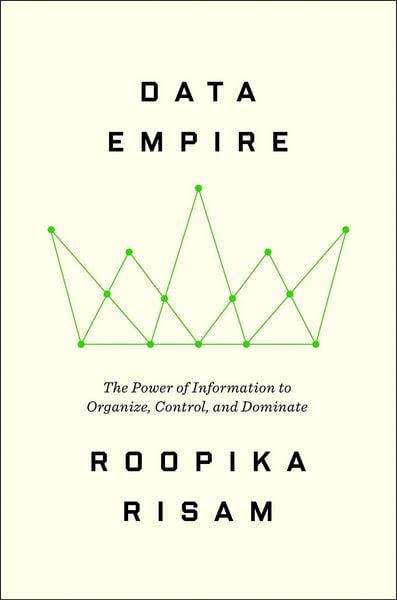
Data Empire The Power of Information to Organize, Control, and Dominate
-
- Hardcover ausgewählt
- Taschenbuch
- eBook
-
Sprache:Englisch
-
Verlag:Harper Collins Publ. USA
17,99 €
inkl. gesetzl. MwSt.,
Lieferung nach Hause
Beschreibung
Produktdetails
Einband
Gebundene Ausgabe
Erscheinungsdatum
14.07.2026
Abbildungen
final Number of photographs and/or illustrations to be mutually agreed
Verlag
Harper Collins Publ. USASeitenzahl
480
Maße (L/B/H)
22,9/15,2/3,4 cm
Gewicht
646 g
Sprache
Englisch
ISBN
978-0-06-343032-7
AN NPR SUMMER READING PICK
"A powerful and thought-provoking deep history of data and power, essential reading for understanding the opportunities and dangers of the technological revolution now transforming our world." -Jonathan Kennedy, author of Pathogenesis
From clay tablets to the algorithmic state, a groundbreaking new lens on human history arguing that information has always been the seed of power, for readers of Nexus and The Age of Surveillance Capitalism.
Long before writing existed, at the dawn of civilization in Mesopotamia, rulers pressed marks into clay to keep track of land, people and grain. To rule, they had to keep count. It is no accident, then, that the first written name in human history was neither a god nor a king, but an accountant.
As ships and navigation expanded our horizons, a new age of European empires took control of more than 80 percent of the world's surface using censuses, maps and ledgers to decide who belonged, who owed, and who could be sacrificed. Today, we live in the third great era, when trading our information for access can feel harmless or inevitable - yet from targeted advertising to border policing and mass surveillance, data shapes the course of our lives.
With our earliest tools like ancient cave markings and knotted strings, to colonial record-keeping and the algorithmic state, Data Empire reveals how data has always been the seed of power: a technology of control that has shaped civilizations and upheld empires. Empire was never just about weapons or ships. It was built on collecting information on us, to rule us. Both a sweeping history and a sharp critique, Data Empire is a call to recognize the power data holds-and to imagine what resistance looks like in an age defined by it. In looking at the history of data, readers will understand:
- Data made civilization possible: Long before algorithms and AI, systems of counting, recording, and organizing information enabled everything from agriculture to taxation. The infrastructures of data are as old as cities themselves, and they are the precondition for large-scale human coordination.
- Every system of data is also a system of power: From clay tablets in Mesopotamia to colonial censuses to modern databases, data determines who is visible, who is legible, and who can be governed.
- The modern data state was built in moments of crisis: In the twentieth century, governments became vast information-processing systems. What we now think of as "data" was created in response to economic collapse and geopolitical conflict.
- The "data" we know now is built on much older inequalities: Today's digital systems inherit the logics of earlier recordkeeping regimes, including those shaped by colonialism, racial classification, and forms of government that extract from land and from populations. The biases we see in algorithms are not new but continuations of a long history.
- We are living through a transformation in who controls data-and therefore power: For most of history, data infrastructures were largely state-driven. Today, they are increasingly owned and operated by private corporations, even as they structure public life. This shift raises urgent questions about accountability, sovereignty, and the future of public life.
Kundinnen und Kunden meinen
Verfassen Sie die erste Bewertung zu diesem Artikel
Helfen Sie anderen Kund*innen durch Ihre Meinung
Kurze Frage zu unserer Seite
Vielen Dank für dein Feedback
Wir nutzen dein Feedback, um unsere Produktseiten zu verbessern. Bitte habe Verständnis, dass wir dir keine Rückmeldung geben können. Falls du Kontakt mit uns aufnehmen möchtest, kannst du dich aber gerne an unseren Kund*innenservice wenden.
zum Kundenservice