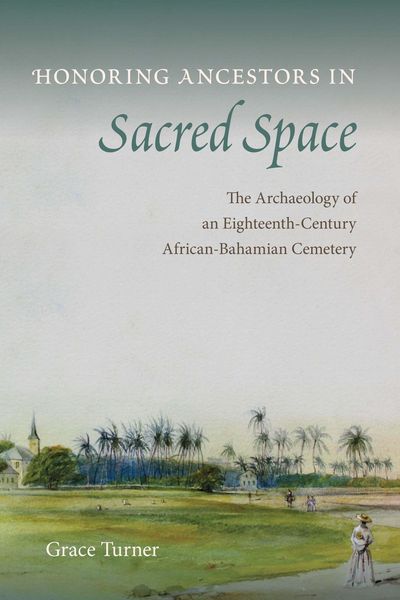
Honoring Ancestors in Sacred Space The Archaeology of an Eighteenth-Century African-Bahamian Cemetery
-
- Hardcover
- Taschenbuch
- eBook ausgewählt
-
Form:Einzelkauf Download
-
Sprache:Englisch
29,49 €
inkl. gesetzl. MwSt.Beschreibung
Produktdetails
Format
ePUB
Kopierschutz
Nein
Family Sharing
Nein
Text-to-Speech
Ja
Erscheinungsdatum
10.10.2023
Verlag
University of Florida PressSeitenzahl
196 (Printausgabe)
Dateigröße
9319 KB
Sprache
Englisch
EAN
9781683404170
The Anglican Church established St. Matthew's Parish on the eastern side of Nassau to accommodate a population increase after British Loyalists migrated to the Bahamas in the 1780s. The parish had three separate cemeteries: the churchyard cemetery and Centre Burial Ground were for whites, but the Northern Burial Ground was officially consecrated for nonwhites in 1826 by the Bishop of Jamaica. In Honoring Ancestors in Sacred Space, Grace Turner posits that the African-Bahamian community intentionally established this separate cemetery in order to observe non-European burial customs. Analyzing the landscape and artifacts found at the site, Turner shows how the community used this space to maintain a sense of social and cultural belonging despite the power of white planters and the colonial government.
Although the Northern Burial Ground was covered by storm surges in the 1920s, and later a sidewalk was built through the site, Turner's fieldwork reveals a wealth of material culture. She points to the cemetery's location near water, trees planted at the heads of graves, personal items left with the dead, and remnants of food offerings as evidence of mortuary practices originating in West and Central Africa. According to Turner, these African-influenced ways of memorializing the dead illustrate W. E. B. Du Bois's idea of "double consciousness"--the experience of existing in two irreconcilable cultures at the same time. Comparing the burial ground with others in Great Britain and the American colonies, Turner demonstrates how Africans in the Atlantic diaspora did not always adopt European customs but often created a separate, parallel world for themselves.
A volume in the Florida Museum of Natural History: Ripley P. Bullen SeriesKundinnen und Kunden meinen
Verfassen Sie die erste Bewertung zu diesem Artikel
Helfen Sie anderen Kund*innen durch Ihre Meinung
Kurze Frage zu unserer Seite
Vielen Dank für dein Feedback
Wir nutzen dein Feedback, um unsere Produktseiten zu verbessern. Bitte habe Verständnis, dass wir dir keine Rückmeldung geben können. Falls du Kontakt mit uns aufnehmen möchtest, kannst du dich aber gerne an unseren Kund*innenservice wenden.
zum Kundenservice