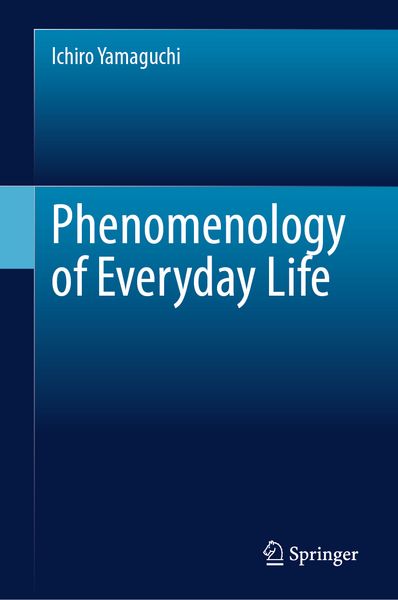
Phenomenology of Everyday Life
126,99 €
inkl. gesetzl. MwSt.,
Lieferung nach Hause
Beschreibung
Produktdetails
Einband
Gebundene Ausgabe
Erscheinungsdatum
03.01.2026
Abbildungen
IX, 6 illus., schwarz-weiss Illustrationen
Verlag
Springer SingaporeSeitenzahl
178
Maße (L/B/H)
24,1/16/1,6 cm
Auflage
1. Auflage
Sprache
Englisch
ISBN
978-981-9546-16-9
This book is an introduction to phenomenology, with a focus on Edmund Husserl (1859–1938). Throughout the book, examples of concrete activities from everyday life (e.g., counting, perceiving, a change of feelings, communicating with others) are provided to elucidate the correlation of the act of consciousness (noesis) and the content of consciousness (noema). This is accomplished through an intentional analysis using the methods of phenomenological reduction and eidetic intuition.
The correlation of consciousness is investigated in genetic phenomenology, in which the genesis of the correlation itself is questioned. The study is divided into two stages of development: passive genesis based on passive intentionality, which is not mediated by self-consciousness, and active genesis based on active intentionality, in which self-consciousness is presupposed. Through an analysis of passive genesis, two of the more difficult problems in phenomenological research— namely, the constitution of temporal flow and the constitution of intersubjectivity—are clarified. In the analysis of the mother–child relationship, in which self-consciousness is not mediated, the formation of the fundamental time flow through the “living co-present” experienced together by the child and mother is clarified by way of the fulfillment of instinctive intentionality. Furthermore, at the basis of intersubjectivity, “passive intersubjectivity” is phenomenologically founded, freed from the spell of solipsism that comes from presupposing self-consciousness. With regard to active genesis, social activities such as politics, economics, culture, and the sciences are developed in the realm of linguistic communication through the active synthesis of perception, language, and judgment. The intentional analysis also clarifies how, in the midst of these activities, one can realize the I–Thou relationship in which the I itself is forgotten and one becomes the thing itself.
In this way, through the phenomenological descriptions based on genetic phenomenology, our everyday life that we started off with is brought to light as the overall structure of a concrete life-world starting from childhood to the creative social activities of adulthood.
Kundinnen und Kunden meinen
Verfassen Sie die erste Bewertung zu diesem Artikel
Helfen Sie anderen Kund*innen durch Ihre Meinung
Kurze Frage zu unserer Seite
Vielen Dank für dein Feedback
Wir nutzen dein Feedback, um unsere Produktseiten zu verbessern. Bitte habe Verständnis, dass wir dir keine Rückmeldung geben können. Falls du Kontakt mit uns aufnehmen möchtest, kannst du dich aber gerne an unseren Kund*innenservice wenden.
zum Kundenservice