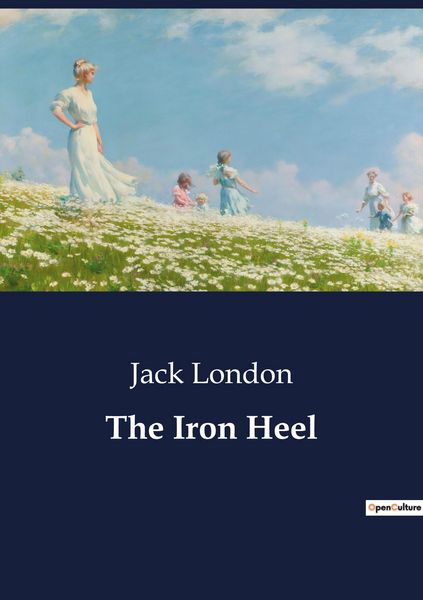
The Iron Heel
-
- Hardcover
- Taschenbuch ausgewählt
- eBook
- Hörbuch
-
Sprache:Englisch
-
Verlag:Culturea
- Chicago Review Press 16,99 €
- Waking Lion Press 21,99 €
- True Sign Publishing House Private Limited 19,99 €
- E-Kitap Projesi & Cheapest Books 22,99 €
- TGC Press 19,99 €
- Penguin Books USA 16,59 €
- Sharp Ink 11,60 €
- Book Jungle 29,99 €
- Culturea 25,00 € ausgewählt
- Martino Fine Books 14,99 €
- Alpha Edition 23,99 €
- Smk Books 19,99 €
- Wildside Press 21,99 €
- Hansebooks 25,90 €
- Ingram Publishers Services 11,99 €
- Antiquum Novum Verlag 34,90 €
- Double 9 Books 19,99 €
-
Auflage:1. Tirage
- 1. Tirage 25,00 € ausgewählt
- 1. Tirage 26,95 €
25,00 €
inkl. gesetzl. MwSt.,
Beschreibung
Produktdetails
Einband
Taschenbuch
Erscheinungsdatum
21.04.2025
Verlag
CultureaSeitenzahl
324
Maße (L/B/H)
21/14,8/1,8 cm
Gewicht
421 g
Auflage
1. Tirage
Sprache
Englisch
ISBN
979-10-418-0538-9
The Iron Heel is some of the earliest dystopian fiction of the 20th century. The novel is framed as a presentation of the long-lost "Everhard Manuscript," a document written by the socialist revolutionary Avis Everhard around 1932. The manuscript is discovered in the year 2600, and is introduced and annotated by a far-future commentator. In it, Avis tells of how the United States was slowly overcome by a group of oligarchs, the Iron Heel, who use their monopoly power to systematically bankrupt American small businesses and farmers in order to cement their control over the capitalist system. Eventually, the U.S. Army is brought under the control of the oligarchs, who entrench a brutal system of repression against the working class. Everhard, her husband, and a scrappy group of socialists fight valiantly against the Iron Heel, though we learn in the foreword that they don't survive the fight, and die as martyrs. London uses the narrative as a vehicle for espousing his socialist views, sometimes to the detriment of the plot, and even going so far as to plagiarize an essay by Frank Harris nearly verbatim-issues which caused the work to earn scant critical praise. Despite this, it sold over 50,000 copies in hardcover and influenced a generation of activists, including George Orwell, Harry Bridges, and Frederic Tuten.
Noch keine Bewertungen vorhanden
Verfassen Sie die erste Bewertung zu diesem Artikel
Helfen Sie anderen Kundinnen und Kunden durch Ihre Meinung.
Kurze Frage zu unserer Seite
Vielen Dank für dein Feedback
Wir nutzen dein Feedback, um unsere Produktseiten zu verbessern. Bitte habe Verständnis, dass wir dir keine Rückmeldung geben können. Falls du Kontakt mit uns aufnehmen möchtest, kannst du dich aber gerne an unseren Kund*innenservice wenden.
zum Kundenservice