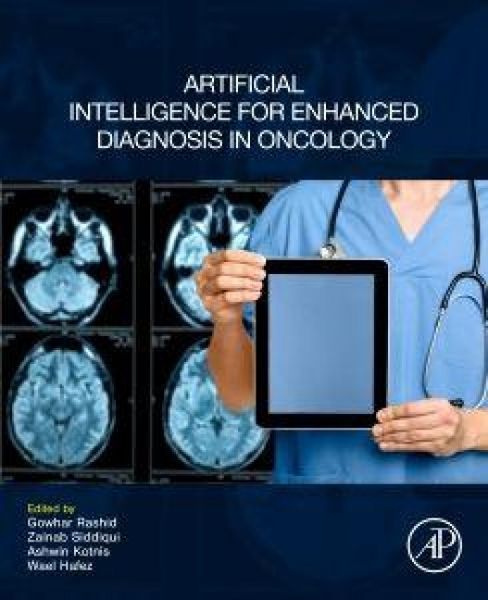
Produktbild: Artificial Intelligence for Enhanced Diagnosis in Oncology

Artificial Intelligence for Enhanced Diagnosis in Oncology

183,99 €

inkl. gesetzl. MwSt., Versandkostenfrei

Lieferung nach Hause

Beschreibung

Produktdetails

Einband

Taschenbuch

Erscheinungsdatum

01.05.2026

Herausgeber

Gowhar Rashid + weitere

Verlag

Elsevier

Seitenzahl

286

Maße (L/B/H)

27,7/21,4/1,8 cm

Gewicht

771 g

Sprache

Englisch

ISBN

978-0-443-45004-4

Beschreibung

Portrait

Dr. Gowhar Rashid is an Assistant Professor in the Department of Medical Lab Technology at Amity Medical School, Amity University-Gurugram, India. He earned his PhD in Biochemistry from the Sher-I-Kashmir Institute of Medical Sciences, focusing on the genetic susceptibility of colorectal cancer. Dr. Rashid has a strong background in laboratory sciences, molecular biology, and clinical biochemistry, with extensive research experience in cancer genetics and biomarkers. He has published numerous research papers and book chapters, contributing significantly to the field. Additionally, he serves on the editorial board for various journals and is a member of several professional organizations, including the European Society for Medical Oncology. Dr. Rashid is actively involved in research and teaching, aiming to advance knowledge in medical laboratory technology and its applications in healthcare. His expertise includes molecular techniques, data analysis, and bioinformatics, making him a valuable asset to the academic community.

Dr. Siddiqui is a prominent medical researcher specializing in cancer biology, with a growing focus on in-silico techniques such as molecular docking, ADMET analysis, and homology modeling. Her recent work has garnered invitations to speak at prestigious events, including the World Congress on Cancer Research (WCCN-2023) and the Inspiring Women in Scientific Academia event by Altem Technologies. During her PhD, she investigated cancer stem cells and their regulation by the tumor microenvironment, laying the groundwork for her current research using 3D bioprinting to identify molecular targets for therapy. In addition to her research, Dr. Siddiqui is an active member of the Editorial Board for Era’s Journal of Medical Research and the Asian Pacific Journal of Cancer Prevention, where she plays a crucial role in the peer-review process, ensuring the dissemination of high-quality research in the field of cancer prevention and treatment.

Prof. Ashwin Kotnis is trained in biochemistry, genetics, and immunology of cancer from prestigious institutions, including MS University Baroda, Tata Memorial Centre, Karolinska Institute, and the University of Oxford. His interdisciplinary research focuses on DNA repair, nutrition, and predisposition to head and neck cancer, vitiligo, and primary immunodeficiency diseases, supported by various organizations such as ICMR and DST. He leads a research team that publishes extensively and aims to develop personalized therapies and affordable diagnostic methods. A FAIMER fellow in medical education, Prof. Kotnis is a popular teacher known for innovative teaching methods and research ethics. As the founder member secretary of the Ethics Committee at AIIMS Bhopal, he serves on several editorial boards and ethics panels. He is dedicated to public awareness on vitiligo and co-founded Apna School, a charity initiative supporting the education of children of construction laborers, earning significant public recognition.

Dr. Wael Hafez graduated from Zagazig University and trained at Cairo University School of Medicine, earning his Master's and Doctorate in Internal Medicine. Since joining the National Research Center of Egypt in 2004, he has focused on applying medical research to internal medicine, including virology, genetics, public health, and noncommunicable diseases. During the COVID-19 pandemic in 2020, Dr. Hafez led the management team at NMC Royal Hospital in Abu Dhabi, where he treated over 2,000 patients and contributed to pandemic task force meetings. He is currently the principal investigator for several studies investigating the pathogenesis, severity, and outcomes of COVID-19. Dr. Hafez's work continues to impact the field of internal medicine and public health through his research and clinical leadership.

Produktdetails

Einband

Taschenbuch

Erscheinungsdatum

01.05.2026

Herausgeber

Verlag

Elsevier

Seitenzahl

286

Maße (L/B/H)

27,7/21,4/1,8 cm

Gewicht

771 g

Sprache

Englisch

ISBN

978-0-443-45004-4

Herstelleradresse

Libri GmbH
Europaallee 1
36244 Bad Hersfeld
DE

Email: gpsr@libri.de

Kundinnen und Kunden meinen

0 Bewertungen

Informationen zu Bewertungen

Zur Abgabe einer Bewertung ist eine Anmeldung im Konto notwendig. Die Authentizität der Bewertungen wird von uns nicht überprüft. Wir behalten uns vor, Bewertungstexte, die unseren Richtlinien widersprechen, entsprechend zu kürzen oder zu löschen.

Die Bewertungen sind nach Format, Anzahl Sterne und Datum sortiert.

Verfassen Sie die erste Bewertung zu diesem Artikel

Helfen Sie anderen Kund*innen durch Ihre Meinung

Kundinnen und Kunden meinen

0 Bewertungen filtern

  • Produktbild: Artificial Intelligence for Enhanced Diagnosis in Oncology
  • 1 Artificial intelligence in oncology: An introduction
    2 AI in early cancer screening
    3 AI in cancer diagnosis and prognosis
    4 AI-driven pathology: Transforming histopathological analysis
    5 Integrating liquid biopsy and artificial intelligence for precision detection of cancer signatures
    6 AI in surgical oncology
    7 Artificial intelligence in cancer imaging
    8 Artificial intelligence and radiomics in precision oncology
    9 AI in cancer clinical trials enhancing study design and patient selection
    10 AI in designing novel cancer treatments
    11 Artificial intelligence for personalized oncology: Tailoring treatments to individual patients
    12 Artificial intelligence in predicting adverse drug reactions, surgical outcomes, and radiotherapy responses
    13 Artificial intelligence in cancer risk assessment
    14 Artificial intelligence for oncology sepsis risk and mortality prediction
    15 AI in cancer education and screening: Improving patient awareness and quality of life
    16 The future of AI in oncology: Trends and innovations