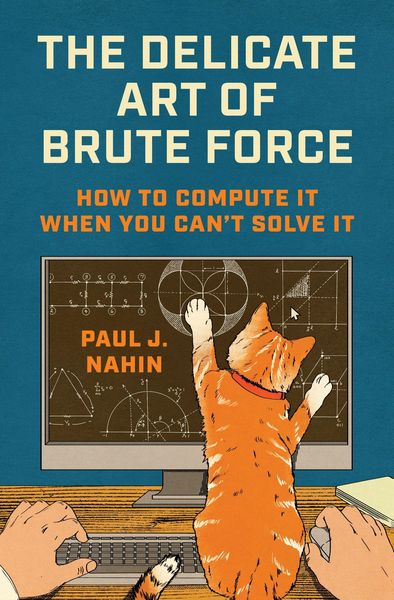
The Delicate Art of Brute Force How to Compute It When You Can't Solve It
27,99 €
inkl. gesetzl. MwSt.,
Beschreibung
Produktdetails
Einband
Gebundene Ausgabe
Erscheinungsdatum
17.03.2026
Abbildungen
1 color + 60 b/w illus. 4 tables.
Verlag
University PressesSeitenzahl
224
Maße (L/B/H)
21,9/14,2/2,1 cm
Gewicht
440 g
Sprache
Englisch
ISBN
978-0-691-26746-3
Using everyday computational power to tackle complex—and seemingly unsolvable—math problems
Confronted by a math problem of seemingly impenetrable difficulty, what can you do? In The Delicate Art of Brute Force, Paul Nahin shows how even if you can’t solve such a problem, you can still get an answer. The computational power of your own computer—the desktop in your home office, the laptop on your coffee table—can be deployed to overwhelm a problem’s complexity through a massive number-crunching assault. Nahin presents a series of apparently intractable math problems and shows the thought process that allows computational solution. Most of the problems are not abstract constructions but originate in the real world—one chapter is titled “How Wi-Fi Coverage and Anti-Submarine Warfare Are the Same.” For each one, Nahin compares computational and analytical approaches, demonstrating how well the computer solutions agree with theory. As a bonus, sometimes the computational solution is better, giving more insight or greater flexibility.
Along the way, Nahin traces the evolution of high-speed electronic computation, explaining that it upended the way analysts approach complex math problems. After the postwar debut of ENIAC (Electronic Numerical Integrator and Computer) and the ever more powerful electronic computers that came afterward, problems that were simply too difficult or messy for analytical treatment could be defeated by the application of pure brute force—the ability of computers to perform an enormous number of simple operations in just minutes. Today, we can harness that computational power from our couches. Accessible to anyone who’s mastered high school calculus, this engaging book gives both mathematicians and nonmathematicians plenty to think about.
Noch keine Bewertungen vorhanden
Verfassen Sie die erste Bewertung zu diesem Artikel
Helfen Sie anderen Kundinnen und Kunden durch Ihre Meinung.
Kurze Frage zu unserer Seite
Vielen Dank für dein Feedback
Wir nutzen dein Feedback, um unsere Produktseiten zu verbessern. Bitte habe Verständnis, dass wir dir keine Rückmeldung geben können. Falls du Kontakt mit uns aufnehmen möchtest, kannst du dich aber gerne an unseren Kund*innenservice wenden.
zum Kundenservice