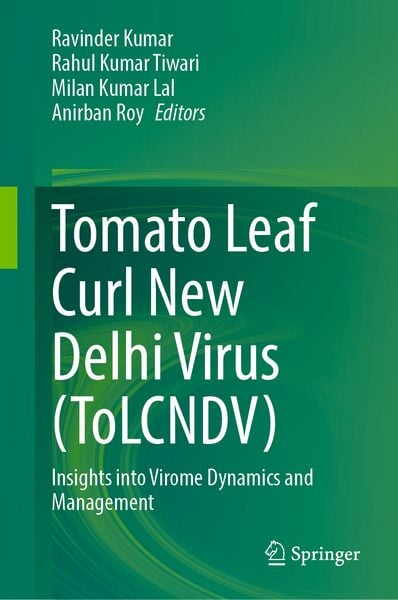
Produktbild: Tomato Leaf Curl New Delhi Virus (ToLCNDV)
- 11%

Tomato Leaf Curl New Delhi Virus (ToLCNDV) Insights into Virome Dynamics and Management

11% sparen

189,99 € UVP 213,99 €

inkl. gesetzl. MwSt., Versandkostenfrei


Beschreibung

Produktdetails

Einband

Gebundene Ausgabe

Erscheinungsdatum

18.11.2025

Abbildungen

XXVII, 369 p. 69 illus., 66 illus. in color.

Herausgeber

Ravinder Kumar + weitere

Verlag

Springer Singapore

Seitenzahl

369

Maße (L/B/H)

24,1/16/2,7 cm

Gewicht

762 g

Auflage

1. Auflage

Sprache

Englisch

ISBN

978-981-9528-51-6

Beschreibung

Portrait


Dr Ravinder Kumar
is working as a Senior Scientist at ICAR-Indian Agricultural Research Institute, New Delhi, India. He has over 15 years of experience in research, teaching, and extension. 


Dr Rahul Kumar Tiwari
is working as a scientist at

ICAR-Indian Institute of Sugarcane Research, Lucknow, India. 


Dr Milan Kumar Lal
is working as a Scientist at

ICAR-Central Rice Research Institute, Odisha, India. 


Dr Anirban Roy
is working as

a
 
Principal Scientist at ICAR-Indian Agricultural Research Institute, New Delhi, India. 

Produktdetails

Einband

Gebundene Ausgabe

Erscheinungsdatum

18.11.2025

Abbildungen

XXVII, 369 p. 69 illus., 66 illus. in color.

Herausgeber

Verlag

Springer Singapore

Seitenzahl

369

Maße (L/B/H)

24,1/16/2,7 cm

Gewicht

762 g

Auflage

1. Auflage

Sprache

Englisch

ISBN

978-981-9528-51-6

Herstelleradresse

Springer-Verlag KG
Sachsenplatz 4-6
1201 Wien
AT

Email: GPSR Kontakt

Noch keine Bewertungen vorhanden

Verfassen Sie die erste Bewertung zu diesem Artikel

Helfen Sie anderen Kundinnen und Kunden durch Ihre Meinung.

Kundinnen und Kunden meinen

Bewertungen (0)

  • Produktbild: Tomato Leaf Curl New Delhi Virus (ToLCNDV)

  • Chapter 1. Contemporary Status of Occurrence, Spread, and Yield Loss Due to Tomato leaf curl New Delhi virus in Global Crop Cultivation.- Chapter 2. Recent Insights on Genome Structure and Biology of Tomato leaf curl New Delhi virus.- Chapter 3. Omics-Based Approaches in Deciphering Molecular Mechanisms of Tomato leaf curl New Delhi virus Infection.- Chapter 4. Mechanistic Understanding of Vector Dynamics and Tomato leaf curl New Delhi virus-Vector Relationship.- Chapter 5. Seed Transmission: A new tool in the weaponry of tomato leaf curl New Delhi virus.- Chapter 6. Epidemiology and Pathophysiology of Tomato leaf curl New Delhi virus Infection in Horticultural Crops.- Chapter 7. Host-Pathogen Interactions: A Case Study on Tomato leaf curl New Delhi Virus-Tomato Pathosystem.- Chapter 8. Advancements in Diagnostic Tools for Rapid and Sensitive Detection of Tomato leaf curl New Delhi virus in Diverse Crops.- Chapter 9. Role of Vector Management Strategies in Mitigating Tomato leaf curl New Delhi virus  Infection.- Chapter 10. Nanoparticle-Based Delivery Systems for Antiviral Compounds and Nanotechnological Interventions in Tomato Leaf Curl New Delhi Virus Management.- Chapter 11. Employing CRISPR-Cas9 Genome Editing Tool Against Tomato leaf curl New Delhi virus: Prospects and Retrospects.- Chapter 12. Plant Viruses in a Changing Climate: Tomato leaf curl New Delhi virus Dynamics, Evolution, and the Myth and Reality of Beneficial Interaction.- Chapter 13. RNA Interference (RNAi) and Other Molecular Approaches for Tomato leaf curl New Delhi virus Control.- Chapter 14. Sustainable strategies for the management of Tomato leaf curl New Delhi virus.- Chapter 15. Genomic diversity and host adaptation of tomato leaf curl New Delhi virus.- Chapter 16. Molecular Arsenal of Tomato leaf curl New Delhi virus: Viral Suppressors of RNA Silencing and Their Roles in Pathogenicity.- Chapter 17. RNA Vaccination in Plants: A Non-Transgenic Approach to Combat Plant Viruses with Special Reference to Tomato Leaf Curl New Delhi Virus.- Chapter 18. Evolutionary Analysis of Tomato Leaf Curl New Delhi Virus.