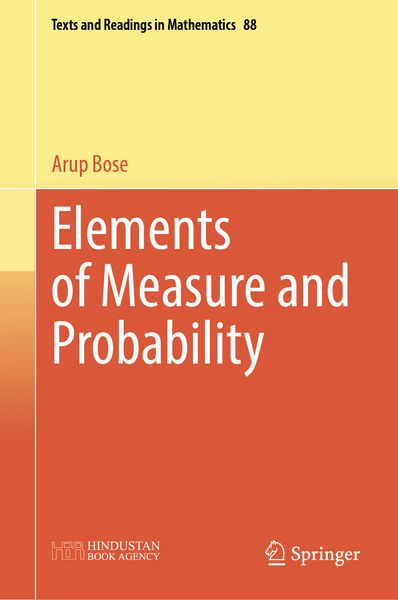
Elements of Measure and Probability
58,99 €
inkl. gesetzl. MwSt.,
Beschreibung
Produktdetails
Einband
Gebundene Ausgabe
Erscheinungsdatum
02.10.2025
Abbildungen
XIX, 308 p.
Verlag
Springer SingaporeSeitenzahl
308
Maße (L/B/H)
24,1/16/2,4 cm
Gewicht
607 g
Auflage
1. Auflage
Sprache
Englisch
ISBN
978-981-9527-57-1
This book can serve as a first course on measure theory and measure theoretic probability for upper undergraduate and graduate students of mathematics, statistics and probability. Starting from the basics, the measure theory part covers Caratheodory’s theorem, Lebesgue–Stieltjes measures, integration theory, Fatou’s lemma, dominated convergence theorem, basics of Lp spaces, transition and product measures, Fubini’s theorem, construction of the Lebesgue measure in Rd, convergence of finite measures, Jordan–Hahn decomposition of signed measures, Radon–Nikodym theorem and the fundamental theorem of calculus.
The material on probability covers standard topics such as Borel–Cantelli lemmas, behaviour of sums of independent random variables, 0-1 laws, weak convergence of probability distributions, in particular via moments and cumulants, and the central limit theorem (via characteristic function, and also via cumulants), and ends with conditional expectation as a natural application of the Radon–Nikodym theorem. A unique feature is the discussion of the relation between moments and cumulants, leading to Isserlis’ formula for moments of products of Gaussian variables and a proof of the central limit theorem avoiding the use of characteristic functions.
For clarity, the material is divided into 23 (mostly) short chapters. At the appearance of any new concept, adequate exercises are provided to strengthen it. Additional exercises are provided at the end of almost every chapter. A few results have been stated due to their importance, but their proofs do not belong to a first course. A reasonable familiarity with real analysis is needed, especially for the measure theory part. Having a background in basic probability would be helpful, but we do not assume a prior exposure to probability.
Noch keine Bewertungen vorhanden
Verfassen Sie die erste Bewertung zu diesem Artikel
Helfen Sie anderen Kundinnen und Kunden durch Ihre Meinung.
Kurze Frage zu unserer Seite
Vielen Dank für dein Feedback
Wir nutzen dein Feedback, um unsere Produktseiten zu verbessern. Bitte habe Verständnis, dass wir dir keine Rückmeldung geben können. Falls du Kontakt mit uns aufnehmen möchtest, kannst du dich aber gerne an unseren Kund*innenservice wenden.
zum Kundenservice