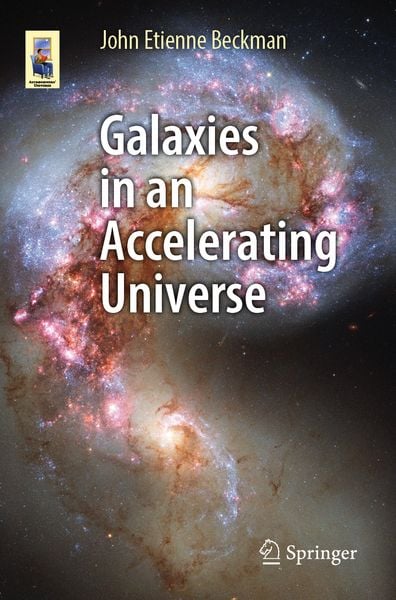

Galaxies in an Accelerating Universe
-
- Taschenbuch ausgewählt
- eBook
-
Sprache:Englisch
34,99 €
inkl. gesetzl. MwSt.,
Lieferung nach Hause
Beschreibung
Produktdetails
Einband
Taschenbuch
Erscheinungsdatum
20.01.2026
Abbildungen
XXIV, 189 illus., schwarz-weiss Illustrationen
Verlag
SpringerSeitenzahl
375
Maße (L/B/H)
23,5/15,5/2,2 cm
Gewicht
604 g
Sprache
Englisch
ISBN
978-3-032-05847-8
This book is aimed at the general reader who has an interest in knowing how modern astronomy is moving towards a steadily increasing understanding of galaxies. It is written from the point of view of the observational astrophysicist, stressing how observations have consistently led the way in opening new horizons.
We first take a brief historical look at how the Milky Way was seen until the development of large telescopes, showing how recently we have come to realize that our Galaxy is not the whole Universe but is just one of billions of similar systems. You will learn how we now measure the size of our Galaxy, and what its structure is: disc, bulge, bar, halo, streams of infalling stars as our Galaxy swallows its smaller neighbours, and the supermassive black hole at the centre.
The author then zooms out to describe our local group of galaxies, including the Milky Way, the Magellanic Clouds, the Andromeda galaxy, and the cloud of local dwarf galaxies.
The next zoom takes you to nearby galaxy clusters, such as the Virgo cluster, and we see how galaxies are classified by their shape and structure: spirals, ellipticals, and irregulars. We discover the populations of stars which make up the galaxies, and an interesting sidelight shows how local galaxies can help us understand the history of the whole Universe, an exciting research branch called "near field cosmology".
Zooming out beyond local galaxy clusters the reader will be shown how astronomers map the structure of the Universe as picked out by the large-scale distribution of the galaxies - sheets, filaments and voids. We are given a view of the evolution of galaxies based on the current standard cosmological model including present doubts and uncertainties. We see how the model can be tested by the observations.
In the penultimate chapter the author gives us a view of astronomical techniques and instruments available over the full range of wavelengths from radio to gamma-rays, from the ground and space, showing how the information in the previous chapters is obtained. The journey ends with a look at the exciting instrumental developments which will enhance our knowledge of galaxies throughout the Universe in the coming decade.
"What I love about this book is that it gives physical pictures of what’s really happening to galaxies. ... a lot of images and stories. ... So if you want to understand how the Big Bang led to people, you might just want to read this book."
John C. Mather
Nobel Laureate in Physics, 2006.
Noch keine Bewertungen vorhanden
Verfassen Sie die erste Bewertung zu diesem Artikel
Helfen Sie anderen Kundinnen und Kunden durch Ihre Meinung.
Kurze Frage zu unserer Seite
Vielen Dank für dein Feedback
Wir nutzen dein Feedback, um unsere Produktseiten zu verbessern. Bitte habe Verständnis, dass wir dir keine Rückmeldung geben können. Falls du Kontakt mit uns aufnehmen möchtest, kannst du dich aber gerne an unseren Kund*innenservice wenden.
zum Kundenservice