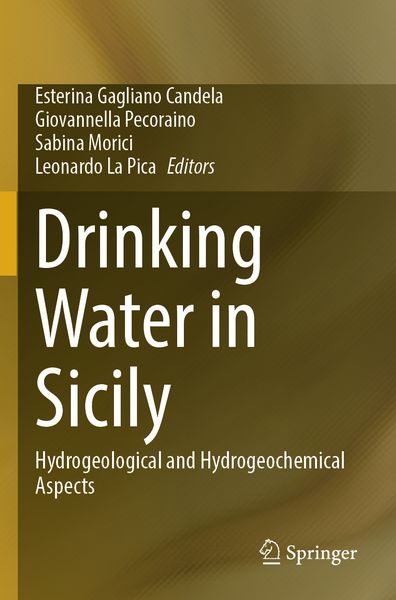
Drinking Water in Sicily Hydrogeological and Hydrogeochemical Aspects
-
- Hardcover
- Taschenbuch ausgewählt
- eBook
-
Sprache:Englisch
146,99 €
inkl. gesetzl. MwSt.,
Beschreibung
Produktdetails
Einband
Taschenbuch
Erscheinungsdatum
21.07.2025
Abbildungen
X, 234 p. 113 illus., 76 illus. in color.
Herausgeber
Esterina Gagliano Candela + weitereVerlag
SpringerSeitenzahl
234
Maße (L/B/H)
23,5/15,5/1,3 cm
Gewicht
421 g
Sprache
Englisch
ISBN
978-3-031-60475-1
This book consists of the hydrogeochemical study of the springs of the Sicilian territory used for drinking water purposes. One of the most important issues in the environmental field is the protection of water resources and in particular the safeguarding of water intended for drinking water use. Water resources need a careful prevention of pollution starting from multidisciplinary studies (geology, hydrogeology, geochemistry, geophysics) to understand the territory in order to highlight vulnerable areas and then plan, where necessary, monitoring activities for the control and protection of the resource.
The reference is the Piano Regolatore degli Acquedotti (PRGA) of Sicily, Italy (updated in November 2010), which lists all the springs, subdivided by province (a total of 1014), currently used to supply water to Sicilian aqueducts. With regard to the geochemical part, the studies carried out by the INGV, Sezione di Palermo, for the Water Protection Plan for Sicily (2004-2005) were used as basic data. The study of the chemical characteristics of groundwater is of fundamental importance from a hydrogeological point of view as it allows the origin of the water and its evolution to be reconstructed. Springs as a groundwater resource are of considerable importance in relation to the availability of water resources due to the general decrease in precipitation. In the first part of the book all the existing data (flow rates, geochemical parameters, water quality, etc.) are collected and subsequently transferred to GIS software, after appropriate evaluations on the validity of the acquired data. Considering that the subject is quite delicate and involves various aspects (compliance with regulations, vulnerability of groundwater, anthropogenic pollution, etc.), carrying out a purely scientific study allows groundwater to be placed in a broader context than that of legislation aimed exclusively at compliance with the regulations in force.
Noch keine Bewertungen vorhanden
Verfassen Sie die erste Bewertung zu diesem Artikel
Helfen Sie anderen Kundinnen und Kunden durch Ihre Meinung.
Kurze Frage zu unserer Seite
Vielen Dank für dein Feedback
Wir nutzen dein Feedback, um unsere Produktseiten zu verbessern. Bitte habe Verständnis, dass wir dir keine Rückmeldung geben können. Falls du Kontakt mit uns aufnehmen möchtest, kannst du dich aber gerne an unseren Kund*innenservice wenden.
zum Kundenservice