Gutscheinbedingungen

**Gültig vom 20.07.2026 bis 22.07.2026 | Gültig für nicht preisgebundene fremdsprachige Bücher | Einzelne Artikel können ausgeschlossen sein | Nicht kombinierbar mit anderen Gutscheinen oder Preisaktionen | Nur einmal pro Einkauf einlösbar | Gutschein wird auf max. 500€ Bestellwert angerechnet | Keine Barauszahlung | Nicht gültig für Versandkosten und Services

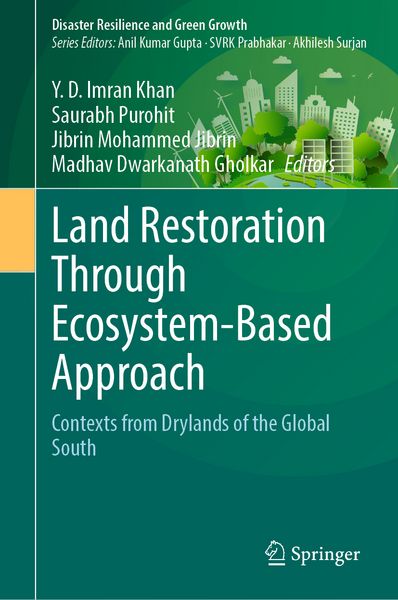
Produktbild: Land Restoration Through Ecosystem-Based Approach
- 10%

Land Restoration Through Ecosystem-Based Approach Contexts from Drylands of the Global South

10% sparen

191,99 € UVP 213,99 €

inkl. gesetzl. MwSt., Versandkostenfrei

Lieferung nach Hause

Beschreibung

Produktdetails

Einband

Gebundene Ausgabe

Erscheinungsdatum

27.09.2025

Abbildungen

XXXIII, 134 illus., 127 illus. in color., farbige Illustrationen, schwarz-weiss Illustrationen

Herausgeber

Y. D. Imran Khan + weitere

Verlag

Springer Singapore

Seitenzahl

700

Maße (L/B/H)

24,1/16/4,5 cm

Gewicht

1199 g

Auflage

1. Auflage

Sprache

Englisch

ISBN

978-981-9503-88-9

Beschreibung

Portrait

Dr. Y. D. Imran Khan is a Senior Researcher and Thematic Lead (Ecology) at the WOTR-Centre for Resilience Studies (W-CReS), Watershed Organisation Trust (WOTR) in Pune, India. He holds a Ph.D. in Zoology (with a specialisation in Ecology) from Bangalore University, Bengaluru, and an M.Sc. in Zoology from Sri Krishnadevaraya University, Anantapur. Before joining WOTR, Dr. Khan worked at the Institute for Social and Economic Change (ISEC) in Bengaluru, the National Institute of Rural Development and Panchayati Raj (NIRD&PR) in Hyderabad, and the Tata Institute of Social Sciences (TISS) in Mumbai. His areas of interest include conservation biology, socio-ecology, rural livelihoods, and watershed Ecology. Dr. Khan collaborates with interdisciplinary and transdisciplinary teams of scholars from various national and international organisations to integrate ecological and social science approaches in assessing the impact of policy and behavioural changes.

Dr. Saurabh Purohit is currently working as a Senior Researcher (Ecology) at the WOTR-Centre for Resilient Ecosystem (W-CReS), Watershed Organization Trust (WOTR), Pune. He has over ten years of research expertise in natural resource management from the Western Himalayan region to the foothills of Western Ghats. He earned both a Master's and a PhD degree in Forestry from the Forest Research Institute (Deemed to be University). His research was conducted at the Indian Institute of Remote Sensing (IIRS), which is affiliated with the Indian Space Research Organisation (ISRO) in Dehradun. In his current role, Dr. Purohit is working on using nature-based solutions to increase the resilience of rural communities in the semi-arid landscape of India. His specialization includes a wide range of subjects, including Nature-based Solutions, carbon sequestration, sustainable forest practices, ecological niche modelling, remote sensing, GIS, and natural resource management.

Prof. Jibrin Mohammed Jibrin is a Professor of Soil Science with over thirty years of experience in agriculture and rural development. His public service started in 1998 as an Extension Specialist with the National Agricultural Extension and Research Liaison Services in Nigeria. He is currently the Director of the World Bank-funded Africa Centre of Excellence in Dryland Agriculture (CDA), President of the Soil Science Society of Nigeria, and President of the Food for West Africa (Food4WA) Network. Professor Jibrin has published several scientific articles in national and international peer-reviewed journals and has contributed to book chapters and edited conference proceedings. His research focuses on plant nutrient management in semi-arid environments, simulating the effects of future climates and soil management on crop yields in semi-arid areas, and natural resource management in drylands. 


Mr. Madhav D. Gholkar , a Thematic Lead (Climate Resilient Agriculture) at W-CReS (WOTR Centre for Resilience Studies), possesses over 16 years of professional expertise in climate-resilient agricultural practices, GHG emission assessment, energy and carbon exchanges, valuation of ecosystem services, knowledge transfer, and capacity building of stakeholders for ecosystem-based adaptation. He holds a Master's degree in Agriculture Systems and Engineering from the Asian Institute of Technology (AIT), Bangkok, and a Bachelor's degree in Agricultural Engineering from Mahatma Phule Krishi Vidyapeeth (MPKV), Maharashtra, India. At WOTR, his focus is on implementation and applied research in sustainable agriculture and allied sectors. Before joining WOTR, he worked at the Space Applications Centre (SAC, ISRO), specialising in remote sensing (RS) and GIS applications in agriculture, and at GVK Bio-Sciences Pvt. Ltd., where he focused on environmental fate modeling of agrochemicals. He has also presented his work at national and international events, including UNCCD COP14 and the ADB conference.

Produktdetails

Einband

Gebundene Ausgabe

Erscheinungsdatum

27.09.2025

Abbildungen

XXXIII, 134 illus., 127 illus. in color., farbige Illustrationen, schwarz-weiss Illustrationen

Herausgeber

Verlag

Springer Singapore

Seitenzahl

700

Maße (L/B/H)

24,1/16/4,5 cm

Gewicht

1199 g

Auflage

1. Auflage

Sprache

Englisch

ISBN

978-981-9503-88-9

Herstelleradresse

Springer-Verlag KG
Sachsenplatz 4-6
1201 Wien
AT

Email: GPSR Kontakt

Noch keine Bewertungen vorhanden

Verfassen Sie die erste Bewertung zu diesem Artikel

Helfen Sie anderen Kundinnen und Kunden durch Ihre Meinung.

Kundinnen und Kunden meinen

Bewertungen (0)

  • Produktbild: Land Restoration Through Ecosystem-Based Approach
  • 1. Land Restoration Using Ecosystem Approaches in the Countries of the Global South - Prologue.- 2. Climate Change and Ecosystem-Based Approach: Adapting to Climate Change in Dryland Ecosystems; Mitigation and Resilience through Ecosystem-Based Solutions.- 3. Nature-based Solutions (NbS) for Restoration and Management of Drylands Ecosystems.- 4. Why Less Visual and Under-valued Lands Need Urgent Restoration: Perspectives from India's semi-arid Rangelands.- 5. Restoration of tropical drylands: lessons from Tamil Nadu, India.- 6. Study of the Impact of Irrigation on Groundwater Quality in the Jam River Basin, Nashik and Ahilyanagar Districts, Maharashtra, India.- 7. Ecosystem-Based Approaches to Natural Resource Management: Adapting to Climate Change in Arid Regions.- 8. Fostering the Future of Drylands: Balancing Productivity and Resilience through Nature-based Solutions.- 9. Adapting to Climate Change in Dryland Ecosystems; Mitigation and Resilience through Ecosystem-based adaptation.- 10. Soil-based Dryland Restoration Practices in Southern Africa: A Systematic Review.- 11. Nature-based disaster risk management approach in the sudano-sahelian zone of Cameroon .- 12. Avian Diversity and Feeding Guild of Inland Wetland in a Semi-arid Region: Implication for wetland conservation and restoration.- 13. Reviving Groundwater Ecosystem Health: Industrial Effluent Impacts on Water Quality and Agricultural Sustainability in Solapur's Chincholi Industrial Zone.- 14. Soybean Farmers’ Ecosystem-Based approach in Mitigating Climate Change in Savannah Agroecological Zones in Northern Ghana.- 15. Mitigating Climate Change through Sustainable Farming: An Organic Approach for Dryland Resilience in Maharashtra.- 16. Scaling up of Vermicomposting in the Selected Landscapes of Madhya Pradesh and Chhattisgarh for Sustainable Agriculture and Land Productivity.- 17. Plant breeding strategies for sustainable agriculture in climate change context: A literature review.- 18. Utilizing decision support tools to optimize resource allocation for different categories of Farmers in Northern Ghana.- 19. Promoting Ecosystem-Based Adaptation to Climate Change in a Fragile Ecological Context of the Northern Cameroon: An Innovation Niche Approach.- 20. Soil and Water Conservation Technologies for Ecosystem Restoration in the Drylands.- 21. MaxEnt's forecast of climate change’s effect on habitat suitability of Anacardium occidentale L. in Togo (West Africa).- 22. Integrating Remote Sensing and Land Use Change to Identify Potential  Wetland Restoration Areas: A Multi-year Analysis Using Landsat Data.- 23. Multi-Stakeholder Participatory Approaches for Sustainable Dryland Restoration in Sub-Saharan Africa.- 24. Indigenous Ecological Knowledge and Climate Change Adaptation.- 25. Mainstreaming Circular Ecosystem-based Approach into National Climate Adaptation Strategies: Enhancing Resilience and Sustainability of Crop-Livestock Systems in Africa's Drylands.- 26. Restoring dryland ecosystems: local knowledge, native species, and tree restoration policies and practices in northern Nigeria.- 27. Understanding Government Policies on Climate-Smart Agriculture : Insights from Burkina Faso and Ghana.- 28. The Potential and Policy Options for Mainstreaming Ecosystem Based Adaptation in Africa’s Drylands.- 29. Probing into Nexus Between Industrial Development and Dryland Degradation in Global South.- 30. Restoring Drylands: Policy Pathways, Governance, and Stakeholder Synergy for Ecosystem Revival.- 31. Lessons Learned and the way forward for Land Restoration through Ecosystem-Based Approach in the Drylands.