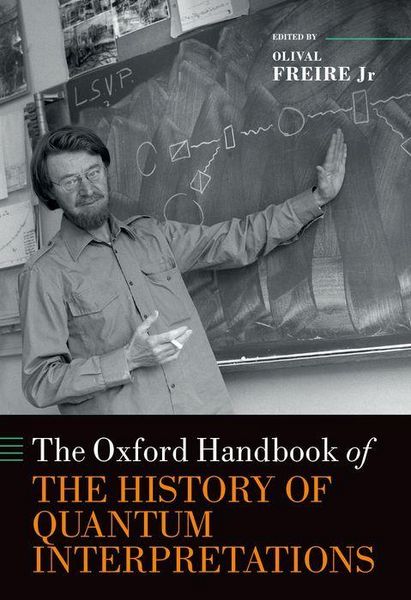
Produktbild: The Oxford Handbook of the History of Quantum Interpretations

The Oxford Handbook of the History of Quantum Interpretations

69,99 €

inkl. gesetzl. MwSt., Versandkostenfrei

Lieferung nach Hause

Beschreibung

Produktdetails

Einband

Taschenbuch

Erscheinungsdatum

07.02.2026

Abbildungen

43 line illustrations and halftones

Herausgeber

Bacciagaluppi Guido + weitere

Verlag

Oxford Academic

Seitenzahl

1312

Maße (L/B/H)

24,6/17,2/5,1 cm

Gewicht

1954 g

Sprache

Englisch

ISBN

978-0-19-898907-3

Beschreibung

Produktdetails

Einband

Taschenbuch

Erscheinungsdatum

07.02.2026

Abbildungen

43 line illustrations and halftones

Herausgeber

Verlag

Oxford Academic

Seitenzahl

1312

Maße (L/B/H)

24,6/17,2/5,1 cm

Gewicht

1954 g

Sprache

Englisch

ISBN

978-0-19-898907-3

Herstelleradresse

Libri GmbH
Europaallee 1
36244 Bad Hersfeld
DE

Email: gpsr@libri.de

Noch keine Bewertungen vorhanden

Verfassen Sie die erste Bewertung zu diesem Artikel

Helfen Sie anderen Kundinnen und Kunden durch Ihre Meinung.

Kundinnen und Kunden meinen

Bewertungen (0)

  • Produktbild: The Oxford Handbook of the History of Quantum Interpretations
    • Introduction

    • Part I - Quantum physics: scientific and philosophical issues under debate

    • 1: Franck Laloë: Quantum Mechanics is Routinely Used in Laboratories with Great Success, but No Consensus on its Interpretation has Emerged

    • 2: Wayne Myrvold: Philosophical Issues Raised by Quantum Theory and its Interpretations

    • Part II - Historical landmarks of the interpretations and foundations of quantum physics

    • 3: Anthony Duncan and Michel Janssen: Quantization conditions, 1900-1927

    • 4: Massimiliano Badino: Of weighting and counting: statistics and ontology in the old quantum theory

    • 5: Helge Kragh: Dead as a doornail? Zero-point energy and Low-temperature physics in early quantum theory

    • 6: Martin Jähnert and Christoph Lehner: The early debates about the interpretation of quantum mechanics by

    • 7: Christian Joas: Foundations and applications: the creative tension in the early development of quantum mechanics

    • 8: Guido Bacciagaluppi: The statistical interpretation: Born, Heisenberg and von Neumann, 1926-27

    • 9: Klaus Hentschel: A perennially grinning Cheshire cat? Over a century of experiments on light quanta and their perplexing interpretations

    • 10: Daniela Monaldi: The evolving understanding of quantum statistics

    • 11: Osvaldo Pessoa Jr.: The measurement problem

    • 12: Michel Paty: Einstein's criticisms of quantum mechanics

    • 13: David Kaiser: Tackling loopholes in experimental tests of Bell's inequality

    • 14: Thiago Hartz: The measuring process in quantum field theory

    • 15: Alexander Blum and Bernadette Lessel: The interpretation debate and quantum gravity

    • 16: Alexei Grinbaum: Quantum information and the quest for reconstruction of quantum theory

    • 17: Olivier Darrigol: Natural reconstructions of quantum mechanics

    • 18: Klaas Landsman: The axiomatization of quantum theory through functional analysis: Hilbert, von Neumann, and beyon

    • 19: Fabio Freitas: Tony Leggett's challenge to quantum mechanics and its path to decoherence

    • Part III - Places and contexts relevant for the interpretations of quantum theory

    • 20: Don Howard: The Copenhagen interpretation

    • 21: Anja Skaar Jacobsen: Copenhagen and Niels Bohr

    • 22: Elise Crull: Grete Hermann's Interpretation of quantum mechanics

    • 23: Climério Paulo da Silva Neto: Instrumentation and the foundations of quantum mechanics

    • 24: José G. Perillán: Early solvay councils: rhetorical lenses for quantum convergence and divergence

    • 25: Flavio Del Santo: The foundations of quantum mechanics in post-war Italy's cultural context

    • 26: Jean-Philippe Martinez: Foundation of quantum physics in the Soviet Union

    • 27: Kenji Ito: Early japanese reactions to the interpretation of quantum mechanics, 1927-1943

    • 28: Josep Simon: Form and meaning: textbooks, pedagogy, and the canonical genres of quantum mechanics

    • 29: Indianara Silva: Chien-Shiung Wu's contributions to experimental philosophy

    • 30: Sebastián Murgueitio Ramírez: On how Epistemological Letters changed the foundations of quantum mechanics

    • 31: Thomas Ryckman: Quantum interpretations and 20th century philosophy of science

    • Part IV - Historical and philosophical theses

    • 32: Stefano Osnaghi: Bohr and the epistemological lesson of quantum mechanics

    • 33: Olival Freire Jr: Making sense of the century-old scientific controversy over the quanta

    • 34: Kristian Camilleri: Orthodoxy and heterodoxy in the postwar era

    • 35: Paul Forman: The reception of the Forman thesis in modernity and postmodernity

    • 36: Alexei Kojevnikov: Quantum historiography and cultural history: revisiting the Forman thesis

    • 37: Richard Staley: The co-creation of classical and modern physics and the foundations of quantum mechanics

    • 38: Giora Hon and Bernard R. Goldstein: Interpretation in electrodynamics, atomic theory, and quantum mechanics

    • Part V - The proliferation of interpretations

    • 39: Jeffrey Bub: Hidden variables

    • 40: Jeffrey Barrett: Pure wave mechanics, relative states, and many worlds

    • 41: Hervé Zwirn: Is QBism a possible solution to the conceptual problems of quantum mechanics?

    • 42: Karen Barad: Agential realism: a relation ontology interpretation

    • 43: Carlo Rovelli: Relational interpretation

    • 44: Jean-Jacques Szczeciniarz and Joseph Kouneiher: The philosophy of wholeness and the general and new concept of order: Bohm's and Penrose's points of view

    • 45: Valia Allori: Spontaneous localization theories: quantum philosophy between history and physics

    • 46: Decio Krause, Jonas Arenhart, and Otavio Bueno: The non-individuals interpretation of quantum mechanics

    • 47: Dennis Dieks: Modal interpretations of quantum mechanics

    • 48: Gustavo Rocha, Dean Rickles, and Florian Boge: A brief historical perspective on the consistent histories interpretation of quantum mechanics

    • 49: Jean Bricmont: Einstein, Bohm and Bell: a comedy of errors

    • 50: Alexander Pechenkin: The statistical (ensemble) interpretation of quantum mechanics

    • 51: Emilio Santos: Stochastic interpretations of quantum mechanics