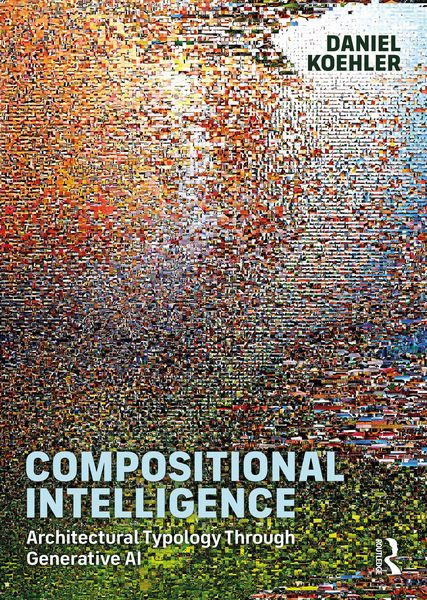
Compositional Intelligence Architectural Typology Through Generative AI
-
- Taschenbuch
- eBook ausgewählt
-
Form:Einzelkauf Download
-
Sprache:Englisch
-
eBook Format:PDF
- PDF 49,99 € ausgewählt
- ePUB 49,99 €
49,99 €
inkl. gesetzl. MwSt.Beschreibung
Produktdetails
Format
Kopierschutz
Ja
Family Sharing
Nein
Text-to-Speech
Nein
Erscheinungsdatum
12.09.2025
Verlag
Taylor & Francis eBooksSeitenzahl
256 (Printausgabe)
Dateigröße
159236 KB
Auflage
1. Auflage
Sprache
Englisch
EAN
9781040442456
*With a foreword by Mario Carpo*
Given the extensive data sources represented by urban environments, this book investigates the potential of architecting for cities using large-scale models - the technological underpinning of Generative AI. Koehler examines Large Language Models (LLMs) in relation to architectural questions of typology - those critical junctures where architecture engages with the city itself. Typology becomes the interface between an AI model and its modeled audiences, represented languages, and scales of operation.
The investigation reveals how LLMs represent a fundamental shift from comprehending discrete elements to understanding entire languages - introducing a stochastic perspective that transforms how we read and shape urban reality. At the heart of this framework lies the concept of "inductive types" - threshold interfaces that superpose multiple value regimes and actively reconfigure themselves in response to changing urban conditions. By treating architecture as a form of representational materialism rather than a fixed language, designers can engage with complex urban systems while maintaining critical agency.
This approach envisions architecture as an embedding of languages, where buildings become processors of information that compute through their spatial arrangements. The synthetic knowledge produced by LLMs enables access to plural values and stakeholder perspectives, allowing architects to participate in broader material ecologies through computational superposition rather than traditional dialectical methods.
Providing a robust theoretical framework as well as practical insights into how architects can adapt their notational tools and design processes to embrace AI, this will be an essential read for any practicing or researching architect or urban designer interested in the implications of AI on the built environment.
Kundinnen und Kunden meinen
Verfassen Sie die erste Bewertung zu diesem Artikel
Helfen Sie anderen Kund*innen durch Ihre Meinung
Kurze Frage zu unserer Seite
Vielen Dank für dein Feedback
Wir nutzen dein Feedback, um unsere Produktseiten zu verbessern. Bitte habe Verständnis, dass wir dir keine Rückmeldung geben können. Falls du Kontakt mit uns aufnehmen möchtest, kannst du dich aber gerne an unseren Kund*innenservice wenden.
zum Kundenservice