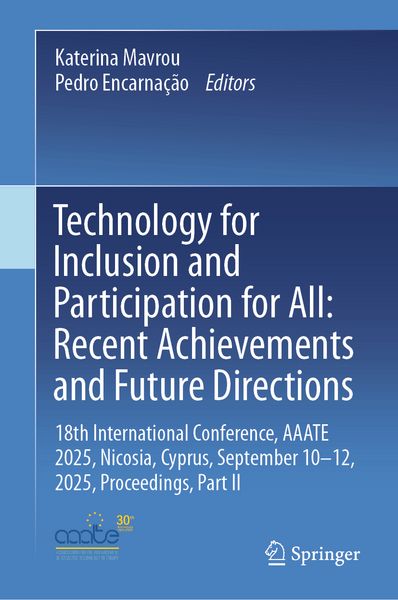
Produktbild: Technology for Inclusion and Participation for All: Recent Achievements and Future Directions
- 12%

Technology for Inclusion and Participation for All: Recent Achievements and Future Directions 18th International Conference, AAATE 2025, Nicosia, Cyprus, September 10-12, 2025, Proceedings, Part II

12% sparen

234,99 € UVP 267,49 €

inkl. gesetzl. MwSt., Versandkostenfrei

Lieferung nach Hause

Beschreibung

Produktdetails

Einband

Gebundene Ausgabe

Erscheinungsdatum

01.09.2025

Abbildungen

XXI, 77 illus., 56 illus. in color., schwarz-weiss Illustrationen, farbige Illustrationen

Herausgeber

Katerina Mavrou + weitere

Verlag

Springer

Seitenzahl

415

Maße (L/B/H)

24,1/16/3 cm

Gewicht

820 g

Sprache

Englisch

ISBN

978-3-032-01631-7

Beschreibung

Produktdetails

Einband

Gebundene Ausgabe

Erscheinungsdatum

01.09.2025

Abbildungen

XXI, 77 illus., 56 illus. in color., schwarz-weiss Illustrationen, farbige Illustrationen

Herausgeber

Verlag

Springer

Seitenzahl

415

Maße (L/B/H)

24,1/16/3 cm

Gewicht

820 g

Sprache

Englisch

ISBN

978-3-032-01631-7

Herstelleradresse

Springer-Verlag KG
Sachsenplatz 4-6
1201 Wien
AT

Email: GPSR Kontakt

Noch keine Bewertungen vorhanden

Verfassen Sie die erste Bewertung zu diesem Artikel

Helfen Sie anderen Kundinnen und Kunden durch Ihre Meinung.

Kundinnen und Kunden meinen

Bewertungen (0)

  • Produktbild: Technology for Inclusion and Participation for All: Recent Achievements and Future Directions
  • Assistive technology in the healtcare sector.- Enhancing Safety and Navigation in Intelligent Nursing Wheelchairs Using 3D LiDAR Technology.- Co-Designing Modular Robots for Rapid Prototyping in the Care Sector.- Public Attitudes to Participatory Governance and Digital Health Infrastructures: A Pan-European, Cross-Sectional Survey.- Assistive technology provision.- Assistive Technology 4 All – Developing Assistive Devices in Low Resource Settings.- Designing technology of inclusion and participation: the relevance of the lived experiences of Dutch parents caring for children with profound intellectual and multiple disabilities at home.- Augmentative and alternative communication.- Sensory Informed AAC: Is This The Missing Piece In AAC Coaching for Autistic Children?.- Empowering Individuals with Speech Disabilities through an Augmentative and Alternative Communication (AAC) App with Visual Scene Display (VSD).- The VoiceKids Knowledge Hub: An Innovative Open Educational Resource Integrating Instructional Design, Assistive Technology, and AAC for Inclusive Teacher Training.- A Review of the State of the Speech Synthesis Technology Landscape - the Availability of Child Voices.- A Review of the State of the Speech Synthesis Technology Landscape - Neural TTS on the Edge.- Embracing change: Aging, digitalisation, and the future of care.- A Study on Implementation of Lifts in Nursing Homes in Japan.- A Physical Load Estimation Model of Assisted Walking for Welfare Aid Placement.- Smart Chair for Activation & Monitoring – Refining the Requirements with Users.- Non-Intrusive Fall Detection in Sensitive Environments: An Ultrasound-Based Solution.- Age-Friendly AI: Ireland's National Artificial Intelligence Literacy Initiative.- Embracing Change Through Ageing Diverse And Equal: Recommendations To Advance The Rights Of Older Persons With Disabilities In Research And Implementation Projects.- Enhancing Mealtime Experiences for Patients with Dementia Experiencing Dysphagia through Assistive Technologies.- Longitudinal Psychosocial Outcomes from the SHAPES Smart and Healthy Ageing Pan-European Pilot Programme: An ethical issue in discontinuing beneficial technologies following the completion of research trials?.- Digital Home Care – Real Life Experiences Reflecting The User Perspective.- Enhancing Elderly Care through IoT Integration: Insights from the ISABELLA Project.- The Implementation And Use Of A Multi-sensory Room For People With Dementia In A Nursing Home.- Human - Assistive technology interface.- AT and AI Tools for Enhancing Smartphone and Computer Accessibility for Mobility-Impaired Users – a short Literature Review and Insights from Two Clinical Case Studies.- Gesture Interface for Providing Interaction to a Child with Cerebral Palsy.- ICT to support inclusive education – Universal Design for Learning (UDL).- Use of ICT in Note-taking by University Students with Specific Learning Difficulties and Their Peers.- Enhancing Image Accessibility in Educational Contexts for Blind and Visually Impaired Learners Through Integrated Computer Vision Techniques.- Competencies for the Transition from the Psychometric Approach to Personalization: the *** Framework.- Education Technology for Students with ADHD in Upper Secondary School.- Empower Me - Enhancing Self-Esteem through Inclusive Digital Gaming.- Innovations in assistive technology to support mobility and participation.- Spatial Information Access for Blind and Visually Impaired People: Research Trends and Regional Perspectives.- Handforce, A Hand Rehabilitation Tool For Domestic Use.- The Viability of a Steering-by-Leaning System to Control a Manual Wheelchair One-Handedly.- From Experiment to Experience: Real-World Case Studies on Steering-by-Leaning Wheelchairs.- Investigating How The Selection And Training In Wheelchair Use Impact Users’ Occupational Balance.- Making Electric Vehicles Audible: Perception and Inclusivity in Acoustic Vehicle Alerting System Design.- Acceptability of AI-based Innovation to Improve Sitting and Overall Health for Wheelchair Users.- Mixed Reality (MR) Application for the Rehabilitation of People with Hemineglect.- A Description of Facilitators and Barriers to Paratransit in Quebec When Travelling With a Child Aged 5 or Younger.- Museums for all: Co-design, inclusion and emerging technologies.- Co-Designing a Digital Person-Centered Plan for Intellectual Disability Services in Ireland: Enhancing Accessibility and Integration through the iPlanit Platform.- A Conceptual Framework for Transforming Accessibility and Sustainability in Museums with Generative AI.- Co-Designing Technology Enhanced Cultural Heritage Educational Programmes with Persons with Intellectual Disabilities: A Small Case Study Experience.- Robotic assistive technology for children.- Exploring the Potential of Educational Robots in Enhancing Mathematics Education for Students with Dyslexia: Towards Inclusive Multimodal Interfaces.- Inclusive Play Through Robotic Toys and Accessible Design: a Child-centred Approach.- Inclusive Play through Robots: Insights from Early Experimentation.- Robots Facilitating Communication In Individuals Who Are Deaf Or Hard Of Hearing.- Assessment Of Speech And Language Therapy Assisted With Social Robots And Virtual Reality: Phonetic And Linguistic Analysis Of Speech.- Investigating the Impact of Learning-by-Teaching a Social Robot on Students with Different Prior Knowledge Levels.- User-centered assistive technology co-design.- Learning from Each Other: An Inclusive and reflexive analysis of the experiences of co-designers with intellectual disabilities.- Enhancing Accessibility In Publishing: Leveraging GAI For Effective Alt-text Solutions.- Toward More Inclusive Recommender Systems: Designing for Blind, Partially Sighted, and Autistic Users.- Empowering People with Visual Disabilities in Audio Description Production: Development and Preliminary Evaluation of a User-Centred Synthesised Voice Adjustment Tool.- Exploring Clinical Evaluation Practices in Companies and Insights for Advancing Assistive Technology.