Gutscheinbedingungen

**Gültig bis 10.06.2026 / Gültig für gebrauchte Bücher / Mindestbestellwert 20,00 € / Einzelne Artikel können ausgeschlossen sein / Online auf www.bücher.de.de / Nicht kombinierbar mit anderen Gutscheinen oder Preisaktionen / Nur einmal pro Einkauf einlösbar / Gutschein wird auf max. 500€ Bestellwert angerechnet / Keine Barauszahlung / Nicht gültig für Versandkosten und Services

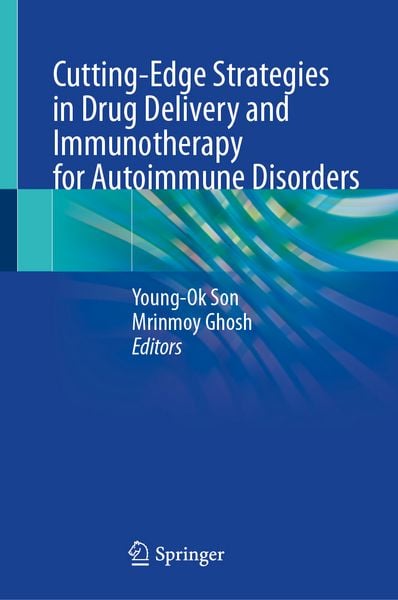
Produktbild: Cutting-Edge Strategies in Drug Delivery and Immunotherapy for Autoimmune Disorders
- 10%

Cutting-Edge Strategies in Drug Delivery and Immunotherapy for Autoimmune Disorders

10% sparen

133,99 € UVP 149,79 €

inkl. gesetzl. MwSt., Versandkostenfrei

Lieferung nach Hause

Beschreibung

Produktdetails

Einband

Gebundene Ausgabe

Erscheinungsdatum

27.09.2025

Abbildungen

VIII, 32 illus., 25 illus. in color., schwarz-weiss Illustrationen, farbige Illustrationen

Herausgeber

Young-Ok Son + weitere

Verlag

Springer Singapore

Seitenzahl

284

Maße (L/B/H)

24,1/16/2,1 cm

Gewicht

657 g

Auflage

1. Auflage

Sprache

Englisch

ISBN

978-981-9505-19-7

Beschreibung

Portrait

Prof. Young Ok Son is a distinguished researcher and educator specializing in cell biology and molecular biochemistry. At Jeju National University, his research focuses on utilizing bioactive compounds derived from Jeju’s rich biodiversity to develop innovative disease control models. His work targets key arthritis-associated genes, including HIF2α, ZIP8, ERRγ, and ZFP36L1, with the aim of identifying natural inhibitors and advancing novel therapeutic strategies for arthritis. As Director of the Practical Translational Research Center and Associate Professor in the Department of Animal Biotechnology, Prof. Son plays a central role in interdisciplinary research initiatives. He also serves as an Adjunct Professor in the Interdisciplinary Graduate Program in Advanced Convergence Technology and Science. His exceptional contributions to education and research have earned him numerous accolades, including the Outstanding Faculty Award for Excellence in Thesis Advising (Ph.D course, 2025) and the Best Professor for Research (2023). Prof. Son is a multiple recipient of the JNU BK-Honor Award for Professor (2025), as well as the JNU Rising BK-Honor Award for Professor (2023, 2022), and has also been recognized with the Best Professor for Teaching Student Thesis award (2021). Internationally, he has been named among the World's Top 2% Scientists by Stanford University and Elsevier in both 2023 and 2024. His expertise has also been acknowledged by the Korean Scientists and Engineers Network and the Korean Society for Cell Biology, where he received the Best Expert Award and Young Scientist Award. Prof. Son’s accomplishments highlight his dedication to scientific excellence, research leadership, and the mentoring of future scholars.

Dr. Mrinmoy Ghosh is a distinguished researcher specializing in molecular biology and computational biology, with a strong foundation in industrial biotechnology and genomics. He began his academic journey as a Postdoctoral Research Fellow at Jeju National University, South Korea, where he has been instrumental in advancing research at the intersection of omics technologies and nanomedicine. His pioneering work focuses on the development of nanotechnology-based microRNA (miRNA) therapeutics for the treatment of osteoarthritis, driven by cutting-edge applications of Next Generation Sequencing (NGS). With deep expertise in genomic analysis and systems biology, Dr. Ghosh is adept at decoding complex biological pathways and extracting actionable insights from high-dimensional data. His research is closely aligned with the missions of major scientific institutions such as the National Research Foundation of Korea (NRF) and the Research Institute for Basic Sciences (RIBS), contributing to interdisciplinary projects aimed at therapeutic innovation. Dr. Ghosh's contributions to science have been recognized with the prestigious Brain Pool Program award in 2022, granted by the Ministry of Science and ICT through the NRF of South Korea. His proficiency in computational biology and dedication to translational research continue to position him as a valuable contributor to the global biomedical research community.

Produktdetails

Einband

Gebundene Ausgabe

Erscheinungsdatum

27.09.2025

Abbildungen

VIII, 32 illus., 25 illus. in color., schwarz-weiss Illustrationen, farbige Illustrationen

Herausgeber

Verlag

Springer Singapore

Seitenzahl

284

Maße (L/B/H)

24,1/16/2,1 cm

Gewicht

657 g

Auflage

1. Auflage

Sprache

Englisch

ISBN

978-981-9505-19-7

Herstelleradresse

Springer-Verlag GmbH
Tiergartenstr. 17
69121 Heidelberg
DE

Email: [email protected]

Kundinnen und Kunden meinen

0 Bewertungen

Informationen zu Bewertungen

Zur Abgabe einer Bewertung ist eine Anmeldung im Konto notwendig. Die Authentizität der Bewertungen wird von uns nicht überprüft. Wir behalten uns vor, Bewertungstexte, die unseren Richtlinien widersprechen, entsprechend zu kürzen oder zu löschen.

Die Bewertungen sind nach Format, Anzahl Sterne und Datum sortiert.

Verfassen Sie die erste Bewertung zu diesem Artikel

Helfen Sie anderen Kund*innen durch Ihre Meinung

Kundinnen und Kunden meinen

0 Bewertungen filtern

  • Produktbild: Cutting-Edge Strategies in Drug Delivery and Immunotherapy for Autoimmune Disorders
  • 1. Introduction to Autoimmune Diseases: A Global Health Challenge.- 2. Genetic Predisposition and Epigenetic Modifications in Autoimmune Pathogenesis.- 3. Familial Aggregation and Hereditary Factors in Autoimmunity.- 4. Decoding Environmental Triggers: Advancing Therapeutic Strategies and Preventive Measures for Rheumatoid Arthritis, Type 1 Diabetes, and Multiple Sclerosis.- 5. Environmental Triggers and Autoimmune Responses.- 6. Spectrum of Autoimmune Disorders: From Systemic to Organ-Specific Manifestations.- 7. Therapeutic Modalities for Autoimmune Diseases: Current Challenges and Future Directions.- 8. Molecular and Cellular Mechanisms Underlying Autoimmune Pathologies.- 9. Underlying the cellular regulations in Autoimmune Pathologies.- 10. Computational Modeling in Understanding Autoimmune Disorders.- 11. Novel Compounds and Drug Delivery Systems in Autoimmune Therapy.- 12. Targeted Next-Generation Nanoparticles in Autoimmune Disease Treatment.