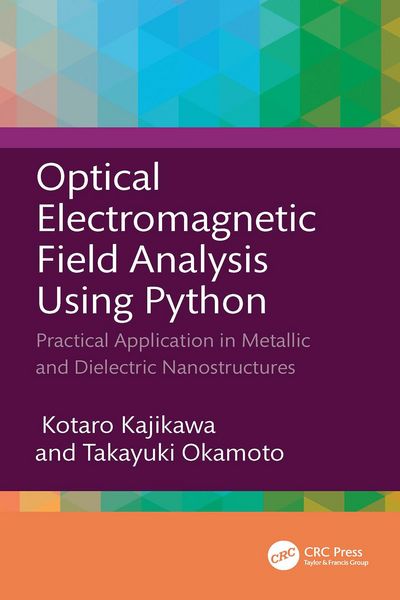
Optical Electromagnetic Field Analysis Using Python Practical Application in Metallic and Dielectric Nanostructures
78,99 €
inkl. gesetzl. MwSt.Beschreibung
Produktdetails
Format
Kopierschutz
Ja
Family Sharing
Nein
Text-to-Speech
Nein
Erscheinungsdatum
25.06.2025
Verlag
Taylor & Francis eBooksSeitenzahl
264 (Printausgabe)
Dateigröße
7735 KB
Auflage
1. Auflage
Sprache
Englisch
EAN
9781040363010
In this book, Kajikawa and Okamoto explain how to use Python to calculate and visualize the optical response of microscopic structures and systems. Throughout, the authors provide varied examples to instruct readers in the application of theoretical knowledge to real-world scenarios.
Electromagnetic field analysis is often necessary to determine the optical response of materials with microscopic structures. Although the principles are widely described, the manual calculation and visualization of results are not and remain challenging. Python is the ideal language to use for this as it has a large functional library for visualizing analysis results and is suitable for programming beginners to use at low cost, so it has many advantages over languages like Fortran, BASIC, and C. Here, the authors introduce the application of Python to various electromagnetic field analysis scenarios in the field of nanophotonics. The first half of the book describes cases in which there is an analytical solution for the structure and addresses scenarios such as scattering and absorption in spherical and cylindrical structures and complex structures such as rotating ellipsoids, sphere-aggregated structures, and hemispherical structures. The second half describes methods including rigorous coupling wave analysis, finite-difference time-domain method and discrete dipole approximation for numerically solving varied structures. This book enables readers to conduct their own electromagnetic field analysis quickly, cheaply, and accurately without in-depth study of other complicated and time-consuming approaches or programs.
This book is invaluable for researchers and postgraduate students working in the fields of optics and photonics. Additionally, the contents are useful not only for those conducting electromagnetic field analysis but also those simulating physical, chemical, and biological phenomena.
Noch keine Bewertungen vorhanden
Verfassen Sie die erste Bewertung zu diesem Artikel
Helfen Sie anderen Kundinnen und Kunden durch Ihre Meinung.
Kurze Frage zu unserer Seite
Vielen Dank für dein Feedback
Wir nutzen dein Feedback, um unsere Produktseiten zu verbessern. Bitte habe Verständnis, dass wir dir keine Rückmeldung geben können. Falls du Kontakt mit uns aufnehmen möchtest, kannst du dich aber gerne an unseren Kund*innenservice wenden.
zum Kundenservice