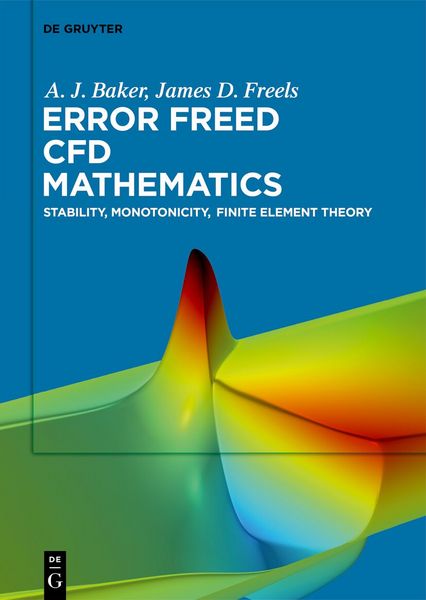
Error Freed CFD Mathematics Stability, Monotonicity, Finite Element Theory
124,99 €
UVP
139,95 €
inkl. gesetzl. MwSt.,
Lieferung nach Hause
Beschreibung
Produktdetails
Einband
Gebundene Ausgabe
Erscheinungsdatum
11.11.2025
Abbildungen
100 b/w Illustrationen, 1 b/w tblättern, schwarz-weiss Illustrationen, Tabellen, schwarz-weiss
Verlag
De GruyterSeitenzahl
250
Maße (L/B)
24/17 cm
Gewicht
500 g
Auflage
1
Sprache
Englisch
ISBN
978-3-11-914776-7
Error Freed CFD Mathematics analytically derives and validates nonlinear continuum calculus alterations to Navier-Stokes partial differential equation systems that completely annihilate the legacy CFD theory/practice intrinsic error mechanisms
- spatial-temporal discretization generated instability
- discrete algebra theorization limitations
- physics-based isotropic Reynolds stress tensor modeling
- weak linear algebra admitted non-convergence
that persist to compromise physics of fluids prediction fidelity . Weak formulation continuous Galerkin finite element (FE) basis theorization identifies cubically nonlinear continuum calculus tensor product functionals that totally eliminate the need for code phake physics stabilization. also stabilized shock capture. Resultant is classic tri-diagonal stencil equivalent generation of strictly monotone discrete approximations that are 4 th order accurate in physical space, wave number space and implicit time on any mesh. Summarily, matrix differential calculus identifies all nonlinear contributions to the quadratic convergent Newton iteration algorithm to eliminate generation of non-converged solutions.
- covers incompressible/compressible laminar, turbulent, transitional thermal-fluid dynamics processes in multiply connected domains with shocks, contact surfaces
- rigorous theory derived asymptotic convergence, local and global error estimates, error quantification, stopping criterion for regular solution adapted nonuniform mesh refinement “on-the-fly” code execution at the optimal mesh solution
- mathematical complexity of TEA theory unstagnation advancements are keyed to ready alteration of current practice finite volume commercial/government and FE CFD codes
Noch keine Bewertungen vorhanden
Verfassen Sie die erste Bewertung zu diesem Artikel
Helfen Sie anderen Kundinnen und Kunden durch Ihre Meinung.
Kurze Frage zu unserer Seite
Vielen Dank für dein Feedback
Wir nutzen dein Feedback, um unsere Produktseiten zu verbessern. Bitte habe Verständnis, dass wir dir keine Rückmeldung geben können. Falls du Kontakt mit uns aufnehmen möchtest, kannst du dich aber gerne an unseren Kund*innenservice wenden.
zum Kundenservice