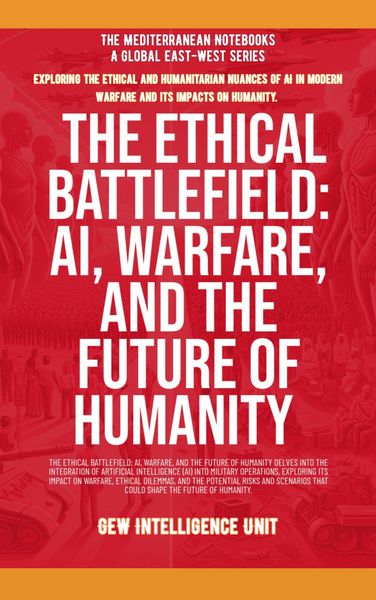
The Ethical Battlefield: AI, Warfare, And The Future Of Humanity (The Mediterranean Notebooks)
-
- Einzelkauf Download ausgewählt
-
Sprache:Englisch
25,99 €
inkl. gesetzl. MwSt.Beschreibung
Produktdetails
Format
ePUB
Kopierschutz
Ja
Family Sharing
Ja
Text-to-Speech
Ja
Erscheinungsdatum
19.05.2025
Verlag
Global East-West LTDSeitenzahl
(Printausgabe)
Dateigröße
268 KB
Sprache
Englisch
EAN
9798231637249
The integration of artificial intelligence (AI) into military operations marks a pivotal shift in the nature of modern warfare, bringing unparalleled precision, efficiency, and ethical challenges. As military powers increasingly adopt AI-driven systems-ranging from autonomous weapons to advanced surveillance-debate has intensified over their impact, particularly when such technologies are deployed in conflict zones like Gaza. Recent disclosures, including bombshell revelations from a former Microsoft employee, have cast a spotlight on the darker side of AI-enabled warfare. These accounts highlight grave concerns about violations of moral, humanitarian, and international legal standards, as AI is used to select and target civilians with disturbing regularity.
The application of AI in warfare has blurred boundaries between human judgment and machine autonomy. While advocates argue that AI can reduce collateral damage by improving strike accuracy, on-the-ground realities often contradict these claims. In places like Gaza, the reliance on AI has sometimes resulted in civilian populations being disproportionately affected, raising urgent questions about transparency, algorithmic bias, and accountability. The opacity in how these systems make decisions, coupled with the risks of flawed or biased programming, threatens to further erode the distinction between combatants and non-combatants-undermining the very humanitarian principles international law seeks to uphold.
This technological evolution brings far-reaching ethical dilemmas. As autonomous machines take on roles once reserved for humans, the question of moral responsibility grows murky. International treaties and UN resolutions struggle to keep pace, particularly as private corporations, such as Microsoft, become central players whose products are repurposed for military use-often without public scrutiny or informed consent. This dynamic raises critical questions about corporate accountability and the societal oversight of AI in warfare.
Looking forward, the book explores three potential futures. First, AI may escalate global arms races, with both states and non-state actors developing ever more sophisticated systems-risking destabilisation and increasing civilian harm. Second, a coordinated global response could lead to new regulatory frameworks or outright bans on autonomous weapons-a difficult but potentially vital international step. Third, as AI technology spreads, non-state actors could exploit it for asymmetric warfare, further complicating accountability and increasing indiscriminate targeting of civilians.
In sum, the fusion of AI and military power presents profound dangers and dilemmas. While AI promises precision, its misuse-and the ethical grey areas it introduces-demand urgent global debate and action to safeguard humanity's future.
Noch keine Bewertungen vorhanden
Verfassen Sie die erste Bewertung zu diesem Artikel
Helfen Sie anderen Kundinnen und Kunden durch Ihre Meinung.
Kurze Frage zu unserer Seite
Vielen Dank für dein Feedback
Wir nutzen dein Feedback, um unsere Produktseiten zu verbessern. Bitte habe Verständnis, dass wir dir keine Rückmeldung geben können. Falls du Kontakt mit uns aufnehmen möchtest, kannst du dich aber gerne an unseren Kund*innenservice wenden.
zum Kundenservice