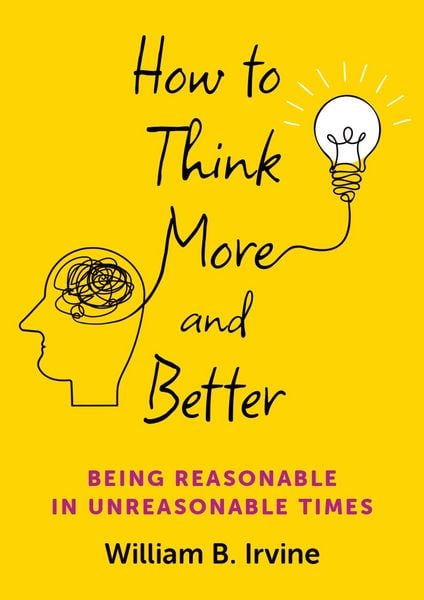
How to Think More and Better Being Reasonable in Unreasonable Times
32,99 €
inkl. gesetzl. MwSt.,
Beschreibung
Produktdetails
Einband
Gebundene Ausgabe
Erscheinungsdatum
06.04.2026
Verlag
Oxford AcademicSeitenzahl
288
Maße (L/B/H)
18,4/13,6/2,8 cm
Gewicht
334 g
Sprache
Englisch
ISBN
978-0-19-778684-0
William B. Irvine, author of the popular book "A Guide to the Good Life," offers much needed philosophical advice on how to become a more rational and critical thinker in today's emotionally-driven and complex world. Even the most reasonable of us can be selective about when we think reasonably. We may realize that the best thing to do is to take the advice of our doctor when facing a medical issue. When shopping for a new car or appliance we might carefully assess online reviews and weigh our options calmly before making an informed decision. But when it comes to things that feel more fraught --voting, navigating a challenge in our family, figuring out what to do in a difficult professional situation-- we might throw this approach out the window, dismissing facts and patterns that form a body of evidence, and trust our gut. (Of course, there is a time and place for this, but not every big decision is purely a matter of the heart.) Likewise, when we think about big ideas, about right and wrong, or about concepts so complex they make anyone's head spin, we can freeze, jumping to conclusions rather than wading into the details, or considering the existing arguments that others offer as a trail through challenging terrain. How can we do better? How can we train our minds to be more consistent? How can we practice using the best of our rational abilities when it matters most? How to Think More and Better offers a philosopher's advice on becoming a more rational and critical thinker, rather than relying on emotions or hearsay to reach important decisions. It trains the reader in open-minded critical thinking. This thinking is crucial in a time of political polarization, social media, politicized news media, and echo chambers, to help us pursue truth and understanding in a world of rabbit holes, echo chambers, and disinformation. Irvine explains the prevalence of emotion-driven thinking is often at the expense of engagement with evidence, and then lays out strategies readers can use to train themselves to think more critically, drawn from what worked for him in the classroom. He also covers important areas to aid intellectual self-transformation, such as Mindcare and Mindcleaning. With practice, most people can become evidence-based thinkers. Seemingly intractable contemporary problems might be solved if we all start engaging more in this kind of slow and careful thinking, considering arguments and evidence even from those on opposite sides of key debates.
Noch keine Bewertungen vorhanden
Verfassen Sie die erste Bewertung zu diesem Artikel
Helfen Sie anderen Kundinnen und Kunden durch Ihre Meinung.
Kurze Frage zu unserer Seite
Vielen Dank für dein Feedback
Wir nutzen dein Feedback, um unsere Produktseiten zu verbessern. Bitte habe Verständnis, dass wir dir keine Rückmeldung geben können. Falls du Kontakt mit uns aufnehmen möchtest, kannst du dich aber gerne an unseren Kund*innenservice wenden.
zum Kundenservice