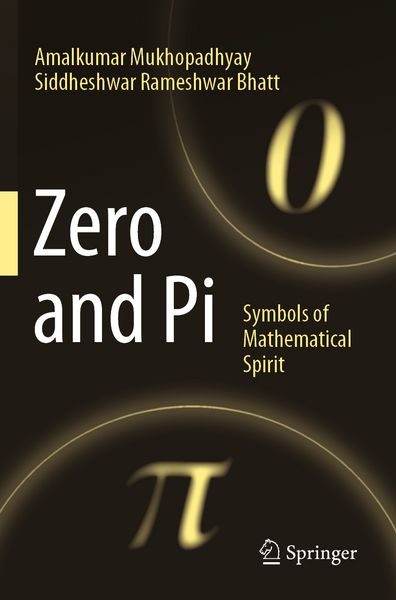
Zero and Pi Symbols of Mathematical Spirit
-
- Hardcover
- Taschenbuch ausgewählt
- eBook
-
Sprache:Englisch
25,99 €
UVP
29,95 €
inkl. gesetzl. MwSt.,
Lieferung nach Hause
Beschreibung
Produktdetails
Einband
Taschenbuch
Erscheinungsdatum
31.03.2025
Verlag
Springer SingaporeSeitenzahl
21
Maße (L/B/H)
23,5/15,5/1,4 cm
Gewicht
376 g
Auflage
1. Auflage
Sprache
Englisch
ISBN
978-981-9930-74-6
Part 1, consisting of six stages spread in six chapters, meets a challenge to the authors as eminent scholars of the history of mathematics have diverse opinions based on conjectures. This part primarily discusses how the symbol O, in the Vedic religious practices, considered a replica of the universe prescribed for meditation on the unknown Brahman (conceived of as the space supreme in the Upanishads), was later transcended to the symbol of an unknown quantity in mathematics along with a dot for zero in an arena of atheism. It also highlights how the zero notation and the decimal system of Indian numerals embellished with the algebraic thoughts of Brahmagupta passed on to China and Europe via Arabia. Topics in this part have traced the development from the origin to the final form as seen today after the western practice and try to put an end to the long-standing debate over history. Appendices contain the Sanskrit verses (transliterated with meanings into English) along with the essential mathematical deduction referred to in the body of the part to help the reader to have a better understanding.
Part 2 speaks of a novel idea of unveiling the nature of pi interwoven with threads of historical ups and downs in the world scenario. This part, containing five chapters, collects all available up-to-date data in every field of history to make the presentation complete in all respects. This part discusses the origin of the definition of pi as the rim of a wheel is thrice its diameter at the Indus Valley in the fourth millennium BC. This part also discusses the enlightenment of China in circle-squaring (classical method), Indian mathematics with astronomical knowledge along the Buddhist channel, and India’s discovering circumference/diameter as a non-Euclidean number.
Kundinnen und Kunden meinen
Verfassen Sie die erste Bewertung zu diesem Artikel
Helfen Sie anderen Kund*innen durch Ihre Meinung
Kurze Frage zu unserer Seite
Vielen Dank für dein Feedback
Wir nutzen dein Feedback, um unsere Produktseiten zu verbessern. Bitte habe Verständnis, dass wir dir keine Rückmeldung geben können. Falls du Kontakt mit uns aufnehmen möchtest, kannst du dich aber gerne an unseren Kund*innenservice wenden.
zum Kundenservice