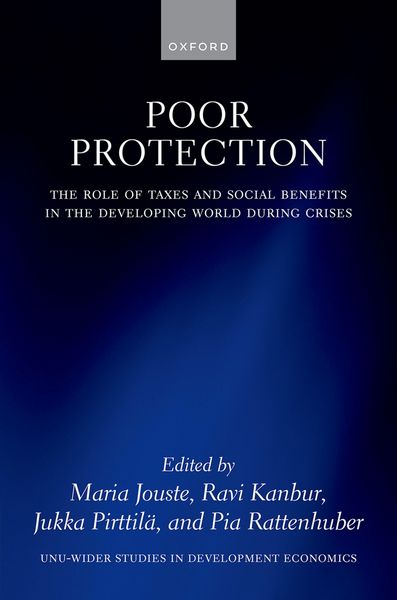
Poor Protection The Role of Taxes and Social Benefits in the Developing World During Crises
-
- Englisch ausgewählt
149,99 €
inkl. gesetzl. MwSt.,
Lieferung nach Hause
Beschreibung
Produktdetails
Einband
Gebundene Ausgabe
Erscheinungsdatum
06.02.2026
Verlag
Oxford AcademicSeitenzahl
368
Maße (L/B/H)
23,7/16,4/2,9 cm
Gewicht
726 g
Sprache
Englisch
ISBN
978-0-19-890942-2
An open access title available under the terms of a CC BY-NC-SA 3.0 IGO licence. It is free to read at Oxford Academic and offered as a free PDF download from OUP and selected open access locations.
This book examines the role of social protection and taxation systems in developing countries during times of crises. The main objective of the work is to promote understanding about proper crisis response, and the way social protection and tax systems can be made more sustainable to support countries' paths through and out of economic crises. While there is a vast body of literature evaluating social protection programmes in general, few of these focus on episodes of crisis. During the COVID-19 pandemic, the number and scale of social protection programmes increased rapidly around the globe, but many developing countries lacked a systematic approach to social protection and taxation.
Crises have a devastating effect on employment, incomes, and livelihoods. These impacts are more dangerous when people are already in a vulnerable position. This has become very clear during the latest worldwide crises, including the sharp rise in food and fuel prices. Armoured with comprehensive policies and systems for social protection and taxation, developing countries could enable automatic and speedy assistance when crises hit across the entire income distribution. Analogously to the currently standard financial stress testing in anticipation of crises, thorough stress testing of social protection and tax policies is also of crucial importance.
Poor Protection explores to what extent tax-benefit systems can act as automatic stabilizers in a developing country context during crises, and how they can help provide the fiscal space necessary to cushion at least the most detrimental developments in terms of inequality.
Noch keine Bewertungen vorhanden
Verfassen Sie die erste Bewertung zu diesem Artikel
Helfen Sie anderen Kundinnen und Kunden durch Ihre Meinung.
Kurze Frage zu unserer Seite
Vielen Dank für dein Feedback
Wir nutzen dein Feedback, um unsere Produktseiten zu verbessern. Bitte habe Verständnis, dass wir dir keine Rückmeldung geben können. Falls du Kontakt mit uns aufnehmen möchtest, kannst du dich aber gerne an unseren Kund*innenservice wenden.
zum Kundenservice