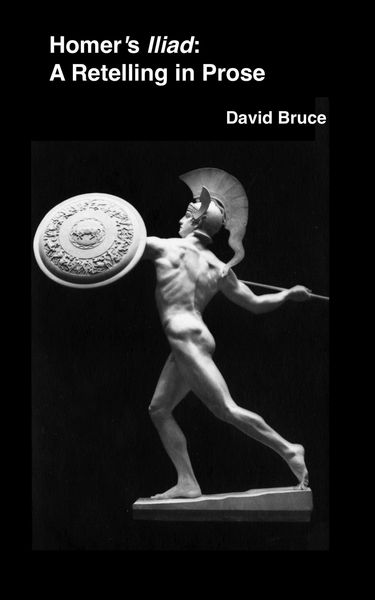
Homer's Iliad: A Retelling in Prose
-
- Einzelkauf Download ausgewählt
-
Sprache:Englisch
0,00 €
inkl. gesetzl. MwSt.Artikel erhalten
Beschreibung
Produktdetails
Format
ePUB
Kopierschutz
Ja
Family Sharing
Ja
Text-to-Speech
Ja
Erscheinungsdatum
06.07.2022
Verlag
David BruceSeitenzahl
(Printausgabe)
Dateigröße
345 KB
Sprache
Englisch
EAN
9798230335290
How ought we to live our life? Should we lead a life of pleasure, or should we work hard to accomplish something remarkable so that our name and deeds will be remembered for a long time - maybe forever - after we die?
Because his mother is an immortal goddess, Achilles, who is a mortal man, knows that if he stays in Greece and avoids battles, he will live a long time but after he dies no one will remember his name and deeds, but if he fights in the Trojan War, he will live a short life but his fame after he dies will be everlasting. He goes to the Trojan War, he fights well, and he is rewarded for his magnificent fighting ability with a spear-bride, aka sex-slave.
But Agamemnon, the leader of the Greeks against the Trojans, insults him by taking away his spear-bride. If Achilles is remembered after he dies, this will be one of the things that people will remember about him. Is that worth dying for?
Achilles decides not to fight for Agamemnon. If he fights, he will fight for himself. When the Trojans attack the Greek camps, Achilles will do nothing until the fires reach his own camp. Then he will fight. But all men are mortal, and Hector, the greatest Trojan warrior, kills a man whom Achilles loves. Now Achilles lives not so he can gain everlasting fame; he lives so he can get revenge against the Trojans and especially against Hector.
Achilles becomes less than human. He fights like a wildfire or a lion that kills everything in its path. He is a war machine that kills without mercy. He kills Trojans who are fleeing from him. He kills Trojans who beg him to keep them alive and allow their family and friends to ransom them for treasure. Achilles also becomes more than human. His anger is the anger of the gods, who are not benevolent and who are willing to allow many, many mortal men to die as a result of something trivial such as a beauty contest. He is nourished by ambrosia, the food of the gods, which the gods have placed in his body to keep him alive because he refuses to eat. When he goes into battle, he carries a shield that the blacksmith god created and on which is depicted the entire cosmos.
But is revenge an adequate reason for living? Revenge does Achilles no good. It does not bring his dead friend back to life.
In order to have a good death, Achilles must accept the human condition: All of us, including ourselves and our loved ones, will die. Can Achilles return to being human again? Can Achilles accept the human condition? If he cannot, he will go to the Land of the Dead without ever having fully achieved his potential as a human being.
Noch keine Bewertungen vorhanden
Verfassen Sie die erste Bewertung zu diesem Artikel
Helfen Sie anderen Kundinnen und Kunden durch Ihre Meinung.
Kurze Frage zu unserer Seite
Vielen Dank für dein Feedback
Wir nutzen dein Feedback, um unsere Produktseiten zu verbessern. Bitte habe Verständnis, dass wir dir keine Rückmeldung geben können. Falls du Kontakt mit uns aufnehmen möchtest, kannst du dich aber gerne an unseren Kund*innenservice wenden.
zum Kundenservice