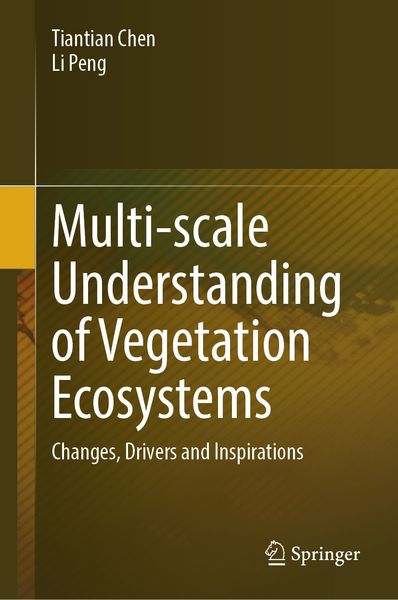
Multi-scale Understanding of Vegetation Ecosystems Changes, Drivers and Inspirations
129,99 €
UVP
149,79 €
inkl. gesetzl. MwSt.,
Beschreibung
Produktdetails
Einband
Gebundene Ausgabe
Erscheinungsdatum
24.06.2025
Abbildungen
XVII, 221 illus., 215 illus. in color., schwarz-weiss Illustrationen, farbige Illustrationen
Verlag
SpringerSeitenzahl
315
Maße (L/B/H)
24,1/16/2,3 cm
Gewicht
729 g
Sprache
Englisch
ISBN
978-3-031-90162-1
This book highlights the vital role of vegetation in terrestrial surface systems, emphasizing its importance in regulating climate change, acting as a carbon sink, and maintaining the surface energy balance by absorbing CO2 from human activities. However, urbanization, extreme droughts, floods, fires, and other events negatively impact biodiversity, increase tree mortality, trigger wildfires, and exacerbate food insecurity and poverty. Understanding the influence of global climate change and human activity on vegetation patterns is essential. The structure and function of vegetation ecosystems result from interactions between natural ecological processes and socio-cultural factors, leading to variability across different spatial and temporal scales. While local-scale studies provide detailed insights, they are often difficult to generalize. Conversely, large-scale studies can inform comprehensive planning but may overlook nuances between subsystems. Therefore, enhancing research on the evolution of vegetation ecosystems and their responses to climate change across multiple scales is crucial to mitigate risks and maintain ecosystem balance.
Extensive studies have explored the spatiotemporal dynamics and driving forces on large-scale vegetation structure, productivity, and resilience, especially on a global scale. However, there is limited research on vegetation characteristics in specific geological conditions and geomorphic regions, particularly in karst regions. Karst landforms account for 15% of the global vegetated land and are vital for global carbon and water cycles, as well as biodiversity conservation. Southwest China, the largest contiguous karst region, represents 0.36% of the vegetated land but contributes 5% of global aboveground biomass, making it a key carbon sink. However, its fragile ecological conditions, frequent extreme climate events, and unsustainable human activities have led to significant vegetation degradation and desertification, resulting in severe environmental damage in recent decades. To address these issues, ecological restoration measures have been launched since the early 2000s to boost vegetation.
Noch keine Bewertungen vorhanden
Verfassen Sie die erste Bewertung zu diesem Artikel
Helfen Sie anderen Kundinnen und Kunden durch Ihre Meinung.
Kurze Frage zu unserer Seite
Vielen Dank für dein Feedback
Wir nutzen dein Feedback, um unsere Produktseiten zu verbessern. Bitte habe Verständnis, dass wir dir keine Rückmeldung geben können. Falls du Kontakt mit uns aufnehmen möchtest, kannst du dich aber gerne an unseren Kund*innenservice wenden.
zum Kundenservice