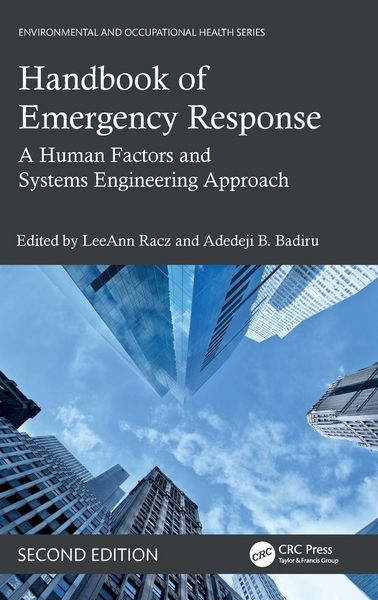
Handbook of Emergency Response A Human Factors and Systems Engineering Approach, Second Edition
-
- Hardcover ausgewählt
- Taschenbuch
- eBook
-
Sprache:Englisch
-
Verlag:Taylor & Francis
- Taylor & Francis 191,99 € ausgewählt
- CRC Press 209,99 €
191,99 €
UVP
245,30 €
inkl. gesetzl. MwSt.,
Lieferung nach Hause
Beschreibung
Produktdetails
Einband
Gebundene Ausgabe
Erscheinungsdatum
12.09.2025
Abbildungen
schwarz-weiss Illustrationen, Raster, schwarz-weiss, Zeichnungen, schwarz-weiss, Tabellen, schwarz-weiss
Herausgeber
Racz LeeAnn + weitereVerlag
Taylor & FrancisSeitenzahl
526
Maße (L/B/H)
24/16,1/3,3 cm
Gewicht
1130 g
Auflage
2. Auflage
Sprache
Englisch
ISBN
978-1-04-107348-2
Despite pre-emptive preparations, disasters can and do occur and are a fact of life. Whether natural disasters, catastrophic accidents, or terrorist attacks, the risk cannot be completely eliminated. A carefully prepared response is your best defense. This fully updated second edition of the Handbook of Emergency Response presents practical advice and guidelines on how to plan the coordinated execution of emergency response.
This handbook incorporates human factors and a systems engineering approach to emergency response project management. It provides cutting-edge research in developing a systematic structure for communication, cooperation, and coordination. Managing a project in the wake of a tragedy is complicated and involves various emotional, sentimental, reactive, and chaotic responses. This is the time when a structured communication model is most needed. This second edition includes important lessons learned and developments since the first edition was published, as well as additional information devoted to systems thinking and industrial engineering in planning for responses to emergencies. The reader will develop a thorough understanding of how to handle an emergency response using a systems approach.
The handbook is an ideal purchase for any student or practitioner of human factors, safety, systems engineering, events management, local or federal governance, or those in the emergency services.
Noch keine Bewertungen vorhanden
Verfassen Sie die erste Bewertung zu diesem Artikel
Helfen Sie anderen Kundinnen und Kunden durch Ihre Meinung.
Kurze Frage zu unserer Seite
Vielen Dank für dein Feedback
Wir nutzen dein Feedback, um unsere Produktseiten zu verbessern. Bitte habe Verständnis, dass wir dir keine Rückmeldung geben können. Falls du Kontakt mit uns aufnehmen möchtest, kannst du dich aber gerne an unseren Kund*innenservice wenden.
zum Kundenservice