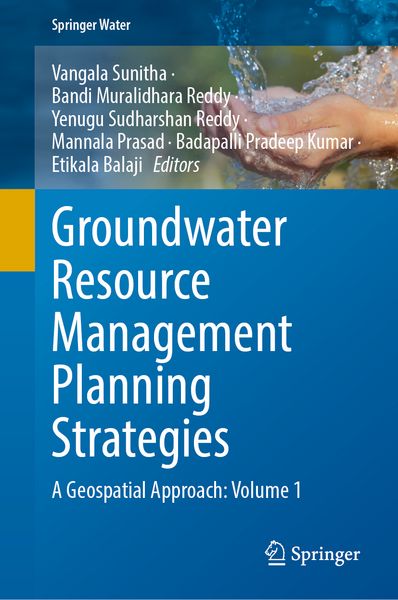
Groundwater Resource Management Planning Strategies A Geospatial Approach: Volume 1
171,99 €
UVP
192,59 €
inkl. gesetzl. MwSt.,
Lieferung nach Hause
Beschreibung
Produktdetails
Einband
Gebundene Ausgabe
Erscheinungsdatum
17.06.2025
Abbildungen
XVIII, 206 illus., 194 illus. in color., schwarz-weiss Illustrationen, farbige Illustrationen
Herausgeber
Vangala Sunitha + weitereVerlag
SpringerSeitenzahl
836
Maße (L/B/H)
24,1/16/5,1 cm
Gewicht
1429 g
Sprache
Englisch
ISBN
978-3-031-88869-4
Geospatial tools to Groundwater Resources explain the most recent methods in Geographic Information Systems (GIS) and geostatistics as they apply to groundwater through complete case studies that demonstrate actual remote sensing applications in this field. Due to the rising demand for water, its decreasing quality, and its limited supply, water resource management has grown to be a serious issue. In many places of the world, groundwater is the main supply of fresh water, but certain areas are growing unduly reliant on it, utilising groundwater more quickly than it can be replenished naturally and resulting in an unceasing decrease in water tables. For the efficient use, management, and modelling of this priceless but diminishing natural resource, systematic planning of groundwater consumption using current approaches is crucial. Remote sensing, GIS, GPS (Global Positioning Systems), and geostatistical approaches are among the effective water management methods that have developed with the introduction of powerful and fast personal computers.
Now more than ever, it is possible to analyse with greater accuracy the relationships between environmental elements and human health and wellbeing. Our understanding of the continuum between environment and health consequences on many different sizes, from the global to even the individual, has evolved thanks to a number of transdisciplinary accomplishments.
This book covers a wide range of geospatial health-related topics and methods, including climate change, healthcare utilisation, health disparities, air quality assessment, asthma, water quality assessment, and machine learning. It also advances scientific understanding, development, and application of geospatial technologies related to water resource management.
Researchers and postgraduate students in Earth and Environmental Sciences, particularly GIS, agriculture, hydrology, natural resources, and soil science, who need to be ableto apply the most recent innovations in groundwater research in a practical way will find Case Studies in Geospatial Applications to Groundwater Resources to be a valuable resource. This edited volume will concentrate on the most recent studies and uses of geospatial methods in water resource management, offering insights into the difficulties and possibilities of applying these methods to solve practical issues.
Kundinnen und Kunden meinen
Verfassen Sie die erste Bewertung zu diesem Artikel
Helfen Sie anderen Kund*innen durch Ihre Meinung
Kurze Frage zu unserer Seite
Vielen Dank für dein Feedback
Wir nutzen dein Feedback, um unsere Produktseiten zu verbessern. Bitte habe Verständnis, dass wir dir keine Rückmeldung geben können. Falls du Kontakt mit uns aufnehmen möchtest, kannst du dich aber gerne an unseren Kund*innenservice wenden.
zum Kundenservice