Gutscheinbedingungen

**Gültig vom 20.07.2026 bis 22.07.2026 | Gültig für nicht preisgebundene fremdsprachige Bücher | Einzelne Artikel können ausgeschlossen sein | Nicht kombinierbar mit anderen Gutscheinen oder Preisaktionen | Nur einmal pro Einkauf einlösbar | Gutschein wird auf max. 500€ Bestellwert angerechnet | Keine Barauszahlung | Nicht gültig für Versandkosten und Services

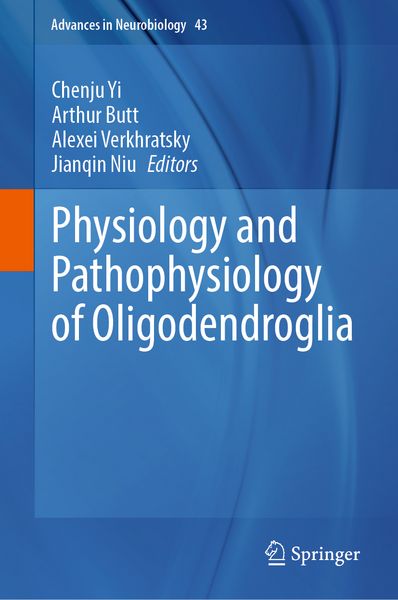
Produktbild: Physiology and Pathophysiology of Oligodendroglia
Band 43 - 21%

Physiology and Pathophysiology of Oligodendroglia

Aus der Reihe Advances in Neurobiology
21% sparen

234,99 € UVP 299,59 €

inkl. gesetzl. MwSt., Versandkostenfrei

Lieferung nach Hause

Beschreibung

Produktdetails

Einband

Gebundene Ausgabe

Erscheinungsdatum

12.06.2025

Abbildungen

X, 58 illus., 57 illus. in color., farbige Illustrationen, schwarz-weiss Illustrationen

Herausgeber

Chenju Yi + weitere

Verlag

Springer

Seitenzahl

477

Maße (L/B/H)

24,1/16/3,2 cm

Gewicht

891 g

Sprache

Englisch

ISBN

978-3-031-87918-0

Beschreibung

Portrait

Chenju Yi, MD, Ph.D. is Professor of Neuroscience and Neurology at the Seventh Affiliated Hospital of Sun Yat-sen University, Shenzhen, China. She obtained MD and PhD from Eberhard Karls Universität Tübingen, Germany and Huazhong University of Science and Technology, China, respectively. She carried out postdoctoral research mentored by Prof. Christian Giaume at the Collège de France in Paris, followed by a Senior Research Fellowship at National University of Singapore. Her research has made groundbreaking contributions to understanding the mechanisms by which glia drive the pathophysiology of brain disorders, such as Alzheimer's disease, with a particular focus on glial connexins.

Alexei Verkhratsky, MD, Ph.D., D.Sc. is Professor of Neurophysiology in the Faculty of Biology, Medicine and Health at The University of Manchester in Manchester, England. Verkhratsky is an internationally recognized scholar in the field of cellular neurophysiology, best known for his contributions to our knowledge of the physiology and pathophysiology of neuroglia.

Jianqin Niu, Ph.D., is Professor of Neuroscience in the Third Military Medical University, Chongqing, China. Niu graduated from the Third Military Medical University and completed a postdoctoral fellowship at both the Collège de France in Paris and the University of California, San Francisco (UCSF). His research primarily investigates oligodendrocyte precursor cells (OPCs), exploring both their myelinating and non-myelinating roles within the central nervous system. His work emphasizes cellular mechanisms and pathological processes underlying neurological and psychiatric disorders, with particular focus on how OPCs interact with other glial cell populations to influence disease pathogenesis.

Arthur M. Butt, Ph.D., is Professor of Cellular Neurophysiology at the University of Portsmouth, U.K.. He obtained his PhD on the blood brain barrier in King’s College London and the Marine Laboratories Plymouth. After postdoctoral research on glial cells and the blood brain barrier as a Grass Fellow at Wood’s Hole Marine Laboratories and Yale University USA, Arthur obtained his first independent position at Guy’s and St Thomas’ Hospitals, London, and later obtained his personal chair at King’s College London. He is an international expert in glial cell biology.

Produktdetails

Einband

Gebundene Ausgabe

Erscheinungsdatum

12.06.2025

Abbildungen

X, 58 illus., 57 illus. in color., farbige Illustrationen, schwarz-weiss Illustrationen

Herausgeber

Verlag

Springer

Seitenzahl

477

Maße (L/B/H)

24,1/16/3,2 cm

Gewicht

891 g

Sprache

Englisch

ISBN

978-3-031-87918-0

Herstelleradresse

Springer-Verlag KG
Sachsenplatz 4-6
1201 Wien
AT

Email: GPSR Kontakt

Noch keine Bewertungen vorhanden

Verfassen Sie die erste Bewertung zu diesem Artikel

Helfen Sie anderen Kundinnen und Kunden durch Ihre Meinung.

Kundinnen und Kunden meinen

Bewertungen (0)

  • Produktbild: Physiology and Pathophysiology of Oligodendroglia
  • Preface.- Chapter 1: Oligodendroglial lineage, myelin and white matter: defining the connectome of the human brain.- Part I: Physiology of oligodendroglia.- Chapter 2: Evolution of myelin and oligodendroglia.- Chapter 3: Development of oligodendroglia and myelin.- Chapter 4: Seeing is believing: insights into myelination and remyelination in zebrafish.- Chapter 5: Morphology of oligodendroglial cells and myelin.- Chapter 6: Physiology of oligodendroglial cells.- Chapter 7: Biochemistry and structure of myelin.- Chapter 8: Plasticity of myelination.- Part II: Pathophysiology of oligodendroglia.- Chapter 9: Demyelination and remyelination: General principles.- Chapter 10: Leukomalacia.- Chapter 11: White matter injury in the brain and spinal cord.- Chapter 12: Multiple sclerosis.- Chapter 13: Ageing and neurodegeneration of oligodendroglia.- Chapter 14: Protein pathologies in oligodendroglia in neurodegenerative diseases.- Chapter 15: Mental disorders.- Chapter 16: Neuromyelitis Optica.- Epilogue.