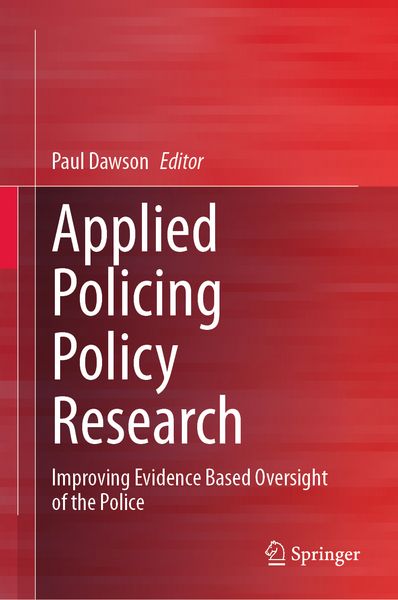
Produktbild: Applied Policing Policy Research
- 10%

Applied Policing Policy Research Improving Evidence Based Oversight of the Police

10% sparen

104,99 € UVP 117,69 €

inkl. gesetzl. MwSt., Versandkostenfrei

Lieferung nach Hause

Beschreibung

Produktdetails

Einband

Gebundene Ausgabe

Erscheinungsdatum

07.06.2025

Abbildungen

XXIII, 20 illus., 18 illus. in color., farbige Illustrationen, schwarz-weiss Illustrationen

Herausgeber

Paul Dawson

Verlag

Springer

Seitenzahl

275

Maße (L/B/H)

24,1/16/2,2 cm

Gewicht

615 g

Sprache

Englisch

ISBN

978-3-031-87239-6

Beschreibung

Portrait

Dr Paul Dawson is Head of Evidence and Insight in the Mayor’s Office for Policing And Crime in London. This team holds a unique position within crime and justice analytics in England & Wales, spanning performance insights, data visualisation, public voice, social research, evaluation, and data science functions all to support MOPAC discharge its statutory responsibility of overseeing the London Metropolitan Police Service. From 2008 to 2014 he was Research Manager within the Metropolitan Police Service. During this time, he co-authored the book: Police Use of Research Evidence: Recommendations for Improvement alongside Professor Betsy Stanko. Between 2003 and 2008 he was a researcher in the UK Home Office where projects included leading the research for the Tackling Gangs Action Programme, and the evaluation of the Prolific and other Priority offenders scheme. Between 2000 and 2003 he held two roles within the National Health Service working in secure forensic psychiatric units therapeutically with mentally disordered offenders as well as conducting national surveys. He holds a PhD in Psychology from the University of Birmingham investigating the empirical contribution of weapon-use within the analysis of serious sexual offending and is an Honorary Senior Research Fellow at the University College London Department of Security and Crime Science.


Produktdetails

Einband

Gebundene Ausgabe

Erscheinungsdatum

07.06.2025

Abbildungen

XXIII, 20 illus., 18 illus. in color., farbige Illustrationen, schwarz-weiss Illustrationen

Herausgeber

Paul Dawson

Verlag

Springer

Seitenzahl

275

Maße (L/B/H)

24,1/16/2,2 cm

Gewicht

615 g

Sprache

Englisch

ISBN

978-3-031-87239-6

Herstelleradresse

Springer-Verlag GmbH
Tiergartenstr. 17
69121 Heidelberg
DE

Email: [email protected]

Kundinnen und Kunden meinen

0 Bewertungen

Informationen zu Bewertungen

Zur Abgabe einer Bewertung ist eine Anmeldung im Konto notwendig. Die Authentizität der Bewertungen wird von uns nicht überprüft. Wir behalten uns vor, Bewertungstexte, die unseren Richtlinien widersprechen, entsprechend zu kürzen oder zu löschen.

Die Bewertungen sind nach Format, Anzahl Sterne und Datum sortiert.

Verfassen Sie die erste Bewertung zu diesem Artikel

Helfen Sie anderen Kund*innen durch Ihre Meinung

Kundinnen und Kunden meinen

0 Bewertungen filtern

  • Produktbild: Applied Policing Policy Research
  • Chapter 1. An Introduction.- Chapter 2. The History of the PCC Office and New Opportunities for Evidence .- Chapter 3. Supporting PCCs and their Offices to Engage with Data – the Role of the Association of Police and Crime Commissioners.- Chapter 4. A transition From Evidence-Based Policing Towards Something New.- Chapter 5. Measuring the Things That Matter – the Power of Performance.- Chapter 6. Charting the Growth of Evidence-Based Over-sight – From Policing Plans to Public Scrutiny .- Chapter 7. Hiding in Plain Sight – The Systematic Coding of Police Data and Insights into Vulnerability.- Chapter 8. Systems Under Scrutiny: The Role of Evidence and Advocacy in Driving Change for Victims.- Chapter 9. MOPAC’s Tools to Capture the Voice of Londoners.- Chapter 10. Trust and Confidence: Learning (and Lessons) from London.- Chapter 11. Exploring the Decline in Victim Satisfaction Within London – Analytics to Oversight .- Chapter 12. Embedding and Stretching a Systematic Approach to Evaluation in the PCC and Beyond.- Chapter 13. Evaluating Technological Innovation Through the Alcohol Abstinence Monitoring Requirement: From Local Proof of Concept Pilot to National Rollout.- Chapter 14. Implementation Continued – Evaluating the Lighthouse, the Largest CSA/E Service in the UK.- Chapter 15. Innovation in Impact Evaluation – Devising a Novel Quasi-Experimental Approach to Understanding the Impact of the London Gangs Matrix .- Chapter 16. Police Research Inside/Outside the Academy: The Institute for Global City Policing .- Chapter 17. Infusing Cutting-edge Computing Algorithms with Crime Data for Policy Evidence through Partnership with King’s College London.- Chapter 18. The Collaborative Path to Evidence-Based Policing.- Chapter 19. Cost of Living and Crime in London: Lessons from an Empirical and Collaborative Study.- Chapter 20. Final Thoughts.