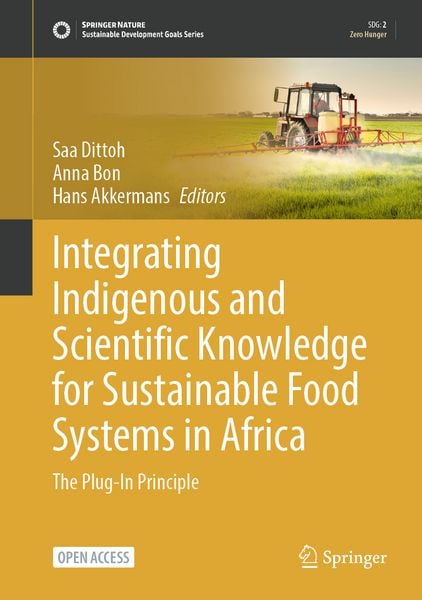
Integrating Indigenous and Scientific Knowledge for Sustainable Food Systems in Africa The Plug-In Principle
-
- Englisch ausgewählt
48,99 €
inkl. gesetzl. MwSt.,
Lieferung nach Hause
Beschreibung
Produktdetails
Einband
Gebundene Ausgabe
Erscheinungsdatum
26.04.2025
Abbildungen
XXIV, 22 illus., 19 illus. in color., schwarz-weiss Illustrationen, farbige Illustrationen
Herausgeber
Saa Dittoh + weitereVerlag
SpringerSeitenzahl
196
Maße (L/B/H)
26/18,3/1,7 cm
Gewicht
668 g
Sprache
Englisch
ISBN
978-3-031-85511-5
This open access book presents a novel approach to food security research (SDG-2 Zero Hunger) by integrating indigenous and scientific knowledge. Through extensive field-based research in Burkina Faso, Ghana, Kenya, Mali, and South Africa, it explores the impact of merging traditional practices and local knowledge with scientific methods.
Through field studies, the book shows the value of local knowledge and community-led innovations in combating hunger, achieving food security, and enhancing nutrition sustainably and food sovereignty. Drawing on decades of research in rural Africa, the authors introduce the "Plug-In Principle"—a theory for integrating indigenous and modern knowledge systems to foster sustainable agricultural practices and enriched food ecosystems in Africa.
The Plug-In Principle advocates that advancements in science and technology should enhance rather than replace existing indigenous knowledge. This principle emerged from the failures of many development interventions where attempts at replacement often led to challenges and failures. In agriculture, for instance, interventions in mechanization, soil amendments, seed and breed improvements, and extension services have seldom succeeded due to a lack of integration with existing practices.
The Plug-In Principle emphasizes that effective knowledge integration hinges on a deep understanding and appreciation of prevailing systems. By designing interventions that seamlessly "plug-in" to existing technologies, we can ensure the co-creation of effective solutions to the challenges we face. This book is a testament to the potential of collaborative innovation in fostering sustainable development.
Development workers, policymakers, researchers, students, and donor agencies in agriculture and other development areas will find this volume invaluable. Additionally, scholars focused on decolonization and indigenous knowledge in the Global South will uncover insightful case studies and analyses.
Kundinnen und Kunden meinen
Verfassen Sie die erste Bewertung zu diesem Artikel
Helfen Sie anderen Kund*innen durch Ihre Meinung
Kurze Frage zu unserer Seite
Vielen Dank für dein Feedback
Wir nutzen dein Feedback, um unsere Produktseiten zu verbessern. Bitte habe Verständnis, dass wir dir keine Rückmeldung geben können. Falls du Kontakt mit uns aufnehmen möchtest, kannst du dich aber gerne an unseren Kund*innenservice wenden.
zum Kundenservice