KI-Beratung Beta

Produktbild: The Making of a Political Reformer

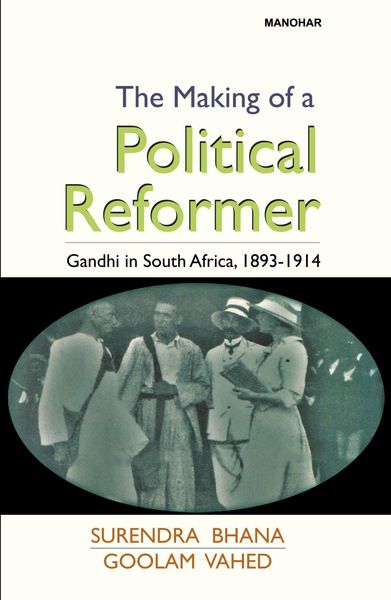
The Making of a Political Reformer Gandhi in South Africa, 1893-1914

63,99 €

inkl. gesetzl. MwSt., Versandkostenfrei


Beschreibung

The religious and cultural orientation of South African Indians was influenced Mohandas K. Gandhi, and this study is the first to explore its relevance to his moral, philosophical, and political growth. Gandhi and his compatriots developed 'Indianness' in transnational politics, and used it as a lever...

Beschreibung

The religious and cultural orientation of South African Indians was influenced Mohandas K. Gandhi, and this study is the first to explore its relevance to his moral, philosophical, and political growth. Gandhi and his compatriots developed 'Indianness' in transnational politics, and used it as a lever to win imperial protection against discriminating practices in colonial South Africa. This linked South Africa to the British Raj in India.
In working closely with his compatriots, Gandhi operated within the cultural and religious parameters set by them, and creatively redefined them. In India, he would expand on the ideas and strategies he developed back in South Africa.
While useful in an imperial setting, 'Indianness' became embedded in the system of White rule at the turn of the twentieth century. Moreover, the emerging political economy in Natal produced sharp competition and conflict, as Africans, Indians, and Whites came into contact in agriculture, industry, commerce, and other services. Racial antipathies simultaneously grew. As subordinate groups, Indians and Africans both developed stereotypes of each other as a way of identifying themselves more sharply to stress differences.
While Gandhi was sensitive to the legitimate political aspirations of Africans, he did not feel the need to spell out how Indians should relate to them because India was at the centre of his thinking. Gandhi's legacy inspired succeeding generations of South African activists. It connects him to Nelson Mandela, who led South Africa to freedom and democracy in the last decade of the twentieth century, yet some have questioned his legacy. This study offers perspectives that more accurately situate Gandhi's role in South Africa's history.

Portrait

Surendra Bhana, formerly a professor at the University of KwaZulu Natal in South Africa, is currently a History professor at the University of Kansas. He has published widely on South Africa's Indians. His last book was Gandhi's Legacy: The Natal Indian Congress, 1884-1994 (1997).
Goolam Vahed is an associate professor at the University of KwaZulu Natal in South Africa with research interests in religion, culture, race, ethnicity, and sports in relation to identity-formation. He is one of the authors of Blacks in Whites: A Century of Sporting Struggles in Colonial Natal, 1880-2002 (2002). In addition, he has published over twenty articles in international scholarly journals.

Produktdetails

Einband

Gebundene Ausgabe

Erscheinungsdatum

30.01.2025

Abbildungen

16 b&w illutrations

Herausgeber Surendra Bhana + weitere

Produktdetails

Einband

Gebundene Ausgabe

Erscheinungsdatum

30.01.2025

Abbildungen

16 b&w illutrations

Herausgeber
Verlag Manohar Books
Seitenzahl

182

Maße (L/B/H)

21,6/14/1,4 cm

Gewicht

343 g

Sprache

Englisch

ISBN

978-81-7304-612-4

Herstelleradresse

Libri GmbH
Europaallee 1
36244 Bad Hersfeld
DE

Email: Libri GmbH

Noch keine Bewertungen vorhanden

Verfassen Sie die erste Bewertung zu diesem Artikel

Helfen Sie anderen Kundinnen und Kunden durch Ihre Meinung.

Kundinnen und Kunden meinen

Bewertungen (0)

  • Produktbild: The Making of a Political Reformer
    • List of Abbreviations 7
    • Acknowledgements 9
    • Introduction 11
    • 1. Gandhi, Africans and Indians in Colonial Natal 26
    • 2. Hindus: Traditional Temples, Religious and Cultural Practices 51
    • 3. Muslims, Mosques and Madrassas 73
    • 4. Gandhi and Community Resources, 1906-1912 93
    • 5. The Satyagraha Campaign, 1913-1914 112
    • 6. Conclusion 139
    • Appendix 1: Organizations 157
    • Appendix 2: Mehfil Saiful Islam Annual Report 162
    • Appendix 3: Trust Deed of Mehafil Eslam Mota-Varachha 164 Glossary 167
    • Bibliography 171
    • Index 177