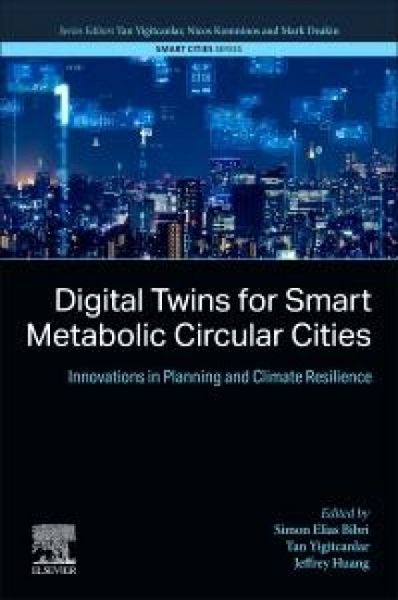
Produktbild: Digital Twins for Smart Metabolic Circular Cities
- 13%

Digital Twins for Smart Metabolic Circular Cities Innovations in Planning and Climate Resilience

13% sparen

101,99 € UVP 117,50 €

inkl. gesetzl. MwSt., Versandkostenfrei

Lieferung nach Hause

Beschreibung

Produktdetails

Einband

Taschenbuch

Erscheinungsdatum

12.06.2025

Herausgeber

Simon Elias Bibri + weitere

Verlag

Elsevier Science & Technology

Seitenzahl

270

Maße (L/B/H)

23,2/19,1/1,3 cm

Gewicht

580 g

Sprache

Englisch

ISBN

978-0-443-33333-0

Beschreibung

Portrait

Simon Elias Bibri, PhD, is a globally recognized scholar and expert in sustainable smart cities and smarter eco-cities. He currently serves as a Senior Researcher and Project and Scientific Coordinator at the Swiss Federal Institute of Technology in Lausanne (EPFL). Dr. Bibri has a diverse professional background, having served as Head of the Computer Department, Software and IT Business Engineer, IT Project Manager, Green ICT and Environmental Sustainability Strategist, Research Associate, and Assistant Professor. He has also been a visiting scholar at Lund University and a visiting senior researcher at the Royal Institute of Technology (KTH) in Sweden. He has served as an international expert in AI for Climate Action for the UNFCCC and in Sustainable Cities for UNIDO. Currently, he is an expert for the Focus Group on Smart Sustainable Cities, Environmental Sustainability, and Digital Twins at the ITU. Dr. Bibri also holds the position of Editor-in-Chief of the International Journal of Environmental Studies at Taylor & Francis Group and serves as Associate Editor of the Journal of Sustainable Cities and Society. He holds a bachelor’s degree in Computer Engineering, multiple master’s degrees from Esteemed Swedish universities, and a PhD in Computer Science and Information Technology from NTNU. He has authored 10 books, edited 3 works, and co-edited 15 volumes. Recently, he joined an EU Horizon Europe consortium project as Scientific Coordinator, Principal Investigator, and Senior Scientist.

Tan Yigitcanlar is an eminent researcher with international recognition and impact in urban studies and planning. He is a Professor of Urban Studies and Planning at the School of Architecture and Built Environment, Queensland University of Technology, Brisbane, Australia. Along with this post, he is an Honorary Professor at the School of Technology, Federal University of Santa Catarina, Florianopolis, Brazil, and the Founding Director position of the Australia-Brazil Smart City Research and Practice Network. His research is clustered around three interdisciplinary themes: Smart technologies, communities, cities, and urbanism; Sustainable and resilient cities, communities, and urban ecosystems; Knowledge-based development of cities and innovation districts. His research findings are disseminated in over 250 articles published in high-impact journals and 18 key reference books. Amongst urban and regional planning scholars, 2020 Science-wide Author Databases of Standardised Citation Indicators ranked him as #1 highly cited researcher in Australia and #7 worldwide.

Jeffrey Huang is the Director of the Media and Design Laboratory and a Full Professor in Architecture and Computer Science, at the Faculty of Computer and Communication Sciences (IC), and at the Faculty of Architecture, Civil and Environmental Engineering (ENAC) at Ecole Polytechnique Fédérale de Lausanne in Switzerland (EPFL). He holds a DiplArch from ETH Zurich, and Masters and Doctoral Degrees from Harvard University, where he was awarded the Gerald McCue medal for academic excellence. Prior to EPFL, he was a researcher at MIT’s Sloan School of Management, and Associate Professor at Harvard University’s Graduate School of Design. He was also a Visiting Professor at Tsinghua University, a Visiting Fellow at Stanford University’s d.school, a Honorary Visiting Professor at the University of Sheffield, and a Berkman Fellow and Faculty Associate at Harvard. In collaboration with Muriel Waldvogel, he founded and co-heads Convergeo, an award-winning, international strategic design firm.

Produktdetails

Einband

Taschenbuch

Erscheinungsdatum

12.06.2025

Herausgeber

Verlag

Elsevier Science & Technology

Seitenzahl

270

Maße (L/B/H)

23,2/19,1/1,3 cm

Gewicht

580 g

Sprache

Englisch

ISBN

978-0-443-33333-0

EU-Ansprechpartner

Zeitfracht Medien GmbH
Ferdinand-Jühlke-Straße 7
99095 Erfurt
DE
produktsicherheit@zeitfracht.de

Herstelleradresse

Elsevier Science & Technology
London Wall 125
EC2Y 5AS London
GB
tradeorders@elsevier.com

Noch keine Bewertungen vorhanden

Verfassen Sie die erste Bewertung zu diesem Artikel

Helfen Sie anderen Kundinnen und Kunden durch Ihre Meinung.

Kundinnen und Kunden meinen

Bewertungen (0)

  • Produktbild: Digital Twins for Smart Metabolic Circular Cities
  • Part 1: Integrating Digital Twins and Circular Metabolism in Urban Environments
    1. Introduction to Digital Twins for Smart Metabolic Circular Cities: Foundations, Technologies, Practices, and Emerging Trends
    2. Modelling Urban Metabolism as a Complex Heterogeneous Graph to Incentivize Environmentally Sustainable Practices
    3. Creating a Universal Semantic Material Bank: Integrating Digital Twins and Semantic Web Technologies for Circular Urban Mining
    4. Application of Computational Technologies in Smart Metabolic Circular Cities
    5. Catalyzing Smart Urban Metabolism through Entrepreneurial Ecosystem Infrastructures: A Regional Approach to Planning and Implementation

    Part 2: Digital Twins for Sustainable Urban Planning and Climate Resilience
    6. Leveraging Digital Twins for Zero-Energy Building Ratings in Sustainable Smart Cities: A Comprehensive Review and Novel Framework
    7. Utilizing City Digital Twins to Understand and Mitigate Climate Change Risks: A Roadmap
    8. Geospatial Digital Twins: Applications in Sustainable Urban Planning
    9. Urban Digital Twin for Resilient Urban Planning: Opportunities and Challenges in the Global South
    10. Urban Heat Island Mitigation with the Urbesgg Digital Twins Platform: A Case Study of Praça XV de Novembro, Florianópolis-SC, Brazil