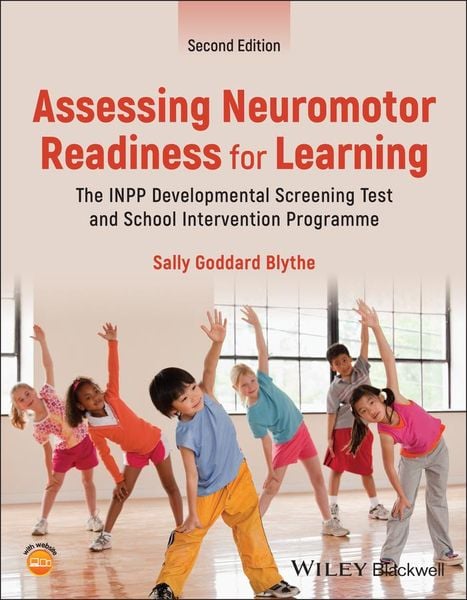
Produktbild: Assessing Neuromotor Readiness for Learning

Assessing Neuromotor Readiness for Learning The Inpp Developmental Screening Test and School Intervention Programme

96,99 €

inkl. gesetzl. MwSt., Versandkostenfrei

Lieferung nach Hause

Beschreibung

Produktdetails

Einband

Taschenbuch

Erscheinungsdatum

19.11.2024

Verlag

John Wiley & Sons

Seitenzahl

160

Maße (L/B/H)

27,4/21,6/1,8 cm

Gewicht

425 g

Auflage

2nd edition

Sprache

Englisch

ISBN

978-1-394-33773-6

Beschreibung

Produktdetails

Einband

Taschenbuch

Erscheinungsdatum

19.11.2024

Verlag

John Wiley & Sons

Seitenzahl

160

Maße (L/B/H)

27,4/21,6/1,8 cm

Gewicht

425 g

Auflage

2nd edition

Sprache

Englisch

ISBN

978-1-394-33773-6

Herstelleradresse

Libri GmbH
Europaallee 1
36244 Bad Hersfeld
DE

Email: gpsr@libri.de

Noch keine Bewertungen vorhanden

Verfassen Sie die erste Bewertung zu diesem Artikel

Helfen Sie anderen Kundinnen und Kunden durch Ihre Meinung.

Kundinnen und Kunden meinen

Bewertungen (0)

Die Leseprobe wird geladen.
  • Produktbild: Assessing Neuromotor Readiness for Learning
  • About the Companion Website vii

    1 Introduction 1

    1.1 Overview 1

    1.2 Rationale for Screening and Remediation of Neuromotor Immaturity 2

    1.3 What is the INPP? 2

    1.4 The INPP Developmental Movement Programme for Schools 3

    1.5 What is Neuromotor Immaturity? 4

    1.6 What is the Significance of Primitive Reflexes to Education? 5

    1.7 What are Primitive Reflexes? 5

    1.8 What is the Significance of Neuromotor Maturity to Education? 6

    1.9 What is the Purpose of Developmental Screening Tests? 8

    1.10 Why Assess Posture and Balance? 9

    1.11 Why Carry Out Assessments for Balance? 9

    1.12 What is the Difference Between Static Balance and Dynamic Balance? 10

    1.13 What is the Significance of Postural Control in Learning? 10

    1.14 Primitive Reflexes: Why Have these Three Reflexes Been Selected for Evaluation? 11

    1.14.1 The Asymmetrical Tonic Neck Reflex 11

    1.14.2 The Symmetrical Tonic Neck Reflex 12

    1.14.3 The Tonic Labyrinthine Reflex 13

    1.15 What Evidence is there Linking Balance, Posture and Reflexes to Educational Achievement? 14

    1.16 What Evidence is there that Intervention in the form of Movement Programmes Aimed at the Level of Primitive Reflexes Improves Educational Outcomes? 17

    1.17 How to Use the Screening Tests 18

    References 19

    2 Developmental Screening Tests for Use with Children Aged 4-7 Years 23

    2.1 General Instructions 23

    2.1.1 Scoring 24

    2.1.2 Tests 24

    2.2 Neuromotor Tests 25

    2.2.1 The Romberg Test 25

    2.2.2 One Leg Stand 27

    2.2.3 The Crawling on Hands and Knees Test 29

    2.2.4 Crossing the Midline, Test No. 1 31

    2.2.5 Crossing the Midline, Test No. 2 33

    2.2.6 Finger and Thumb Opposition Test 35

    2.3 Tests for Primitive Reflexes 37

    2.3.1 Asymmetrical Tonic Neck Reflex (ATNR) 37

    2.3.2 The Symmetrical Tonic Neck Reflex (STNR) 40

    2.3.3 Tonic Labyrinthine Reflex (TLR) - Erect Test 42

    2.4 Tests for Visual Perception and Visual- Motor Integration 44

    2.4.1 Pencil and Paper Tasks 45

    2.4.2 Additional Measures 49

    2.5 Score Sheets for 4-7 Year Old Test 50

    2.6 Observation Sheets 52

    2.7 Interpreting the Scores 53

    2.7.1 Tests for Gross Muscle Coordination and Balance (/36) 53

    2.7.2 Tests for Primitive Reflexes (/24) 54

    2.7.3 Tests for Visual Perception and Visual- Motor Integration (/72) 54

    References 54

    3 Developmental Screening Tests for Use with Children From 7 Years of Age 56

    3.1 General Instructions 56

    3.1.1 Scoring 57

    3.1.2 The Tests 57

    3.2 Tests for Gross Muscle Coordination and Balance 58

    3.2.1 Tandem Walk 58

    3.2.2 Walking on the Outsides of the Feet (Fog Test) 60

    3.3 Tests for Aberrant Primitive Reflexes 62

    3.3.1 The Asymmetrical Tonic Neck Reflex (ATNR) 62

    3.3.2 Symmetrical Tonic Neck Reflex (STNR) 68

    3.3.3 The Tonic Labyrinthine Reflex (TLR) 70

    3.4 Tests for Oculomotor Functioning 72

    3.4.1 Test for Fixation, Convergence and Control of Saccades (VALETT) 73

    3.4.2 Test for Visual Integration 74

    3.5 Tests for Visual- Speech Recognition 75

    3.5.1 Sound Discrimination (Individual Sounds, Sound Blends and Syllables) 75

    3.5.2 Sound Synthesis 77

    3.6 Tests for Visual Perception and Visual- Motor Integration 78

    3.6.1 Visual Perception 78

    3.6.2 Visual- Motor Integration (VMI) 80

    3.6.3 Spatial Difficulties 81

    3.6.4 The Tansley Standard Visual Figures Test 82

    3.6.5 Figures Based on the Bender Visual Motor Gestalt Test 83

    3.6.6 Scoring the Visual- Perceptual Tests 86

    3.6.7 Additional Measures 88

    3.7 Score Sheets (7 + Test) 89

    3.8 Observation Sheets (7 + Test) 90

    3.9 How to Interpret the Scores 91

    3.9.1 Tests for Gross Muscle Coordination, Balance and Reflexes 91

    3.9.2 Tests for Visual Perception and Visual- Motor Integration 92

    3.9.3 Tests for Auditory-Speech Recognition 92

    References 93

    4 The INPP Developmental Movement Programme 94

    4.1 How to Use the INPP Developmental Movement Programme 94

    4.1.1 Developmental Movements 95

    4.1.2 Why Use a Movement Programme to Improve Educational Performance? 95

    4.1.3 Instructions for Use of the Exercises 97

    4.1.4 Guidelines for Schedule for Exercises 98

    4.2 The Developmental Movement Programme 98

    4.2.1 Introduction 98

    4.2.2 Windmills 98

    4.2.3 Caterpillar 100

    4.2.4 The Curious Caterpillar 101

    4.2.5 The Sea Anemone 102

    4.2.6 The Octopus (Part 1) 103

    4.2.7 The Agitated Caterpillar 104

    4.2.8 The Parachute 105

    4.2.9 The Octopus (Part 2) 106

    4.2.10 The Head Lift 108

    4.2.11 The Fish 109

    4.2.12 The Lizard 110

    4.2.13 Hand to Foot 111

    4.2.14 Hand to Knee 112

    4.2.15 The Hinge 113

    4.2.16 The Bracket 114

    4.2.17 Lower Body Rotation 115

    4.2.18 Upper Body Rotation 116

    4.2.19 The Tadpole Who Turns into a Frog 117

    4.2.20 The Drunken Frog 119

    4.2.21 The Alligator 120

    4.2.22 The Commando Crawl 121

    4.2.23 The Cat 122

    4.2.24 Three- Point Crawling on Hands and Knees 124

    4.2.25 Cross- Pattern Crawling on Hands and Knees 125

    4.3 Additional Optional Exercises for Integration of Left and Right 126

    4.3.1 Differentiated Angels in the Snow 127

    4.3.2 Finger Exercises 130

    4.4 Postscript 131

    References 131

    Appendix 1: Resources 132

    A1.1 Test and Exercise Video Clips 132

    A1. 2 Training 132

    A1. 3 Supplementary Resources 132

    A1.4 Other Books by the Author 132

    A1.5 INPP Training Courses 133

    Appendix 2: Chapter 2 Test Resources 134

    A2.1 Tansley Standard Figures 134

    A2.2 Vertical, Horizontal and Diagonal Lines 135

    A2.3 Observation Sheet for Chapter 2 Tests 136

    A2.4 Scoring Sheet for Chapter 2 Tests 139

    Appendix 3: Chapter 3 Test Resources 141

    A3.1 Test for Fixation, Convergence and Control of Saccades 141

    A3.2 Test for Visual Integration 142

    A3.3 Sound Discrimination (Individual Sounds, Sound Blends and Syllables) 143

    A3.4 Sound Synthesis 144

    A3.5 The Tansley Standard Visual Figures Test 145

    A3.6 Adapted Bender Visual- Gestalt Test 147

    A3.7 Observation Sheets for Chapter 3 149

    A3.8 Scoring Sheets for Chapter 3 151