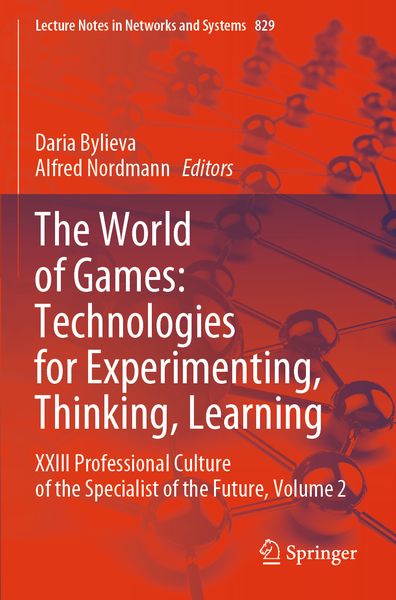
Produktbild: The World of Games: Technologies for Experimenting, Thinking, Learning
Band 829

The World of Games: Technologies for Experimenting, Thinking, Learning XXIII Professional Culture of the Specialist of the Future, Volume 2

214,99 €

inkl. gesetzl. MwSt., Versandkostenfrei

Lieferung nach Hause

Beschreibung

Produktdetails

Einband

Taschenbuch

Erscheinungsdatum

19.11.2024

Herausgeber

Daria Bylieva + weitere

Verlag

Springer

Seitenzahl

412

Maße (L/B/H)

23,5/15,5/2,3 cm

Gewicht

639 g

Sprache

Englisch

ISBN

978-3-031-48018-8

Beschreibung

Produktdetails

Einband

Taschenbuch

Erscheinungsdatum

19.11.2024

Herausgeber

Verlag

Springer

Seitenzahl

412

Maße (L/B/H)

23,5/15,5/2,3 cm

Gewicht

639 g

Sprache

Englisch

ISBN

978-3-031-48018-8

Herstelleradresse

Springer-Verlag KG
Sachsenplatz 4-6
1201 Wien
AT

Email: GPSR Kontakt

Noch keine Bewertungen vorhanden

Verfassen Sie die erste Bewertung zu diesem Artikel

Helfen Sie anderen Kundinnen und Kunden durch Ihre Meinung.

Kundinnen und Kunden meinen

Bewertungen (0)

  • Produktbild: The World of Games: Technologies for Experimenting, Thinking, Learning
  • Part I: From Building Blocks to Augmented Reality Glasses - Technologies for Gaming.- The Metaverse: Changing the Landscape of Media Education.- Application of Phygital Games at the University in the Context of Digitalization.- An EON-XR Augmented Reality Application for Motivation Stimulation and Vocabulary Training of Master’s Degree Students Majoring in Civil Engineering.- Game Technologies and High-Fidelity Patient Simulation in the field of Psychology and Medicine.- Video Games in Teaching Audiovisual Translation to University Students.- Development of a Play and Program Mobile Application Based on the Gamification Methodology.- Experience of Non-linguistics Students Creating Online Games on Foreign Language Grammar.- Part II: Games in Various Educational Environments.- Using Game Practices to Identify Teams Capable of Generating Entrepreneurial Ideas.- The Phenomenon of "Social Responsibility" as a Construct of the Humanitarian Educational Ecosystem for the Training of Future Engineers: Perspectives, Forms, Approaches.- The Use of Gamification Elements for the Development of Creativity in Engineering.- Designing Tabletop Games for Individuals with Disabilities through Student Project activity.- Computer Games and Literary Education:  Opportunities and Limitations.- A Gamification Conceptual Framework for Marketing Courses.- The Formative Role of "Model UN" in the Development of the Professional Personality of Diplomats.- Unlocking the Power of Gamification: Evaluating the Efficacy of Wizer.me in EFL Vocabulary Acquisition.- Assessment of the Creative Freedom of Students Trained in the Acting Technique "Demidov Études".- The Development of Ethno-Cultural Empathy within a Multicultural Educational Environment: Peculiarities and Role-Playing Experiences.- Moot Court Competition in a Foreign Language : Developing Professional Competencies  through a Business Game.- Gaming Technologies in the Formation of Legal Students’ Professional Competencies: Moot Courts.- Technologies for Innovative Potential Development of University Students majoring in Engineering.- Gamification in Teaching Foreign Languages to Economics Students: A Case Study.- Visual Novels as a Means of Business Communication Skills Development for Computer Science Students.- WebQuest as a Means for Students’ Soft Skills Development in Engineering Foreign Language Education.- Problem-Based Role Plays in Teaching English to Students of Humanities.- A Business Game Introduction into Foreign Language Training of Materials Science and Engineering Students.- Gamification in Foreign Language Education: Development of Lexical Skills in Teaching a Second Foreign Language at the University.- Gamified Communication as a Didactic tool for Mastering a Professionally Oriented Video Course in a Foreign Language.- The use of role-playing games to develop the skills of constructive communication of healthcare professionals.- The Use of Games in English Language Lessons as a Means of Communication.