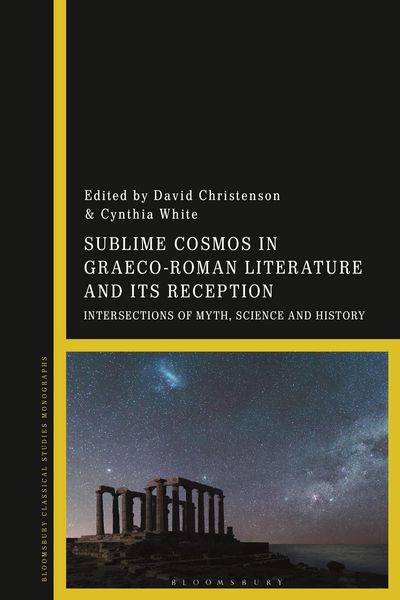
Produktbild: Sublime Cosmos in Graeco-Roman Literature and its Reception

Sublime Cosmos in Graeco-Roman Literature and its Reception Intersections of Myth, Science and History

52,99 €

inkl. gesetzl. MwSt., Versandkostenfrei

Lieferung nach Hause

Beschreibung

Produktdetails

Einband

Taschenbuch

Erscheinungsdatum

30.10.2025

Herausgeber

David Christenson + weitere

Verlag

Bloomsbury Academic

Seitenzahl

246

Maße (L/B/H)

23,4/15,6/1,4 cm

Gewicht

380 g

Sprache

Englisch

ISBN

978-1-350-34471-6

Beschreibung

Produktdetails

Einband

Taschenbuch

Erscheinungsdatum

30.10.2025

Herausgeber

Verlag

Bloomsbury Academic

Seitenzahl

246

Maße (L/B/H)

23,4/15,6/1,4 cm

Gewicht

380 g

Sprache

Englisch

ISBN

978-1-350-34471-6

Herstelleradresse

Libri GmbH
Europaallee 1
36244 Bad Hersfeld
DE

Email: gpsr@libri.de

Kundinnen und Kunden meinen

0 Bewertungen

Informationen zu Bewertungen

Zur Abgabe einer Bewertung ist eine Anmeldung im Konto notwendig. Die Authentizität der Bewertungen wird von uns nicht überprüft. Wir behalten uns vor, Bewertungstexte, die unseren Richtlinien widersprechen, entsprechend zu kürzen oder zu löschen.

Die Bewertungen sind nach Format, Anzahl Sterne und Datum sortiert.

Verfassen Sie die erste Bewertung zu diesem Artikel

Helfen Sie anderen Kund*innen durch Ihre Meinung

Kundinnen und Kunden meinen

0 Bewertungen filtern

Die Leseprobe wird geladen.
  • Produktbild: Sublime Cosmos in Graeco-Roman Literature and its Reception
  • Contributors
    Acknowledgments

    Introduction, David Christenson (University of Arizona, USA)

    Part I - Sublime Epic
    1. Homer's Odyssey and the Mystery of Time, Norman Austin (University of Arizona, USA)
    2. Helen, Paris, and the Philosophical Eros: Love, Strife, and Sublime Contact from Homer to Plato, Boris Shoshitaishvili (University of Southern California, USA)
    3. The Hard-Break at Hesiod, Theogony 200, Frank Romer (East Carolina University, USA)
    4. Visions and Memories of Lucretius in Seneca's Naturales Quaestiones, Christopher Trinacty (Oberlin College and Conservatory, USA)
    5. Vergil's Bougonia Rite: Its Nature, Sources, and Possible Link to the Indo-European Myth of Creation, Michael Teske? (University of Arizona, USA)

    Part II - Celestial Drama
    6. An Early Morning Person? Aristophanes and His Star-Studded Comic Prologues, Gonda van Steen (King's College London, UK)
    7. Frighteningly Funny Gods: Comic and Cosmic Space in Plautus, David Christenson (University of Arizona, USA)

    Part III - History, Historiography, and the Cosmos
    8. Day Suddenly Became Night: Eclipses and the Sublime in Greek Historiography, Philip Waddell (University of Arizona, USA)
    9. The Cosmic Barrier: The Isthmus of Corinth in Imperial Latin Poetry, David Wright (University of Houston, USA)

    Part IV - Reception
    10. Reading the Classics in Plague-Ridden England, 1629-1722, Thomas Willard (University of Arizona, USA)
    11. '"Solution Sweet" and Keats's Poetic Ideal: Erotic and Nuptial Imagery in The Eve of St. Agnes' , Cynthia White (University of Arizona, USA)

    Notes
    Bibliography
    Index