KI-Beratung Beta

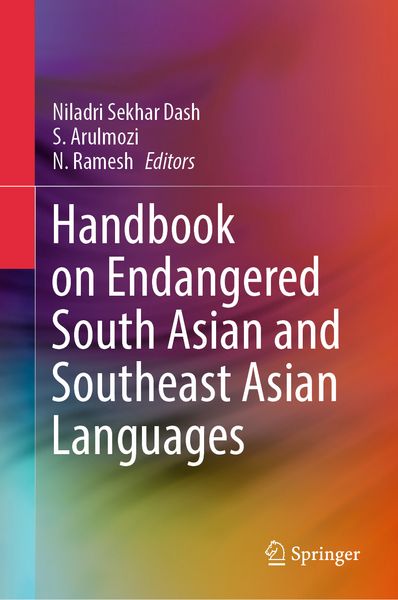
Produktbild: Handbook on Endangered South Asian and Southeast Asian Languages
- 10%

Handbook on Endangered South Asian and Southeast Asian Languages

10% sparen

238,99 € UVP 267,49 €

inkl. gesetzl. MwSt., Versandkostenfrei


Beschreibung

Produktdetails

Einband

Gebundene Ausgabe

Erscheinungsdatum

03.06.2025

Abbildungen

XVI, 414 p. 102 illus., 30 illus. in color.

Herausgeber

Niladri Sekhar Dash + weitere

Verlag

Springer

Seitenzahl

414

Maße (L/B/H)

24,1/16/2,9 cm

Gewicht

759 g

Sprache

Englisch

ISBN

978-3-031-80751-0

Beschreibung

Portrait


Niladri Sekhar Dash is a Professor and Head of the Linguistic Research Unit, Indian Statistical Institute, Kolkata. Since 1992, he has been working in the areas of Corpus Linguistics and Language Technology, Language Documentation and Digitization, Digital Lexicography, Computer Assisted Language Teaching, Digital Humanities and Ethnography, and Dementia of Bilingual Aphasic and Alzheimer's patients. Prof. Dash was an International Visiting Fellow of the British Academy, UK (2018) and a Visiting Scholar of the Language and Brain Laboratory, University of Oxford, UK (2019). Since 2018, he is acting as a Visiting Research Fellow at the School of Psychology and Clinical Language Sciences, University of Reading, UK (2018-2024). In 2022, he was invited as a Visiting Scholar at the Institute of Education (IoE), University College London (UCL), UK. He has acted as the Principal Investigator for more than 20 research–based projects funded by the Govt. of India, international funding agencies, and corporate houses. To his credit, Prof. Dash has published 18 research books, 4 edited anthologies and 300+ research papers in international and national journals, anthologies, and conference proceedings. He has delivered academic lectures and taught courses in more than 100 universities and institutions in India and abroad.


S. Arulmozi is a Professor at the Centre for Applied Linguistics and Translation Studies, University of Hyderabad, Hyderabad, India. He has obtained his Ph.D. from the University of Hyderabad in 1999. Before joining the current position, he worked at Dravidian University, Kuppam where he carried out mission projects on Telugu WordNet and Indian Languages Corpora Initiative (Telugu), funded by the Department of Information Technology, Ministry of Electronics and Information Technology, Govt. of India. His areas of research include Corpus Studies, Language Endangerment Studies, and Sociolinguistics. To his credit he has published 3 edited volumes, more than 50+ research papers in journals, anthologies and conference proceedings.


 N. Ramesh is an Associate Professor at the Centre for Applied Linguistics and Translation Studies, University of Hyderabad, Hyderabad, India. He has obtained his Ph.D. from Bharathiar University, Coimbatore, India in 1997. Before joining the current position, he worked at Bharathiar University where he carried out projects related to documentation and digitization of tribal languages and cultures of the Nilgiri regions. His areas of research include Tribal linguistics, Language Endangerment, and Language Documentation. To his credit he has published several research papers in journals, edited volumes and conference proceedings.

Produktdetails

Einband

Gebundene Ausgabe

Erscheinungsdatum

03.06.2025

Abbildungen

XVI, 414 p. 102 illus., 30 illus. in color.

Herausgeber

Verlag

Springer

Seitenzahl

414

Maße (L/B/H)

24,1/16/2,9 cm

Gewicht

759 g

Sprache

Englisch

ISBN

978-3-031-80751-0

Herstelleradresse

Springer-Verlag GmbH
Europaplatz 3
69115 Heidelberg
DE

Email: ProductSafety@springernature.com

Noch keine Bewertungen vorhanden

Verfassen Sie die erste Bewertung zu diesem Artikel

Helfen Sie anderen Kundinnen und Kunden durch Ihre Meinung.

Kundinnen und Kunden meinen

Bewertungen (0)

  • Produktbild: Handbook on Endangered South Asian and Southeast Asian Languages

  • Noun Morphology in Hajong.- The Constraints of Linguistic Fieldwork and Documentation Concerning the Languages of Nagaland.- Exploring the Reasons for Language Shift in Larkana’s Baloch Community in the Sindh Province of Pakistan.- The Punchi Language: A Typological Sketch.- Language Shift: Intergenerational language choice in family discourse among the Plain Tiwas of Assam.