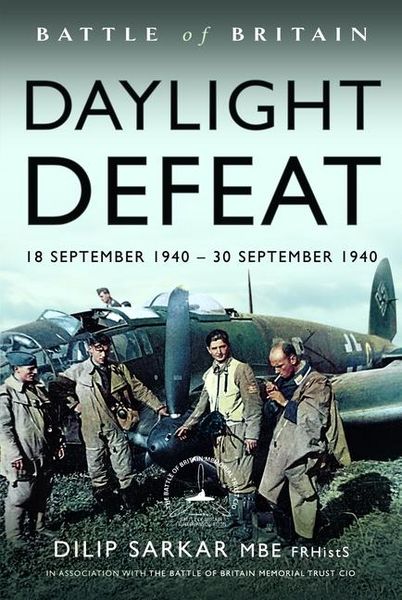
Battle of Britain Daylight Defeat 18 September 1940 - 30 September 1940
-
- Englisch ausgewählt
31,99 €
inkl. gesetzl. MwSt.,
Beschreibung
Produktdetails
Einband
Gebundene Ausgabe
Erscheinungsdatum
02.05.2025
Abbildungen
32 mono illustrations
Verlag
Pen & Sword Books LtdSeitenzahl
304
Maße (L/B/H)
16,5/24,3/3,1 cm
Gewicht
546 g
Sprache
Englisch
ISBN
978-1-399-03464-7
"... this is a book best approached not for groundbreaking revelations, but for the richness of its detail, the humanity of its storytelling, and the care with which it documents the lived experience of aerial warfare." - The Journal of the Air Force Historical Foundation
In this, the sixth of Dilip Sarkar's unprecedented eight-volume series, the day-by-day events occurring in the fourth phase of the Battle of Britain are chronicled and set within a much wide context, including the operations of Bomber and Coastal Commands and the Home Front. Renowned for his evidence-based approach, the author has returned to primary sources, the analysis arising often challenging our previous understanding and the popular narrative.
In Volume 5, Target London: 7 September 1940 - 17 September 1940, the beginning of the Blitz was explored at length. This illuminated the inescapable fact that Luftwaffe air intelligence completely failed to understand how Fighter Command was organised and controlled, nor that it was replacement pilots, not aircraft, that was Air Chief Marshal Dowding's greatest concern. Indeed, on 15 September 1940, Luftwaffe aircrews were briefed to expect but a token resistance over London from the last handful of RAF fighters - their morale shattered when their first attack was met by over 300, the second by nearly as many. This convinced Hitler that the Luftwaffe could not achieve the aerial superiority needed for the invasion of Britain to proceed. Two days later Operation Seelöwe was postponed 'indefinitely'.
Reichsmarschall Herman Göring, however, still believed that the Luftwaffe could prevail - and so continued attacking the UK, changing tack, yet again. As London had proved it 'could take it', the Luftwaffe, whilst continuing to bomb the capital by night, now focussed its daylight attacks on the British aircraft industry. Naturally the Supermarine Spitfire factory at Southampton was a primary target; it was subsequently badly hit, with great loss of life. Other factories, in the West Country, were also targeted, and, owing to a navigation error due to cloud cover, the picturesque town of Sherborne was devasted on 30 September 1940.
By that date, however, it was clear that Göring's He 111 force was unable to continue absorbing such losses and the type was exclusively switched to night-bombing - thereby substantially reducing the German daylight bombing force. On 20 September 1940, Me 109 fighter-bombers attacked London, and going forward the next and final phase would see such attacks, and high-flying fighter sweeps, dominate the daytime arena.
Such raids, though, were never going to defeat Britain, so it is fair to say that the period reviewed in this volume really did see the 'Daylight defeat' of the Luftwaffe over England in 1940 - and the events involved are interpreted and recounted in great detail.
Noch keine Bewertungen vorhanden
Verfassen Sie die erste Bewertung zu diesem Artikel
Helfen Sie anderen Kundinnen und Kunden durch Ihre Meinung.
Kurze Frage zu unserer Seite
Vielen Dank für dein Feedback
Wir nutzen dein Feedback, um unsere Produktseiten zu verbessern. Bitte habe Verständnis, dass wir dir keine Rückmeldung geben können. Falls du Kontakt mit uns aufnehmen möchtest, kannst du dich aber gerne an unseren Kund*innenservice wenden.
zum Kundenservice