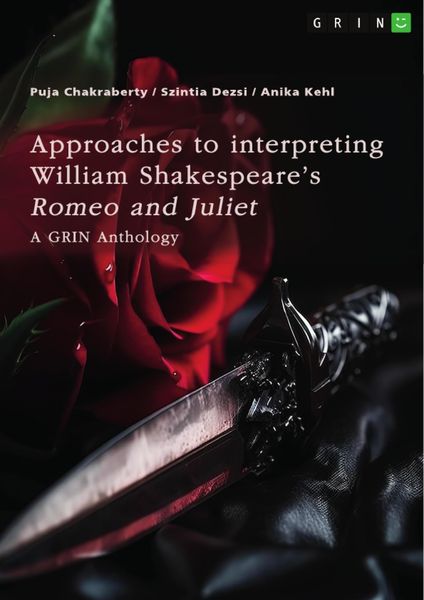
Approaches to interpreting William Shakespeare's "Romeo and Juliet". Sonnet no.116, the role of visual perception, and the death reasons A GRIN Anthology
-
- Taschenbuch
- eBook ausgewählt
-
Form:Einzelkauf Download
-
Sprache:Englisch
29,99 €
inkl. gesetzl. MwSt.Beschreibung
Produktdetails
Format
Kopierschutz
Nein
Family Sharing
Nein
Text-to-Speech
Nein
Erscheinungsdatum
18.10.2024
Herausgeber
GRIN Verlag (Hrsg.Verlag
GRINSeitenzahl
71 (Printausgabe)
Dateigröße
8305 KB
Auflage
1. Auflage
Sprache
Englisch
EAN
9783389079218
Anthology from the year 2024 in the subject English Language and Literature Studies - Literature, , language: English, abstract: This anthology consists of three term papers.
The first paper primarily endeavours to elaborate upon the basic conception of tragedy as laid out by imminent critics over the ages; to religiously undertake a comprehensive close study of the classic tragedy "Romeo and Juliet" written by William Shakespeare; compare and contrast the previous works relating the story and Shakespeare's very own interpretation; to critically scrutinize and elucidate upon the theme of love, its nature and quality, which is the deciding factor of the play, with special reference been made to 'Sonnet no. 116' by William Shakespeare.
Sight is a leading theme in "Romeo and Juliet" and the frequent use of words relating to visual perception is not random or gratuitous. Therefore, the primary object of the second paper is demonstrating that beside the well-debated forces that govern the action, there are others that may have been neglected. Precisely because readers may focus too much on the love story or on other outstanding elements of the play, such as the comic passages which stand in stark contrast with the tragic theme of the play, a considerable amount of intriguing aspects might escape our attention. These are subtle details, which serve a great purpose in the plot development. On many occasions, vision becomes the cause of a series of events in the play.
Why did Shakespeare's Romeo and Juliet have to die? The third paper is going to explore three different reasons: the (seemingly) inevitable fate of the "star-crossed lovers", the danger of immature love and the feud with its consequences for society, family, and coming of age. Ultimately, the paper will try to find out what Shakespeare might have wanted to tell his audience and how his messages are conveyed by recent film adaptations.
The first paper primarily endeavours to elaborate upon the basic conception of tragedy as laid out by imminent critics over the ages; to religiously undertake a comprehensive close study of the classic tragedy "Romeo and Juliet" written by William Shakespeare; compare and contrast the previous works relating the story and Shakespeare's very own interpretation; to critically scrutinize and elucidate upon the theme of love, its nature and quality, which is the deciding factor of the play, with special reference been made to 'Sonnet no. 116' by William Shakespeare.
Sight is a leading theme in "Romeo and Juliet" and the frequent use of words relating to visual perception is not random or gratuitous. Therefore, the primary object of the second paper is demonstrating that beside the well-debated forces that govern the action, there are others that may have been neglected. Precisely because readers may focus too much on the love story or on other outstanding elements of the play, such as the comic passages which stand in stark contrast with the tragic theme of the play, a considerable amount of intriguing aspects might escape our attention. These are subtle details, which serve a great purpose in the plot development. On many occasions, vision becomes the cause of a series of events in the play.
Why did Shakespeare's Romeo and Juliet have to die? The third paper is going to explore three different reasons: the (seemingly) inevitable fate of the "star-crossed lovers", the danger of immature love and the feud with its consequences for society, family, and coming of age. Ultimately, the paper will try to find out what Shakespeare might have wanted to tell his audience and how his messages are conveyed by recent film adaptations.
Noch keine Bewertungen vorhanden
Verfassen Sie die erste Bewertung zu diesem Artikel
Helfen Sie anderen Kundinnen und Kunden durch Ihre Meinung.
Kurze Frage zu unserer Seite
Vielen Dank für dein Feedback
Wir nutzen dein Feedback, um unsere Produktseiten zu verbessern. Bitte habe Verständnis, dass wir dir keine Rückmeldung geben können. Falls du Kontakt mit uns aufnehmen möchtest, kannst du dich aber gerne an unseren Kund*innenservice wenden.
zum Kundenservice