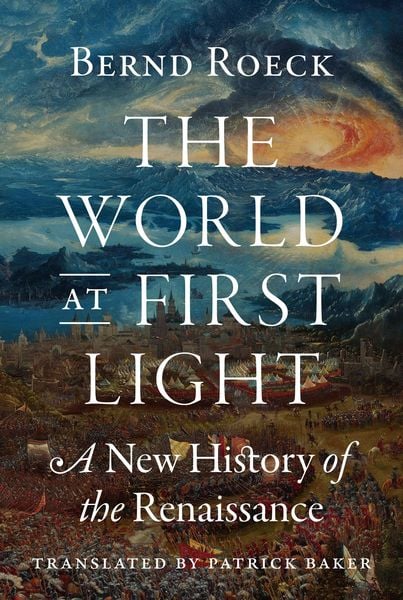
The World at First Light A New History of the Renaissance
-
- Hardcover ausgewählt
- Taschenbuch
-
Sprache:Englisch
47,99 €
inkl. gesetzl. MwSt.,
Beschreibung
Produktdetails
Einband
Gebundene Ausgabe
Erscheinungsdatum
03.06.2025
Verlag
University PressesSeitenzahl
1184
Maße (L/B/H)
24,1/17,1/7,2 cm
Gewicht
1746 g
Übersetzt von
Patrick Baker
Sprache
Englisch
ISBN
978-0-691-18383-1
"A new and ambitious history of the Renaissance as a global event which, the author argues, was much more revolutionary and profoundly influential than we currently appreciate. This is nothing less than a new history of the origins, development and legacy of the Renaissance in a global and comparative context. Presented as a panorama of what the author characterises as a restless and dramatic epoch, the book is an exploration of how a distinct concentration of ideas, discoveries, and tumultuous political circumstance should have coalesced in Europe in such a way and at a particular time as to bring about the modern world as we know it. Drawing on a multidisciplinary awareness of history, art, philology, literature, philosophy, science and medicine, and exploiting both traditional accounts and post-colonial approaches, the author seeks to explain how the Renaissance came about and how it was, for better or worse, both the dawn of the modern world and the dawning of modern worldliness. After highlighting the distinctive and advantageous geographical position of Europe and establishing the absolutely crucial heritage of dialogue, criticism and communication from the classical world, the author recounts the various cultural 'rebirths' throughout the first millennium, from the Islamic empire to the Carolingians and late Byzantium, as well as the ongoing 'struggles for order' which marked much of the uneven development of the medieval period. By the very late Middle Ages, then, Europe was a propitious collection advanced states engaged in acrimonious but productive rivalry, wherein populated urban areas offered ideal venues for the exploitation of two phenomena: the importation of moveable type and a widespread adoption of the classical discourse of criticism and exchange. In situating Europe in the context of political and cultural conditions in central and south Asia as well as the Far East, Roeck argues that the explosion in learning and expression which we associate with the Renaissance was a combination of new ideas and material conditions, and of innovations as well as serendipitous political realities; it was also as much the culmination of a long and slow evolution of ancient tendencies as any sudden rediscovery. The consequences in any case have been profound: much that we take for granted in politics, scientific enquiry and intellectual life is a consequence of the Renaissance"--
Noch keine Bewertungen vorhanden
Verfassen Sie die erste Bewertung zu diesem Artikel
Helfen Sie anderen Kundinnen und Kunden durch Ihre Meinung.
Kurze Frage zu unserer Seite
Vielen Dank für dein Feedback
Wir nutzen dein Feedback, um unsere Produktseiten zu verbessern. Bitte habe Verständnis, dass wir dir keine Rückmeldung geben können. Falls du Kontakt mit uns aufnehmen möchtest, kannst du dich aber gerne an unseren Kund*innenservice wenden.
zum Kundenservice