KI-Beratung Beta

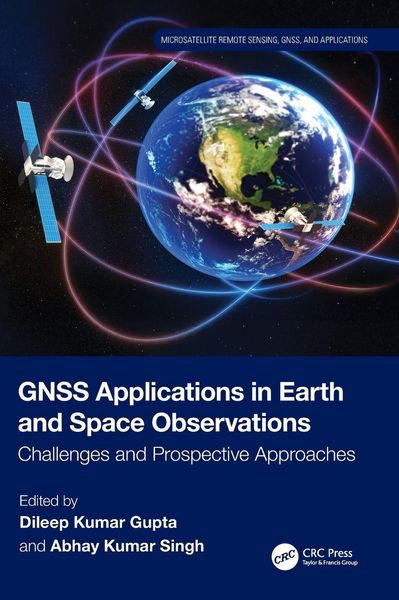
  • Produktbild: GNSS Applications in Earth and Space Observations
  • Produktbild: GNSS Applications in Earth and Space Observations

GNSS Applications in Earth and Space Observations Challenges and Prospective Approaches

328,99 €

inkl. gesetzl. MwSt., Versandkostenfrei


Beschreibung

Produktdetails

Einband

Gebundene Ausgabe

Erscheinungsdatum

24.04.2025

Abbildungen

schwarz-weiss Illustrationen, farbige Illustrationen, Raster,schwarz-weiss, Raster, farbig, Zeichnungen, schwarz-weiss, Zeichnungen, farbig, Tabellen, schwarz-weiss

Herausgeber

Dileep Kumar Gupta + weitere

Verlag

Taylor and Francis

Seitenzahl

390

Maße (L/B/H)

26/18,3/2,5 cm

Gewicht

926 g

Sprache

Englisch

ISBN

978-1-03-271243-7

Beschreibung

Produktdetails

Einband

Gebundene Ausgabe

Erscheinungsdatum

24.04.2025

Abbildungen

schwarz-weiss Illustrationen, farbige Illustrationen, Raster,schwarz-weiss, Raster, farbig, Zeichnungen, schwarz-weiss, Zeichnungen, farbig, Tabellen, schwarz-weiss

Herausgeber

Verlag

Taylor and Francis

Seitenzahl

390

Maße (L/B/H)

26/18,3/2,5 cm

Gewicht

926 g

Sprache

Englisch

ISBN

978-1-03-271243-7

Noch keine Bewertungen vorhanden

Verfassen Sie die erste Bewertung zu diesem Artikel

Helfen Sie anderen Kundinnen und Kunden durch Ihre Meinung.

Kundinnen und Kunden meinen

Bewertungen (0)

Die Leseprobe wird geladen.
  • Produktbild: GNSS Applications in Earth and Space Observations
  • Produktbild: GNSS Applications in Earth and Space Observations
  • Section 1: Introduction to GNSS and Its Advances in Earth Observation 1. Introduction to Navigation Satellite Systems (GNSSs) in a Global Perspective 2. Quantitative Analysis of Variance and Optimization of Coordinate Systems and Temporal Conditions for Minimizing GPS Measurement Errors 3. Application of GNSS in Earth System Sciences 4. Introduction to the Measurement Techniques of GNSS Geodesy in Surveying: Enhancing Precision and Efficiency Section 2: GNSS Applications for Disaster Management 5. Cyclone Global Navigation Satellite System (CYGNSS): Insights to the cyclone 'Mocha' (2023) in the Bay of Bengal 6. Lightning Locations and Thunderstorm-induced Ionospheric Perturbations: Applications of GNSS Technology 7. Advancing Sustainability: A Comprehensive Review of Geospatial Technology in Monitoring Climate Change-driven Landslide Hazards 8. Detection of Tsunami-induced Ionospheric Disturbances Using GNSS Measurements 9. Monitoring of Calbuco Volcanic Eruption Using GNSS-derived TEC Perturbation 10. Quantifying Mineral Abundance and Erosion Using Remote Sensing and Global Navigation Satellite System (GNSS) Technology 11. Forest Fire Risk (FFR) Mapping Using Analytical Hierarchy Process (AHP) and Geospatial Technique and Advantage of GNNS to Monitor the Forest Fire: A Case Study in the Southern Districts of Uttarakhand Section 3: GNSS Applications for Climate Studies 12. Monitoring of Sea Level Variations Using GNSS Technology 13. Monitoring Climate Impacts on Himalayan Glacier Dynamics Using GNSS Radio Occultation 14. Global Navigation Satellite Systems (GNSS) and Their Applications in Climate Monitoring and Modeling 15. Real-time Computation of Precipitable Water Vapor from GPS Data 16. Water Vapour Retrieval and Its Climatic Implications Using GNSS Signals 17. GNSS-enabled Precision Agriculture Section 4: GNSS Applications for Space Weather 18. Role of GNSS-derived TEC for Space Weather Studies 19. Characteristic of Ionospheric Irregularities Using GNSS Measurements over Indian EIA Region Varanasi 20. GNSS as a Cost-effective Tool for Continuous Monitoring of Solar Flare Effect on the Ionosphere 21. Geomagnetic Storms and Their Effect on Global Positioning System: A Supplication of Global Navigation Satellite System Receivers 22. GPS TEC Response During the Solar Flare 23. A Brief Review of Low Latitude Ionosphere: With Multi-frequency Observation Using GPS, NavIC, and GMRT Section 5: Challenges and Future Prospects 24. Challenges and Future Developments in GNSS Technology in Disaster Management 25. Limitation, Improvement, and Future Aspects of GNSS in Climate Studies 26. Advancements and Limitations of GNSS in Ionospheric Research 27. Enhancing GNSS Applications in Climate Studies: A Path Forward