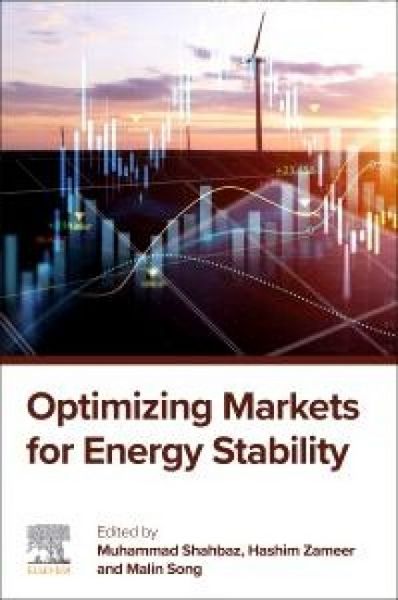
Produktbild: Optimizing Markets for Energy Stability
Neu

Optimizing Markets for Energy Stability

199,99 €

inkl. gesetzl. MwSt., Versandkostenfrei

Lieferung nach Hause

Beschreibung

Produktdetails

Einband

Taschenbuch

Erscheinungsdatum

01.06.2026

Herausgeber

Hashim Zameer + weitere

Verlag

Elsevier

Seitenzahl

300

Maße (L/B)

22,9/15,2 cm

Gewicht

450 g

Sprache

Englisch

ISBN

978-0-443-29977-3

Beschreibung

Portrait

Dr. Muhammad Shahbaz is Professor of Economics at Beijing Institute of Technology, China, and Senior Department Fellow at the University of Cambridge, United Kingdom. He holds a PhD in Economics from the National College of Business Administration and Economics, Lahore, Pakistan. Dr. Shahbaz’s research covers development economics, energy economics, environmental economics, and international finance. He has received recognition as one of the world’s top authors in economics and was named among the top five active researchers from developing countries by the World Bank’s Chief Economist. In 2019, he received the ‘Scientist of the Year’ award from the Turkish Presidency and was recognized as a ‘Distinguished Scientist’ by Dozce University, Turkey. His work has also been acknowledged by Clarivate Web of Science as highly cited in economics, business, and social sciences for 2020 and 2021.

Hashim Zameer is an Associate Professor at the College of Economics and Management of Nanjing University of Aeronautics and Astronautics, China. He received his PhD degree in Management Science from Nanjing University of Aeronautics and Astronautics, Nanjing, China. He has published in various journal of international repute including top ranked journals. His previous research has appeared in Business Strategy and the Environment, the Journal of Environmental Management, Technological Forecasting & Social Change, the Journal of Cleaner Production, Resources Policy, and many others.

Malin Song is both Director and Professor at the Collaborative Innovation Center of Ecological Economy and Management of Anhui University of Finance and Economics; the Editor-in-Chief of Management of Environmental Quality; Subeditor of International Journal of Innovation Science; editorial board member of Energy and Environment, Journal of Cleaner Production, and Journal of Chinese Management; and Guest editor of Energy Policy, Resources, Conservation & Recycling, Journal of Cleaner Production, Technological Forecasting and Social Change, Computational Economics, Energy and Environment, Expert Systems, and Sustainability.

Produktdetails

Einband

Taschenbuch

Erscheinungsdatum

01.06.2026

Herausgeber

Verlag

Elsevier

Seitenzahl

300

Maße (L/B)

22,9/15,2 cm

Gewicht

450 g

Sprache

Englisch

ISBN

978-0-443-29977-3

Herstelleradresse

Libri GmbH
Europaallee 1
36244 Bad Hersfeld
DE

Email: gpsr@libri.de

Kundinnen und Kunden meinen

0 Bewertungen

Informationen zu Bewertungen

Zur Abgabe einer Bewertung ist eine Anmeldung im Konto notwendig. Die Authentizität der Bewertungen wird von uns nicht überprüft. Wir behalten uns vor, Bewertungstexte, die unseren Richtlinien widersprechen, entsprechend zu kürzen oder zu löschen.

Die Bewertungen sind nach Format, Anzahl Sterne und Datum sortiert.

Verfassen Sie die erste Bewertung zu diesem Artikel

Helfen Sie anderen Kund*innen durch Ihre Meinung

Kundinnen und Kunden meinen

0 Bewertungen filtern

  • Produktbild: Optimizing Markets for Energy Stability
  • 1. Introduction
    2. Market design and regulatory frameworks for energy stability
    3. Integration of renewable energy sources into existing markets
    4. Demand response and dynamic pricing mechanisms
    5. Risk management and mitigation strategies for energy markets
    6. Energy storage technologies and their impact on market stability
    7. Market mechanisms for grid resilience and reliability
    8. Techno-economic modelling and optimization of energy markets
    9. Decentralized energy markets and peer-to-peer trading platforms
    10. Policy and governance frameworks for market stability and efficiency
    11. Behavioural aspects and consumer engagement in energy markets
    12. Conclusion