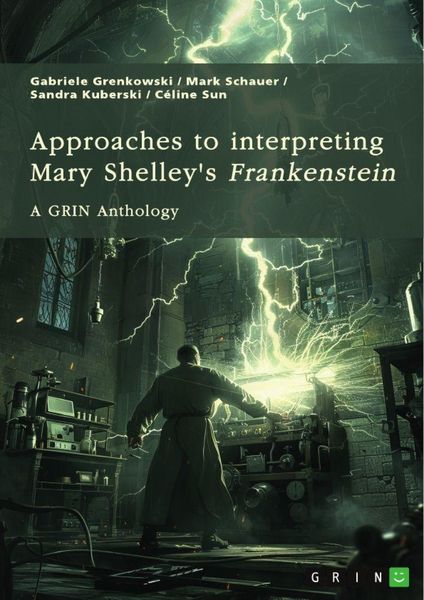
Approaches to interpreting Mary Shelley's "Frankenstein". Frankenstein's monster, the creation of terror, and genre-related questions A GRIN Anthology
-
- Taschenbuch ausgewählt
- eBook
-
Sprache:Englisch
42,95 €
inkl. gesetzl. MwSt.,
Beschreibung
Produktdetails
Einband
Taschenbuch
Erscheinungsdatum
25.09.2024
Herausgeber
GRIN Verlag (Hrsg.Verlag
GRINSeitenzahl
92
Maße (L/B/H)
21/14,8/0,7 cm
Gewicht
146 g
Auflage
1. Auflage
Sprache
Englisch
ISBN
978-3-389-07271-4
The Monster in Frankenstein with Regard to Rousseaüs Concept of the ¿Noble Savage¿ (2011) 1. Introduction 2. Rousseaüs Concept of a ¿Noble Savage¿ 2.1 Opposite Theory: Thomas Hobbes 3. Frankenstein¿s Monster as a ¿Noble Savage¿ 3.1 Arguments for Frankenstein¿s Monster as a ¿Noble Savage¿ 3.2 The Monster¿s Transition from a ¿Noble Savage¿ into a Murderer 3.3 Reference to Paradise Lost by John Milton 4. Conclusion List of Sources Précis Critiques of Mary Shelley's Frankenstein. Was Victor Frankenstein a woman? And other post-modern literary disputes (2012) Critique one Critique Two Critique Three Critique Four Critique Five Works Cited The Creation of Terror in Mary Shelley¿s ¿Frankenstein¿ (2011) 1. Introduction 2. Frankenstein as Gothic story 3. Terror 3.1 The Term ¿Terror¿ 4. Sublime and Obscurity 4.1 Edmund Burke on the sublime 4.2 Obscurity 5. Terror in Frankenstein 5.1 Terror within the Story Itself 5.2 Terror achieved through other Features 6. Conclusion Bibliography The Significance of Limits. The Parallels between Dostoyevsky's "Crime and Punishment" and Shelley's "Frankenstein" (2018) 1. Introduction 2. Limits for the Profane Mind 2.1 Empathy and Morality 2.2 Sexuality and Mortality 3. Overcoming Limits: Self-Absolutizing 3.1 Reason and Ethics 3.2 Science and Spirit 4. Limits in a Secular World 4.1 Materiality and Immorality 4.2 Self-Containment and Death 5. Overcoming Limits: Transformation through the Other 5.1 Image and Language 5.2 Dialogue and Grace 6. Conclusion: Transcendence in-and-beyond the Embodied Bibliography The function of comic relief in stage adaptations of Mary Shelley¿s "Frankenstein" (2019) 1. Introduction 2. Comic relief in stage adaptations of Frankenstein 2.1 A brief definition of comic relief 2.2 Primary works and their way of adapting Frankenstein 2.3 Comic relief in Frankenstein adaptations 2.4 Comparison of ¿Presumption¿ and ¿The bride of Frankenstein¿ 3. Conclusion Works Cited Is Mary Shelley's "Frankenstein" a typical Gothic Novel? Context and Themes in "The Modern Prometheus" (2022) 1. Introduction 2. Context 2.1. Information about Mary Shelley 2.2 The Gothic genre 3. Gothic themes in Frankenstein 3.1 Horror and monstrosity 3.2 Similarity of Victor and the monster 3.3 Sexuality and incest 3.4 Narrative style 4. Conclusion Works Cited
Noch keine Bewertungen vorhanden
Verfassen Sie die erste Bewertung zu diesem Artikel
Helfen Sie anderen Kundinnen und Kunden durch Ihre Meinung.
Kurze Frage zu unserer Seite
Vielen Dank für dein Feedback
Wir nutzen dein Feedback, um unsere Produktseiten zu verbessern. Bitte habe Verständnis, dass wir dir keine Rückmeldung geben können. Falls du Kontakt mit uns aufnehmen möchtest, kannst du dich aber gerne an unseren Kund*innenservice wenden.
zum Kundenservice