Gutscheinbedingungen

**Gültig vom 24.08.2026 bis 26.08.2026 | Gültig für nicht preisgebundene fremdsprachige Bücher | Einzelne Artikel können ausgeschlossen sein | Online auf www.bücher.de einlösbar | Click & Collect nur mit Online-Zahlung (Paypal/Kreditkarte) vorab | Nicht kombinierbar mit anderen Gutscheinen oder Preisaktionen | Nur einmal pro Einkauf einlösbar | Gutschein wird auf max. 500€ Bestellwert angerechnet | Keine Barauszahlung | Nicht gültig für Versandkosten und Services

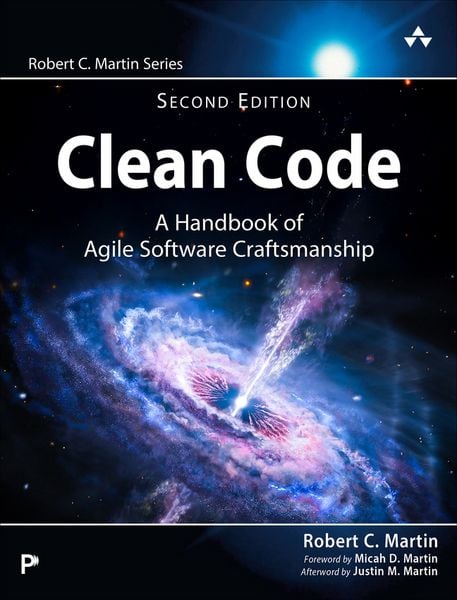
Produktbild: Clean Code: A Handbook of Agile Software Craftsmanship

Clean Code: A Handbook of Agile Software Craftsmanship

53,99 €

inkl. gesetzl. MwSt., Versandkostenfrei


Beschreibung

Produktdetails

Verkaufsrang

10307

Einband

Taschenbuch

Erscheinungsdatum

08.10.2025

Verlag

Pearson Education Limited

Seitenzahl

672

Maße (L/B/H)

22,8/17,3/3,7 cm

Gewicht

1121 g

Farbe

Schwarz / Graublau

Auflage

2

Sprache

Englisch

ISBN

978-0-13-539857-9

Beschreibung

Produktdetails

Verkaufsrang

10307

Einband

Taschenbuch

Erscheinungsdatum

08.10.2025

Verlag

Pearson Education Limited

Seitenzahl

672

Maße (L/B/H)

22,8/17,3/3,7 cm

Gewicht

1121 g

Farbe

Schwarz / Graublau

Auflage

2

Sprache

Englisch

ISBN

978-0-13-539857-9

Herstelleradresse

Pearson Benelux B.V.
St.-Martin-Straße 82
81541 München
DE

Email: GPSR Kontakt

Noch keine Bewertungen vorhanden

Verfassen Sie die erste Bewertung zu diesem Artikel

Helfen Sie anderen Kundinnen und Kunden durch Ihre Meinung.

Kundinnen und Kunden meinen

Bewertungen (0)

  • Produktbild: Clean Code: A Handbook of Agile Software Craftsmanship
  • Foreword xix

    Introduction xxv

    Introduction (from Long Ago) xxix

    About the Author xxxi

    Chapter 1: Clean Code 1

    There Will Be Code 2

    Bad Code 3

    The Art of Clean Code 5

    Putting All This Together 9

    We Read More Than We Write 13

    The Boy Scout Rule 14

    Part I: Code 17

    Chapter 2: Clean That Code! 19

    The Cleaning Process 30

    Conclusion 37

    Postscript: Future Bob Playing with Grok3 37

    Postscript Conclusion 40

    Chapter 3: First Principles 41

    Everything Small, Well Named, Organized, and Ordered 42

    A More Significant Example 44

    A Final Thought 68

    Chapter 4: Meaningful Names 71

    Use Intention-Revealing Names 72

    Final Words 87

    Chapter 5: Comments 89

    Compensating for Failure 90

    Good Comments 92

    Bad Comments 97

    Conclusion 115

    Chapter 6: Formatting 117

    The Purpose of Formatting 118

    Vertical Formatting 118

    Horizontal Formatting 127

    Team Rules 132

    Uncle Bob's Formatting Rules 133

    Chapter 7: Clean Functions 137

    Small! 138

    Reading Code from Top to Bottom: The Stepdown Rule 140

    Switch Statements 142

    Clean Functions: A Deeper Look 144

    Conclusion 157

    Chapter 8: Function Heuristics 159

    Function Arguments 159

    Command Query Separation 164

    Prefer Exceptions to Returning Error Codes 165

    DRY: Don't Repeat Yourself 169

    Side Effects 177

    Structured Programming 181

    This Is Too Much to Constantly Keep in Mind 183

    Conclusion 184

    Chapter 9: The Clean Method 185

    Make It Right 186

    Example 188

    Conclusion 210

    Chapter 10: One Thing 211

    Extract Method Refactoring 212

    What Are Large Functions Anyway? 217

    Conclusion 239

    Chapter 11: Be Polite 241

    The Newspaper Metaphor 243

    The Stepdown Rule: Once Again 245

    The Abstraction Roller Coaster 246

    This Is How We Write, but Not How We Want to Read 246

    Chapter 12: Objects and Data Structures 249

    What Is an Object? 250

    Data Abstraction 251

    Data/Object Antisymmetry 252

    The Law of Demeter 255

    Data Transfer Objects 258

    Switch Statements 260

    The OO/Procedural Trade-off 264

    But What About Performance? 265

    Conclusion 265

    Chapter 13: Clean Classes 267

    Classes and Modules versus Files 267

    What Should a Class Contain? 268

    Chapter 14: Testing Disciplines 289

    Discipline 1: Test-Driven Development (TDD) 291

    Discipline 2: Test && Commit || Revert (TCR) 292

    Discipline 3: Small Bundles 293

    Design 293

    Discipline 294

    Keeping Tests Clean 299

    Tests Enable the -ilities 300

    Chapter 15: Clean Tests 303

    Domain-Specific Testing Language 307

    F.I.R.S.T. 310

    Test Design 311

    Conclusion 311

    Chapter 16: Acceptance Testing 313

    The Acceptance Testing Discipline 314

    Conclusion 316

    Chapter 17: AIs, LLMs, and God Knows What 317

    Programming by Prompt 319

    Conclusion 328

    Part II: Design 329

    Chapter 18: Simple Design 331

    YAGNI 333

    Covered by Tests 333

    Maximize Expression 334

    Minimize Duplication 337

    Chapter 19: The SOLID Principles 341

    SRP: The Single Responsibility Principle 343

    OCP: The OpenClosed Principle 347

    LSP: The Liskov Substitution Principle 351

    ISP: The Interface Segregation Principle 354

    DIP: The Dependency Inversion Principle 356

    Chapter 20: Component Principles 363

    Components 364

    A Brief History of Components 364

    Component Cohesion 368

    Component Coupling 373

    Conclusion 387

    Chapter 21: Continuous Design 389

    Continuous Change 390

    Continuous Design 391

    Sailing on the Four Cs of Continuous Design 392

    When Else Do We Design? 420

    Chapter 22: Concurrency 423

    Why Concurrency? 424

    Concurrency Defense Principles 427

    2025 Update and Report from the Field 437

    Conclusion 442

    Part III: Architecture 443

    Chapter 23: The Two Values of Software 445

    Keeping Options Open 446

    Chapter 24: Independence 449

    Use Cases 450

    Operation 450

    Development 451

    Deployment 451

    Leaving Options Open 451

    Chapter 25: Architectural Boundaries 453

    What Lines Do You Draw, and When? 454

    Plug-in Architecture 456

    Case Study: FitNesse 457

    Conclusion 459

    Chapter 26: Clean Boundaries 461

    Third-Party IoT Framework: Lots o' Boundaries 462

    UI/Application Boundary 466

    Clean Boundaries 474

    Chapter 27: The Clean Architecture 475

    The Dependency Rule 476

    Conclusion 481

    Part IV: Craftmanship 483

    "A Great Number" 484

    Eight Decades 484

    The Oath 492

    Chapter 28: Harm 495

    No Harm to Society 496

    Harm to Function 497

    No Harm to Structure 499

    Soft 500

    Tests 501

    Chapter 29: No Defect in Behavior or Structure 503

    Making It Right 504

    Programmers Are Stakeholders 507

    Do Your Best 508

    Chapter 30: Repeatable Proof 511

    Dijkstra 511

    Structured Programming 514

    Functional Decomposition 516

    Test-Driven Development et al. 517

    Chapter 31: Small Cycles 519

    The History of Source Code Control 519

    Continuous Integration 524

    Branches versus Toggles 525

    Continuous Deployment 527

    Continuous Build 528

    Chapter 32: Relentless Improvement 529

    Test Coverage 529

    Mutation Testing 530

    Semantic Stability 530

    Cleaning 531

    Creations 531

    Chapter 33: Maintain High Productivity 533

    Viscosity 533

    Managing Distractions 535

    Time Management 538

    Chapter 34: Work as a Team 539

    Collaborative Programming 539

    Open/Virtual Office 540

    Chapter 35: Estimate Honestly and Fairly 543

    Lies 544

    Honesty, Accuracy, Precision 544

    Lessons from Me 545

    Accuracy and Precision 547

    Aggregation 548

    Honesty 549

    Pressure 550

    Chapter 36: Respect for Fellow Programmers 553

    Chapter 37: Never Stop Learning 555

    Afterword 557

    Appendix: The Clean Code Debate 561

    Introductions 562

    Method Length 563

    Method Length Summary 575

    Comments 576

    Comments Summary 590

    John's Rewrite of PrimeGenerator 591

    A Tale of Two Programmers 596

    Bob's Rewrite of PrimeGenerator2 599

    Test-Driven Development 603

    TDD Summary 612

    Closing Remarks 613

    Bibliography 615

    Index 619